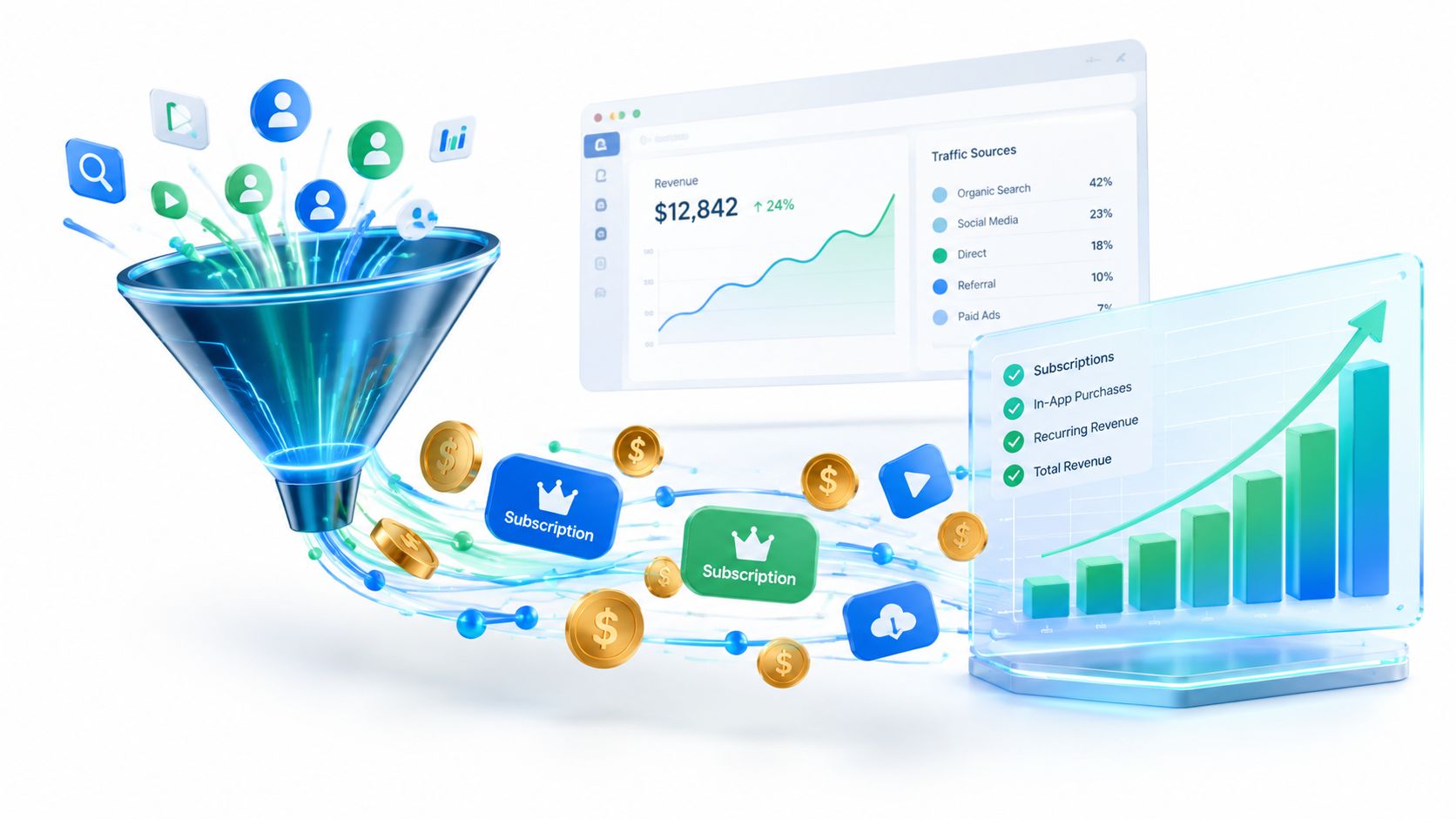
You can have a busy dashboard and still not know which channels bring paying customers. That's the trap most Freemius-powered SaaS businesses fall into, especially when traffic, trial starts, and checkout activity all look healthy while MRR tells a different story.
Freemius is strong at billing and product monetization, but Freemius revenue attribution only becomes useful when you connect those billing events back to the original marketing source. That gap is where founders usually lose the plot, because visits and signups don't tell you who paid, who renewed, or which source kept producing revenue after the first sale.
Table of Contents
- Why Traffic Numbers Can Mislead
- The Journey From Visit to Recurring Revenue
- Connecting Website Traffic to Freemius Subscriptions
- High Traffic Does Not Equal High Revenue
- Analyzing MRR Changes by Acquisition Source
- Practical Checklist for Reviewing Channel Performance
Why Traffic Numbers Can Mislead
A founder can spend a morning in analytics and still back the wrong channel. One source may drive a lot of visits, while another brings fewer people but still produces the customers who pay and stay. For SaaS plugin and theme businesses, that difference matters more than raw traffic, because revenue depends on subscriptions, renewals, and upgrades, not clicks.
The problem starts before the checkout
Freemius's own history makes the point clearly. It described a model built around revenue sharing rather than a fixed subscription fee, where the economically meaningful outcome is the subscription and product revenue processed for each maker, not just installs or checkout starts. In that context, traffic is only the first signal, not the business result.
Freemius also reported a 65% checkout-abandonment rate across its maker community, then said Cart Abandonment Recovery produced an 11.5% recovery rate among abandoned checkouts, moving conversion from 35% to 42.5% and lifting maker revenue by 7.5%. Those figures show why checkout volume can be misleading on its own. A source can create motion without creating money, and a dashboard can reward activity that has little effect on MRR. turn data into growth is a good companion read if you want a practical lens for separating useful traffic from vanity metrics.

What founders usually miss
A channel can look strong in web analytics and still fail at the one job that matters. I've seen content campaigns bring plenty of free users while a smaller review site produced the best-paying accounts. The loud source gets attention, but the quieter source pays the bills.
Practical rule: if a channel can't be tied to paying customers and recurring revenue, treat it as an input, not a success metric.
That is why marketing review has to go beyond visits and signups. The better question is which source produced the customer who paid, renewed, upgraded, or churned. The internal guide on tracking paying customers by marketing channel goes deeper on that exact distinction.
The Journey From Visit to Recurring Revenue
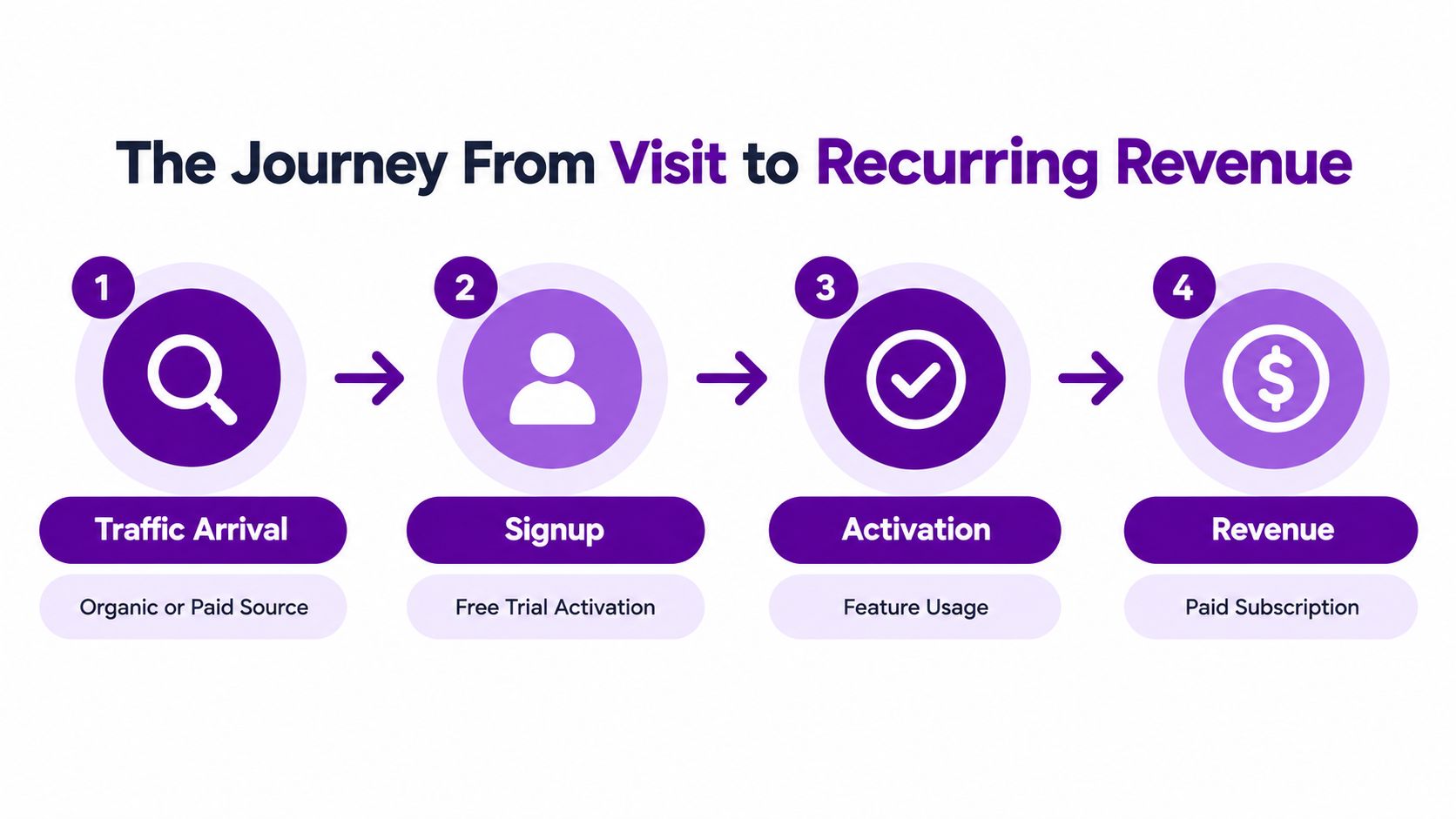
A visitor can come from organic search, paid ads, an affiliate, email, or a free-plugin discovery moment. They may sign up, start a trial, or buy directly. The revenue story only becomes clear once that person turns into a customer and the billing trail can be tied back to the source that brought them in.
The path is simple, the tracking usually isn't
Freemius handles subscription and payment data well, but that does not tell you where the buyer came from before they reached your site. Its API separates subscriptions from payment records, and the billing-cycle field makes the model explicit, with 0 for lifetime, 1 for monthly, and 12 for annual billing. A channel that brings lifetime buyers behaves differently from one that brings recurring customers, so those revenue types should stay separate. The practical setup is to preserve product, plan, status, timestamps, currency, and subscription identifiers so acquisition source can be tied to the original purchase and later renewals. If you are mapping the step from first visit to first payment, tracking signup-to-paid conversion is the right next read.
Where the journey breaks
For small teams, the break usually happens in three places. The website analytics tool knows the source, the billing tool knows the subscription, and nobody joins the two cleanly. The result is a lot of partial truth.
A source that creates trials but never produces retained revenue is still a weak channel, even if the top of the funnel looks strong.
Freemius also handles refunds and chargebacks in the payment layer, and its documentation ties refunds back to original payments. That matters because revenue attribution should follow retained revenue, not only the first gross sale. A useful report should show whether the same customer later downgraded, renewed, or got reversed, because the acquisition source should not get full credit for money that did not stick.
What the ideal handoff looks like
When traffic-heavy and revenue-heavy sources compete, the gap becomes obvious. One channel may drive most visits and still produce little retained value. Another may bring fewer clicks but stronger renewals, which is the difference that matters for a subscription business.
| Step | What has to happen |
|---|---|
| 1 | Capture the source on the website. |
| 2 | Match the customer identity at purchase. |
| 3 | Keep the billing record tied to that source through renewals and reversals. |
Getting the records to match is where the work lies. Once that chain is intact, you can compare channels on actual revenue instead of just the number of people who showed up.
Connecting Website Traffic to Freemius Subscriptions
A Freemius connection gives you billing truth, but it does not show where the customer came from. To make revenue attribution useful, the website identity and the billing identity have to meet somewhere, usually through a shared customer record such as email or another stable identifier that both systems can recognize. Without that match, you can see who paid, but you cannot tell which channel earned the credit.
Matching records is the real work
The hard part is practical. The person who clicked the ad, downloaded the plugin, or read the comparison page is often not the same row the billing system sees later. Small SaaS teams need a way to preserve the source at first touch, then carry it into the customer record when the buyer converts. Those metrics matter because they show the shape of revenue after acquisition, not just the first click, and once you connect them to source, you can see whether a channel brings durable customers or fragile ones.
Chartsy's Freemius data source guide shows the kind of setup that makes this possible through a direct connection to Freemius billing data. That workflow matters when a business sells subscriptions, lifetime licenses, bundles, or a mix of all three, because the attribution rule has to respect the transaction type before revenue gets grouped.
A plugin developer I worked with found that affiliate traffic converted at a lower rate than organic search, but the buyers it brought stayed longer. The traffic-heavy source looked better at the top of the funnel. The revenue-heavy source was the one that kept paying back.
What to preserve in the pipeline
The strongest attribution setup keeps the original acquisition source attached to the customer, then rolls later payments back to that same source. One customer can renew multiple times without breaking the trail, and a refund can reverse previously counted revenue instead of leaving it in the report.
A useful attribution table usually keeps these fields together:
- Source identity, so organic search, paid, affiliate, email, or direct traffic stays visible.
- Customer identifier, so the same buyer can be matched across systems.
- Subscription or payment status, so failed or reversed revenue does not get counted as retained income.
- Plan and billing cycle, so lifetime and recurring revenue stay separate.
- Timestamp and currency, so monthly reporting does not blur events together.
Practical rule: match the customer once, then analyze every later subscription event through that same identity.
Why this matters for recurring revenue
Attribution stops being a vanity report and starts helping with growth decisions here. If one source produces buyers who renew and another source brings one-off purchases that do not recur, those channels deserve very different treatment. The same holds for free-plugin discovery, direct traffic, and affiliate-driven demand, because each path can create a different revenue shape after the first sale.
Chartsy is one option for this kind of analysis because it connects website activity with subscription and revenue reporting, while keeping the focus on who paid, how revenue changed, and where the customer originally came from. That is the difference between billing data and actionable attribution.
High Traffic Does Not Equal High Revenue
A realistic comparison makes the gap hard to ignore. Channel A brings 10,000 monthly visitors and 50 paid subscriptions. Channel B brings 1,000 visitors and 80 paid subscriptions. Channel A wins on volume, but Channel B creates more revenue because it turns a much smaller audience into more paying customers.
A channel comparison that changes the budget conversation
| Marketing Channel Performance Comparison | Monthly Visitors | Paid Subscriptions | Revenue Impact |
|---|---|---|---|
| Channel A | 10,000 | 50 | High traffic, weaker paid conversion |
| Channel B | 1,000 | 80 | Lower traffic, stronger paid conversion |
The table matters because it changes the question from “which channel gets attention?” to “which channel brings buyers?” A channel can look impressive in analytics and still create weak downstream value if those visitors never become customers, or become customers who churn quickly. That is why the revenue side matters more than the traffic side when you are deciding where to spend.
What the example really tells you
This is the part many SaaS teams miss. Exposure and demand quality are different problems. A high-traffic source can still be a poor sales source if the visitors are early-stage, curious, or not a fit for the product.
A smaller source often wins because it reaches people who are closer to buying, or because the channel carries trust before the first visit. That happens with niche review content, a partner recommendation, or a community discussion where the buyer already understands the problem and just wants the right tool. In those cases, revenue per visitor matters more than raw visits, because it shows how efficiently the channel turns intent into paid accounts.
Use the right comparison before you spend more
Compare paid conversion and revenue contribution side by side. If a source produces fewer visits but more subscriptions, that's exactly what a high-performing channel looks like. Traffic is still useful, but only as context for the paid outcome.
Don't reward the channel that creates attention if another channel creates customers.
For plugin and theme makers, that usually means treating revenue attribution as a decision tool, not a vanity report. The key job is to show where paying customers came from, not who showed up.
Analyzing MRR Changes by Acquisition Source
A channel that looks strong on traffic can still be weak on revenue. Once the source is matched to the customer, the value is in tracking how each channel changes MRR over time, including expansion, contraction, and churn. That gives a clearer read than a one-time conversion report.

Look beyond the first purchase
Freemius subscription analytics already tracks the pieces small software teams care about, including MRR, new subscriptions, cancellations, churned revenue, new trials, trial cancellations, and trial-to-paid conversion. Those metrics matter because they show the full revenue picture after the initial signup. Once you connect them to source, you can see whether a channel brings durable customers or fragile ones.
A content channel may convert more slowly but keep customers longer, while affiliate traffic may close faster and hold less value over time. I trust that comparison more than a headline visit count, because it reflects how the customer behaves after the campaign has already spent its budget.
Separate the revenue movements
A useful MRR view by source separates the movements instead of flattening them into one number. New revenue shows which channels added fresh customers. Expansion shows which sources produced users willing to upgrade. Contraction and churn show where the channel brought customers who did not stick.
Useful habit: review the source of the customer, then review the source of the revenue movement. They overlap, but they measure different things.
This also matters when your product mix includes monthly, annual, and lifetime offers. A source that brings annual subscribers may look quiet in the short term but still drive cleaner recurring revenue than a source that converts into one-time lifetime sales. The numbers should reflect that difference instead of hiding it.
Use churn carefully
Stripe's churn logic is customer-based, not just subscription-based. A customer moves from non-zero MRR to zero MRR before they count as churned, and if they still have another paid subscription, they are not churned yet. That matters when you study source-level retention, because one customer can affect MRR without creating a full churn event. Stripe's subscriber-churn calculation is the reference point if your billing stack includes Stripe data alongside Freemius.
The channel that creates the most new revenue is not always the channel that keeps revenue alive.
That is why source-based MRR analysis matters for small teams. It keeps the focus on the revenue stream that survives the first sale, instead of the one that only looked strong at signup.
Practical Checklist for Reviewing Channel Performance
Before you change the budget, review the channel with a revenue lens rather than a traffic lens. The goal is not to punish channels that produce top-of-funnel activity, but to find the ones that support MRR and retention. If you skip this step, you will often cut the source that brought good customers and scale the one that only looked active.
A simple review sequence
- Verify attribution accuracy, make sure the customer-source match is complete before you trust the report.
- Compare paid conversion, not just traffic, because the source that converts better is often the real growth driver.
- Review recurring revenue contribution, so you see whether the channel brings one-time value or durable MRR.
- Check churn and reversals, because refunds, cancellations, and chargebacks change what the channel really earned.
If you want a broader market-monitoring angle after that, the guide on AI search monitoring tools is a good example of how teams evaluate signal quality before they spend more.
What to look for before shifting spend
- Attribution completeness, so source data isn't missing on a chunk of buyers.
- Lifetime value by source, so you don't overpay for a channel with weak retention.
- Churn by source, so you can spot revenue that leaves as fast as it arrives.
- Net revenue after refunds or chargebacks, so gross sales don't fool you.
- Acquisition cost by channel, so revenue strength gets compared against what you paid to get it.
These checks are especially useful for SaaS founders, solo builders, and small ops teams who don't have the luxury of a dedicated analyst. They keep budget decisions grounded in customer behavior instead of dashboard drama.
If you're trying to answer which marketing channels bring paying customers to a Freemius business, Chartsy gives you a practical way to connect website traffic, signups, and billing data in one view. Visit Chartsy if you want to see how source-level attribution can show which channels bring real revenue, not just visits.

Written by
Chartsy TeamAnalytics team at Chartsy
The Chartsy Team writes guides, product updates, and resources to help SaaS and eCommerce founders make sense of their metrics, without SQL or spreadsheets.
Chartsy