
“Choose Freemius because it saves you building a billing stack” is incomplete advice. For a SaaS founder, the better test is whether that saved work justifies the fee at your actual prices, and whether you can still explain which marketing sources bring paying customers, what you keep after fees, and why MRR changes.
This Freemius review starts with those decisions rather than a feature checklist. A convenient checkout can be worth paying for, but convenience doesn't make every subscription price financially sensible.
Table of Contents
- Freemius Verdict and What Its Reviews Show
- What Freemius Really Costs at Common Plugin Prices
- How Freemius Handles Subscriptions and Renewals
- Strengths and Weak Spots Worth Weighing
- Real-World Setups for Plugin, Theme and SaaS Sellers
- Connecting Freemius Billing Data to Chartsy for MRR Analysis
- Freemius Alternatives and How to Choose Between Them
- Check Your Freemius Net Revenue Before You Commit
Freemius Verdict and What Its Reviews Show
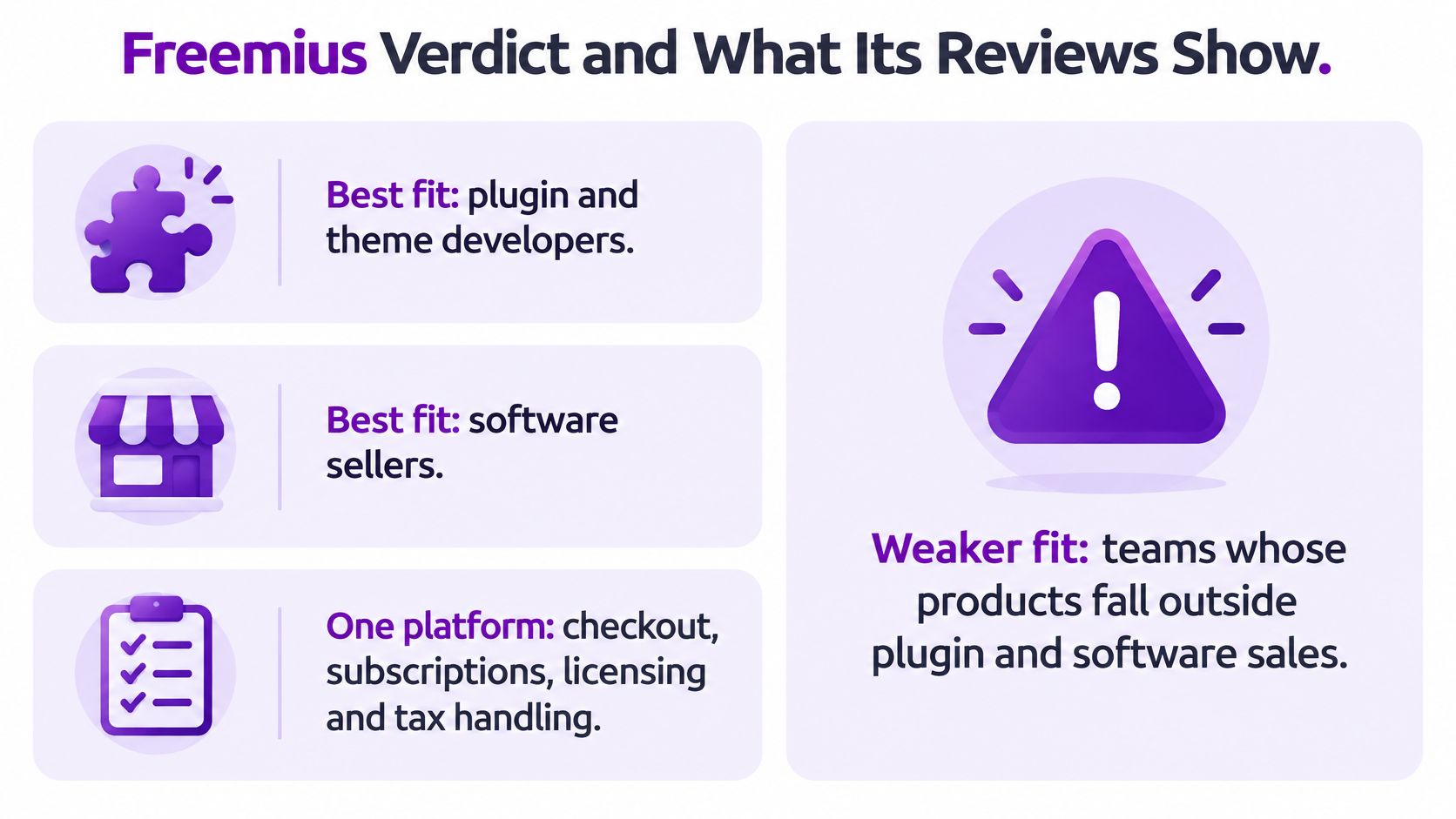
Freemius suits software sellers who want checkout, subscriptions, licensing and tax handling together, especially plugin and theme developers running recurring software businesses. It's a weaker fit for very low-priced products, where a fixed transaction fee consumes more of each payment.
For SaaS founders, the distinction is practical. If your application needs licence validation as well as recurring billing, a bundled platform can remove substantial implementation work. If you only need to collect subscriptions for a hosted app, evaluate whether you'll actually use the software-specific features.
What the ratings establish
G2's Freemius review page lists 4.7 out of 5 from 68 verified reviews, with 86% five-star, 10% four-star and 2% one-star ratings, and no three- or two-star reviews displayed. The 2026 Trustpilot listing shows 3.7 from 44 reviews, according to Trustpilot's Freemius page.
Freemius review signals and how to read them
| Source | Score | Sample | How to read it |
|---|---|---|---|
| G2 overall rating | 4.7 out of 5 | 68 verified reviews | Strong but small sample; ratings change as reviews are added |
| G2 review breakdown | 86% five stars, 10% four stars, 2% one star | 68 reviews | No three- or two-star reviews displayed |
| Trustpilot overall rating | 3.7 | 44 reviews (2026) | Lower score and mixed signal from a small sample |
The G2 sample is concentrated at the positive end, not spread evenly across satisfaction levels. That supports a favourable directional verdict, but it isn't a census of customers.
Trustpilot provides a useful counterweight. Its lower score means you shouldn't assume that support, billing or customer experience satisfies everyone equally. Read individual reviews for the workflow you're buying, rather than averaging scores from different platforms into a supposedly more authoritative number.
A quick fit test
Before comparing checkout screenshots, answer these questions:
- Your billing model: Do you sell licences or subscriptions that benefit from software-specific access controls?
- Your operational preference: Do you want tax handling and failed-payment recovery handled within the platform?
- Your pricing: Is the average successful payment large enough to absorb a fixed fee comfortably?
A “yes” to all of them makes Freemius worth modelling. If licensing adds little value or your pricing leaves very little margin, investigate alternatives before integrating.
What Freemius Really Costs at Common Plugin Prices
Freemius publishes a base platform fee of 3.8% plus $0.50 per successful transaction, in addition to payment-gateway fees, with progressive percentage rates reaching 0.5% on revenue above $100,000 per month, according to its pricing documentation.
Progressive pricing isn't a blanket discount. A lower percentage applies to revenue inside the relevant band, not retrospectively to every sale. Your blended percentage therefore reflects revenue across the bands, while fixed transaction charges and gateway costs still need to be included.
Check the intermediate bands on the current pricing page before modelling a higher-volume business. Applying the lowest advertised percentage to all monthly revenue will understate your costs.
The base-rate calculation
The following hypothetical examples use the published base formula:
Platform fee = sale amount × 3.8% + $0.50
They exclude taxes and gateway fees. Figures are rounded to cents, and effective rates are rounded to a decimal place. Every row is a calculation, not a Freemius quote.
Freemius net revenue per sale at base rate
| Product example | Freemius fee at base rate | Effective rate | Kept before gateway fees |
|---|---|---|---|
| $29 one-time plugin licence, calculated | $1.60 | 5.5% | $27.40 |
| $99 annual licence, first year, calculated | $4.26 | 4.3% | $94.74 |
| $20 monthly subscription, calculated | $1.26 per month | 6.3% | $18.74 per month |
The annual licence doesn't escape platform charges after the first payment. Each successful renewal creates another transaction to price into your margin.
For a SaaS business, the monthly example deserves particular attention. A fixed charge repeats with each collection, so inexpensive monthly plans can carry a noticeably higher effective platform rate than larger annual payments. Don't change billing cadence solely to reduce fees, though. Customer commitment, conversion and retention also matter.
Practical rule: Compare what you keep per customer with the operational work you avoid, not just one provider's percentage against another's.
What you're buying beyond payment processing
Freemius bundles checkout, subscription billing, tax handling, fraud protection, failed-payment recovery, customer portals and licensing. Replacing that bundle means paying vendors, assigning engineering time, or accepting manual operations.
Use a payment-fee comparison to organise the transaction-cost side, then add the replacement services you genuinely need. Don't count hypothetical engineering savings for features your app won't use.
The integration's reporting structure matters too. The Freemius subscriptions API links recurring agreements to their associated payments and exposes subscription status, plan and billing-cycle information. Preserve those relationships when assessing profitability, so renewals don't get mistaken for newly acquired customers.
A good fee model therefore has two outputs: cash retained after transaction costs and recurring revenue by customer and plan. Neither substitutes for the other.
How Freemius Handles Subscriptions and Renewals
Freemius monthly and annual subscriptions renew automatically, unlike lifetime or one-time purchases. Its licence-renewal documentation says annual customers receive a reminder one month before renewal, successful monthly and annual renewals extend licences by 30 days and 365 days, respectively, and delayed processing can leave a licence in an Expired state until payment succeeds.
That sequence matters for access and reporting. A cancellation after a reminder is different from a payment that hasn't cleared, even if neither produces a successful collection on the expected date.
Turn billing events into reporting rules
The subscription API reference defines billing_cycle 1 as monthly, 12 as annual and 0 as lifetime. Use those values alongside subscription status rather than inferring recurring revenue from the existence of a licence.
Freemius billing values and how to report them
| Billing value or event | What it means | How to report it |
|---|---|---|
| billing_cycle 1 | Monthly subscription | Recurring; renewal extends licence by 30 days |
| billing_cycle 12 | Annual subscription | Recurring; normalise to monthly equivalent; renewal extends licence by 365 days |
| billing_cycle 0 | Lifetime purchase | One-time; keep out of MRR |
| Delayed or failed renewal | Licence may enter Expired state | Track separately from cancellation |
| Cancellation | Renewal stops | Churn, in the period it takes effect |
For a hypothetical $99 annual subscription, the monthly equivalent is $8.25, calculated by dividing the annual amount by its monthly billing-cycle equivalent. That's an MRR normalisation, not a monthly cash receipt.
A lifetime payment can increase collections without increasing recurring revenue. Likewise, a successful renewal maintains an existing recurring agreement; it doesn't automatically represent new MRR.
Freemius's SaaS documentation describes purchase, renewal and cancellation lifecycle notifications through webhooks or its API. Your app can use these events to grant or restrict access as subscription status changes.
A licence tells you about access. A subscription tells you about an ongoing billing agreement. A payment tells you that money moved.
Keep those records connected, but don't collapse them into a single “active customer” flag. Define when cancellation becomes effective, how delayed payments are treated, and how recovered subscriptions return to your reports.
Strengths and Weak Spots Worth Weighing
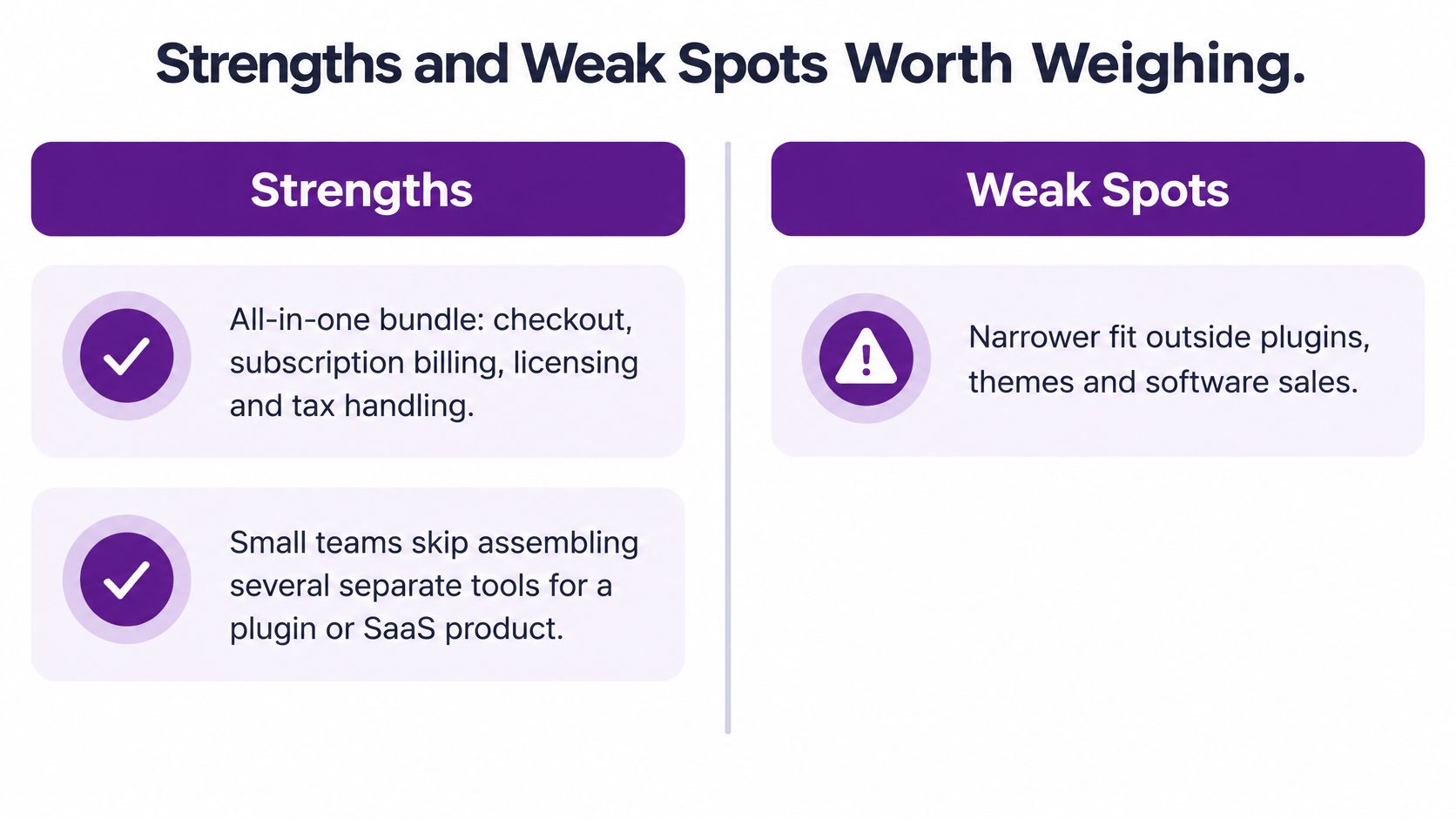
The strongest argument for Freemius isn't that its percentage looks small. It's that a small software team may prefer maintaining its application to assembling checkout, recurring billing, licensing and tax workflows from separate tools.
Support also deserves consideration. Freemius reported that 96% of customers rated technical support “Great” in 2024, based on 158 ratings, in its 2024 year-in-review report. Its 2023 report reported 93% “Great Support” from 177 customer ratings.
These are vendor-reported figures, not independent service benchmarks. They indicate attention to support, but they don't establish how quickly your particular billing or integration problem will be resolved.
The cost that's harder to put in a fee table
The immediate weaknesses are visible in transaction economics: low-priced subscriptions absorb the fixed charge poorly, and gateway charges sit alongside the platform fee. The less obvious weakness is switching cost.
Once your app relies on Freemius licence checks and access rules, changing providers becomes an engineering project. You'll need to replace validation logic, preserve customer entitlements and plan what happens to existing recurring agreements.
Before committing, document:
- Access dependencies: Which application features depend on a Freemius response?
- Customer continuity: How would existing subscribers retain access during a migration?
- Data ownership: Which customer, subscription and payment identifiers must remain usable elsewhere?
This isn't a reason to reject a bundled platform. Every billing implementation creates dependencies. It's a reason to make those dependencies explicit before launch, while you can still choose an architecture without disrupting paying customers.
Real-World Setups for Plugin, Theme and SaaS Sellers
A solo builder with a subscription add-on
Consider a hypothetical developer selling a $49 one-time licence alongside a $9 monthly support add-on. Calculated using the base formula, the licence incurs about $2.36 in platform fees, or 4.8%, leaving $46.64 before gateway charges and taxes.
The support subscription incurs about $0.84 per collection, or 9.4%, leaving approximately $8.16 on the same basis. These are worked calculations, not quoted prices.
The recurring add-on is where the developer should scrutinise margin. Bundled checkout and licence checks may still be worthwhile, but the support workload must fit inside what remains after all payment costs.
Don't use a healthy margin on the main product to hide an underpriced recurring service.
An annual subscription business serving agencies
A hypothetical theme studio sells $99 annual licences with ongoing updates and support. Its decision isn't just whether an initial sale is profitable, but whether recurring service obligations remain affordable through renewal cycles.
The studio should separate first purchases from renewals, then compare subscription retention across plans. Stable renewal collections can support the business without indicating that acquisition has improved.
That distinction helps a small team decide whether to invest in marketing, onboarding or existing-customer support. A total-sales chart alone can't answer that question.
A hosted SaaS already using Stripe
A hypothetical four-person SaaS team selling a $30 monthly plan already uses Stripe and needs neither licence keys nor plugin distribution. Moving billing just to acquire software-specific tools would add work without addressing a demonstrated problem.
The useful question is which acquisition sources bring subscribers and whether upgrades offset downgrades and cancellations. Chartsy supports Stripe analytics for that workflow, connecting subscription performance with acquisition reporting rather than requiring a billing migration.
Connecting Freemius Billing Data to Chartsy for MRR Analysis
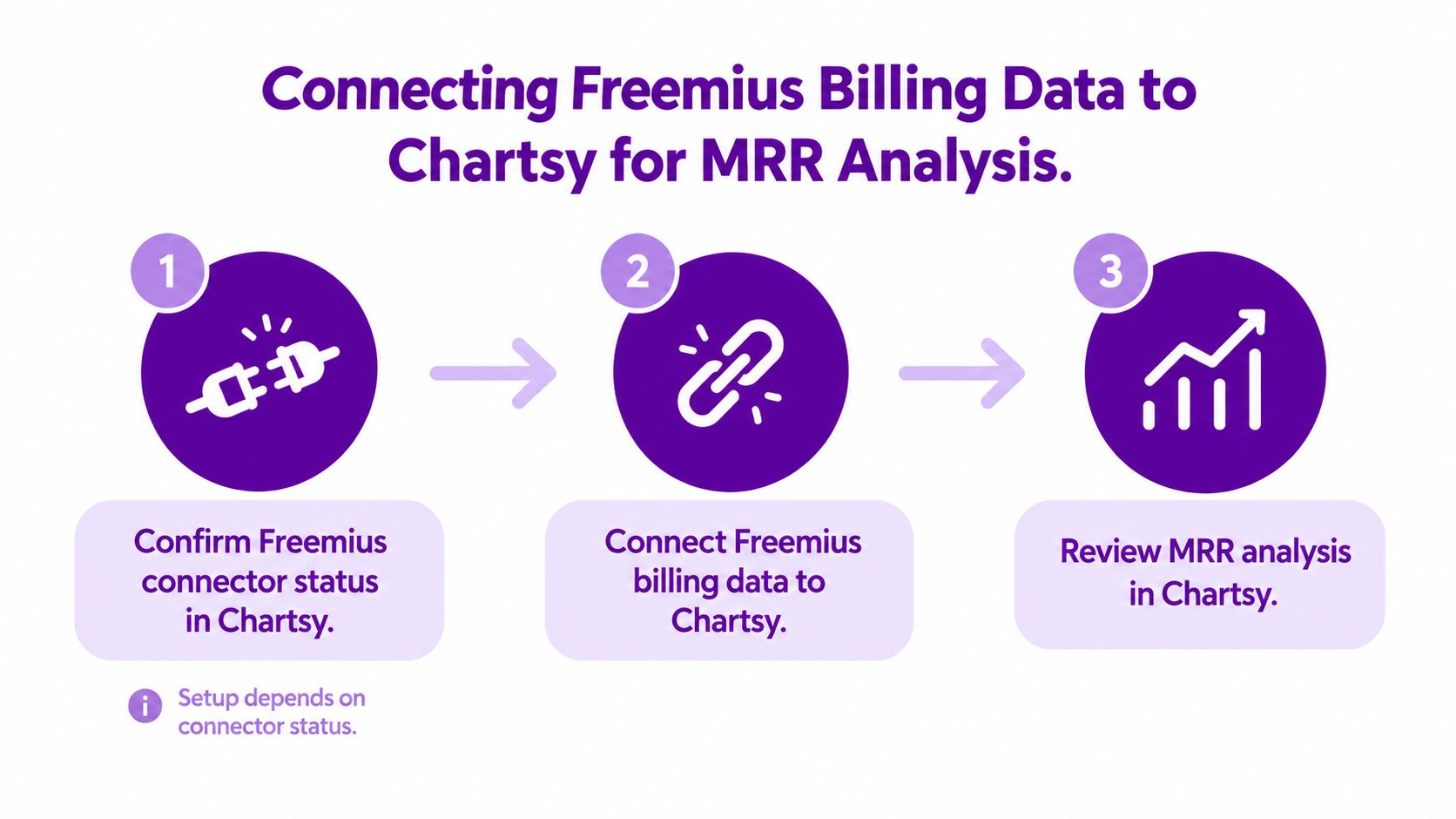
Start with the connection path. Chartsy supports analytics for Stripe, Paddle Billing and Paddle Classic, and its approved product information includes Freemius support; check the current Freemius connection documentation for the setup available to your account.
If a native connection isn't available for your required source or setup, the alternative is to send normalised records through the Custom API. That means mapping source fields to the expected structure yourself, not assuming an automatic provider connection.
Map the records before building dashboards
The Freemius payments API treats a payment as a completed transaction and can include refund and chargeback details. Keep gross collections, refunds, chargebacks and fees distinct so you can reconcile retained revenue rather than labelling gross collections as net revenue.
Prepare this inventory:
- Identity: Product ID, customer ID and subscription ID.
- Timing and lifecycle: Transaction timestamp, subscription status and effective change dates.
- Commercial details: Billing cycle, plan and payment amount.
- Adjustments: Refund or chargeback state, plus available fee records.
- Optional sentiment analysis: Review timestamps and product-level review records.
Link payments to subscriptions and deduplicate using stable identifiers. Classify revenue movements from agreement changes, not by treating every payment notification as another customer.
Reconcile the imported records with Freemius before trusting a dashboard. Missing annual subscriptions or duplicated webhook events can make an attractive chart materially wrong.
Explain the MRR movement
ScaleXP's MRR guide distinguishes new, expansion, contraction and churned MRR. Its illustrative scenario has ten new customers at $150 adding $1,500, four downgrades of $125 removing $500, and five cancellations of $100 removing $500.
With no expansion in that hypothetical month, the calculation is:
Net New MRR = New MRR + Expansion MRR − Contraction MRR − Churned MRR
$1,500 + $0 − $500 − $500 = $500
That's more useful than seeing only a higher month-end balance. The business acquired revenue, but downgrades and cancellations offset much of it.
Connect website visits and signup tracking to the paying customer records to examine which marketing sources contributed recurring revenue. Attribution describes the recorded relationship; it doesn't prove that a channel caused a purchase.
For a team without an analyst, plain-English AI questions can make exploration easier. Ask which sources brought paying customers or how MRR movements differed by plan, then save useful charts to a dashboard.
If review volume changes before conversion or retention changes, compare review-period cohorts. Treat that as a hypothesis to test, not an explanation for why individual customers cancelled.
Freemius Alternatives and How to Choose Between Them
A payment gateway and a merchant of record solve different operational problems. With a gateway, your business keeps responsibility for tax and chargeback handling. A merchant of record takes on transaction-related duties under its own terms, for a fee.
Freemius adds software licensing on top of that choice. Decide which operating model you need before comparing headline percentages, because a lower rate attached to the wrong model costs more than a higher rate attached to the right one.
Freemius compared with other billing options
| Option | Model | Best fit | Main trade-off | Chartsy connection |
|---|---|---|---|---|
| Freemius | Software sales platform with checkout, subscriptions and licensing | Plugin and theme developers, software sellers wanting bundled licensing | Platform charges plus gateway fees; the fixed charge weighs on low prices | Confirm current connector status; otherwise Custom API |
| Stripe | Payment gateway; you remain responsible for tax and chargebacks | Teams handling tax and compliance themselves or with an accountant | You own tax and chargeback handling; check current pricing | Analytics supported |
| Paddle Billing | Merchant of record | Global SaaS wanting tax handled on its behalf | Paddle takes over tax handling in exchange for accepting its fee structure and terms | Analytics supported |
| Paddle Classic | Earlier Paddle product line | Existing Paddle Classic accounts | Older product line; compare any new setup against Paddle Billing first | Analytics supported |
| Other billing system | Provider-specific gateway, merchant-of-record or internal billing model | Businesses without a native connector | Requires sending normalised records | Custom API, not automatic |
Choose according to the work you want to own
Low-priced SaaS plans need transaction modelling first. A fixed fee can matter more than a modest difference in percentage rates, especially when customers pay frequently.
For international subscriptions, decide who manages transaction taxes and the related administration. A merchant-of-record arrangement can reduce that workload. Review the provider's stated responsibilities and exclusions rather than assuming it removes every compliance obligation your company carries.
Licence requirements change the comparison. If your product needs licence validation and software-specific access controls, Freemius is more relevant than a payment-only comparison suggests. If you run an ordinary hosted SaaS on Stripe and billing already works, better reporting may be the change to make instead of switching providers.
Run the numbers before committing. The Paddle fee calculator models transaction costs for a merchant-of-record setup, so you can compare it against a gateway arrangement at your actual price points. A calculator produces an estimate rather than a contract; confirm current provider pricing and terms on an account-specific basis.
Keep billing selection separate from analytics selection. Pick the provider for operational fit, then analyse subscription growth alongside acquisition data through your analytics layer rather than expecting the billing provider to answer every marketing question.
Check Your Freemius Net Revenue Before You Commit
Set aside an afternoon for a focused reconciliation. The aim is to make a decision from your own transaction mix, not an average review score.
- Pull a defined period. Use the last three months as a practical review window. Separate one-time, monthly and annual sales, and note your average payment amount.
- Estimate and reconcile fees. Apply the base-rate formula as an initial estimate, then compare it with actual charges, including progressive pricing, gateway costs and adjustments.
- Connect and validate. Confirm the current Freemius connection setup. Where a Custom API implementation is required, send normalised records and match payment and subscription totals for the same dates.
- Inspect recurring movements. Review new, expansion, contraction and churned MRR over that window. Identify which movement accounts for the largest observed change.
- Check acquisition patterns. Examine which marketing sources brought those paying customers. Investigate the pattern without treating attribution as proof of causation.
If retained revenue is acceptable and licensing and support save meaningful work, keep the setup and monitor it monthly. If transaction costs undermine your margin, model an alternative before your next pricing change, including migration work and existing subscriber access.
Chartsy connects website traffic and signups with paying customers and subscription revenue, helping small SaaS teams examine acquisition, MRR and churn together. Visit Chartsy to check the Freemius connection workflow and build a dashboard for subscription movements and the marketing sources behind your paying customers.

Written by
Chartsy TeamAnalytics team at Chartsy
The Chartsy Team writes guides, product updates, and resources to help SaaS and eCommerce founders make sense of their metrics, without SQL or spreadsheets.
Chartsy