You're preparing a board update, and your subscription dashboard shows a stronger business than your income statement seems to describe. A new annual customer has lifted ARR, but recognized revenue has barely moved. Before you change either report, check whether you're comparing the value of the current recurring customer base with the amount earned during the reporting period.
The useful question in ARR vs revenue isn't which number is right. It's which transactions explain the difference, and whether that difference reflects ordinary timing, non-recurring work, or a reporting policy that needs attention.
Table of Contents
- ARR vs Revenue at a Glance
- Defining Each Metric and the Rules Behind It
- Tracing One Annual Contract Through Both Metrics
- What Moves ARR, Revenue or Both
- Reading ARR Growth Beside Retention and Benchmarks
- Where ARR and Revenue Diverge in Practice
- Choosing Which Figure to Report and When
ARR vs Revenue at a Glance
ARR and recognized revenue compared
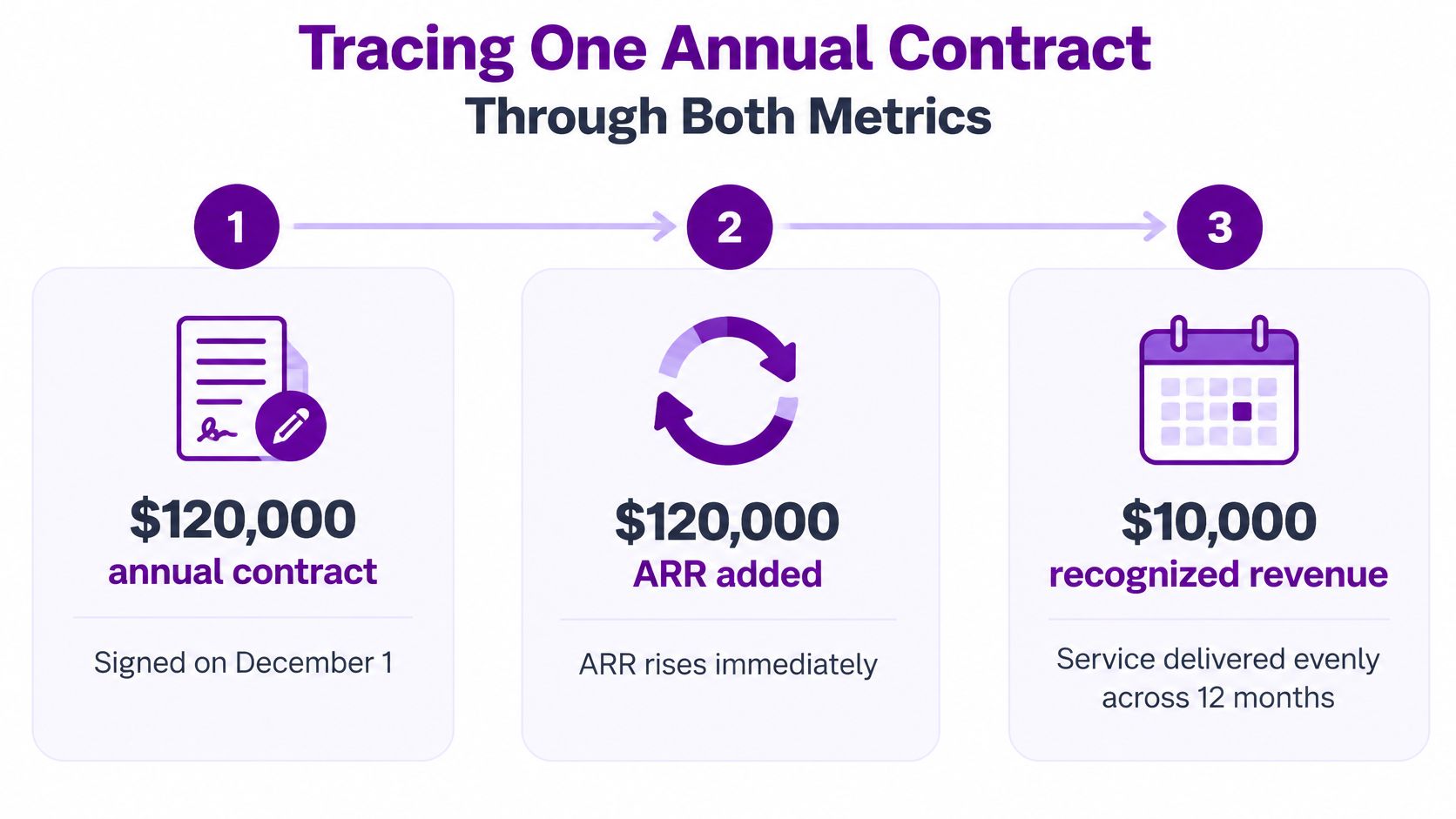
The shared contract example below assumes service starts when the customer signs and is delivered evenly. SaaSCEO's ARR-versus-revenue guide illustrates how a $120,000 annual contract signed December 1 can add $120,000 to ARR while contributing only $10,000 to December revenue.
| Aspect | ARR | Recognized revenue |
|---|---|---|
| Definition | Annualized value of active recurring contracts | Income earned in a defined period as service is delivered |
| Time orientation | Point-in-time and forward-looking | Backward-looking and period-based |
| Typical calculation | MRR multiplied by twelve | Sum of amounts earned in the period under applicable revenue-recognition rules |
| One-time implementation fees | Usually excluded | Included when earned |
| Governing standard | Management-defined, non-GAAP operating metric | Financial-reporting rules such as GAAP or IFRS |
| Where it is reported | Board decks, investor updates, retention reviews | Income statement and formal financial statements |
| Effect of a $120,000 annual contract signed December 1 | Adds $120,000 at signing, assuming immediate activation | Adds $10,000 to December, assuming even service delivery |
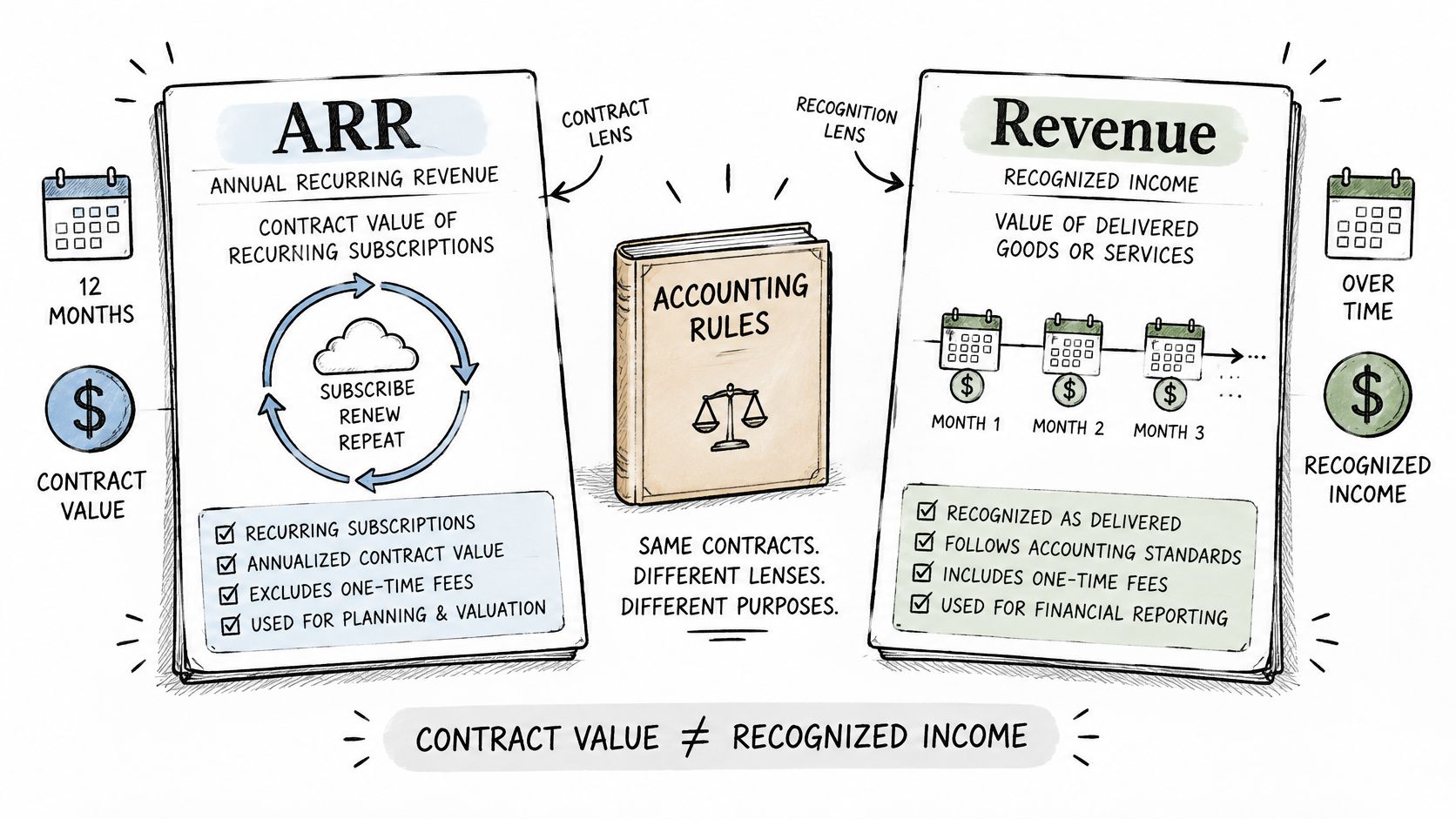
ARR is a run rate, commonly MRR multiplied by twelve; recognized revenue is what the business earned during a defined period. Both can be correct because they measure different things at different times. When they disagree, check the final row first: when does contract value enter each figure?
Defining Each Metric and the Rules Behind It
Your ARR policy is part of the metric. There's no official accounting definition that makes every company's ARR directly comparable. Ordway's report on public SaaS and cloud-company ARR explains the need for company-specific definitions and distinguishes ARR from recognized revenue governed by ASC 606 or IFRS 15.
Write down how you treat discounts, committed usage, variable usage, implementation fees and professional services. Specify when expansions, contractions and churn enter the calculation. Apply those decisions consistently rather than changing the treatment when a transaction makes the growth story look better.
Separate operating definitions from accounting rules
ARR means annual recurring revenue, calculated as MRR multiplied by twelve. Our annual recurring revenue calculation guide provides a practical starting point for documenting that calculation.
Recognized revenue follows performance obligations, not invoices or cash receipts. For a standard subscription delivered evenly over time, the business earns revenue throughout the service term, as DualEntry's explanation of subscription revenue recognition describes under ASC 606.
Billing dashboards can use another lens. In our reporting, gross revenue is all money collected during a period, recurring and one-off, before refunds; net revenue is gross revenue after refunds and chargebacks, applied in the period they occur. Those collection-based definitions shouldn't be mistaken for an accounting recognition schedule.
Practical rule: A clear label is a control. Specify whether a figure represents recurring run rate, collected money, or earned revenue before discussing its movement.
Keep a definition sheet
Use this compact template for each business:
- Metric name: Distinguish ARR, collected revenue and recognized revenue.
- Included items: List eligible recurring commitments and their treatment.
- Excluded items: Identify services, one-off charges and uncommitted usage.
- Measurement date: State the ARR snapshot date.
- Revenue standard: Record the accounting framework applied.
- Policy owner: Name who approves changes and documents their effect.
ARR supports operating analysis and retention reporting. It doesn't replace audited revenue or establish that the business has already earned the recurring value it reports.
Tracing One Annual Contract Through Both Metrics
Say a customer signs a $120,000 annual subscription on December 1, service starts immediately, and you deliver it evenly across twelve months. In ChargeOver's ARR explanation, that arrangement can add $120,000 to ARR immediately, while only $10,000 is recognized as December revenue.
The following schedule extends that example arithmetically. Assume no discounts, amendments, refunds or cancellation, and measure each monthly ARR snapshot while the contract remains active.
Follow the contract rather than the invoice
Monthly view of one $120,000 annual contract
The recognized-revenue column shows the monthly amount, followed by the cumulative amount earned since activation. All amounts are dollars.
| Period | ARR (annualized contract value) | Recognized revenue |
|---|---|---|
| December (signing month) | $120,000 | $10,000 monthly; $10,000 cumulative |
| January | $120,000 | $10,000 monthly; $20,000 cumulative |
| February | $120,000 | $10,000 monthly; $30,000 cumulative |
| March | $120,000 | $10,000 monthly; $40,000 cumulative |
| April | $120,000 | $10,000 monthly; $50,000 cumulative |
| May | $120,000 | $10,000 monthly; $60,000 cumulative |
| June | $120,000 | $10,000 monthly; $70,000 cumulative |
| July | $120,000 | $10,000 monthly; $80,000 cumulative |
| August | $120,000 | $10,000 monthly; $90,000 cumulative |
| September | $120,000 | $10,000 monthly; $100,000 cumulative |
| October | $120,000 | $10,000 monthly; $110,000 cumulative |
| November | $120,000 | $10,000 monthly; $120,000 cumulative |
| Full 12-month term | $120,000 annualized value, not a sum | $120,000 total |
Don't add the ARR column. Each row repeats a snapshot of the same annualized recurring commitment. Recognized revenue, by contrast, accumulates as the company delivers service.
At the end of the term, cumulative recognized revenue equals the contract's annual value. That equality doesn't make ARR a cumulative measure. If the customer doesn't renew, the recurring base must reflect the expiration rather than retaining the contract indefinitely.
Introduce cancellation without rewriting history
Suppose the customer instead cancels after the fourth service month, with termination effective immediately and no remaining service obligation. Remove the contract from ARR at that effective date. The revenue already earned for delivered service remains in its historical periods, subject to any required refund or accounting adjustment.
A cancellation therefore changes the current recurring base without automatically erasing previously earned revenue. Treating the entire original contract as still-active ARR would overstate the base; reversing all historical revenue would confuse a future loss with past delivery.
Build linked bridges
Use an ARR bridge to explain the opening recurring base, new subscriptions, expansion, contraction and churn. Separately, build a revenue-recognition bridge that identifies service delivered during the period and the adjustments needed to reach the accounting total.
Connect both through customer identifiers, contract identifiers, service dates and invoice references. Then ask:
Which exact transactions explain the difference between this month's ARR movement and recognized revenue?
A company-wide subtraction won't answer that question. A contract-level schedule will show whether the difference comes from activation timing, service delivery, amendments or non-recurring work.
What Moves ARR, Revenue or Both
Classify transactions by eligibility and timing, not just by their invoice description. DualEntry's ARR-versus-revenue guide distinguishes recurring subscription value from non-recurring implementation and professional-services revenue, and explains why ARR can move before accounting revenue catches up.
Transaction types and their effect on each metric
| Transaction | Effect on ARR | Effect on recognized revenue |
|---|---|---|
| Annual subscription fee | Included at annualized value from start | Recognized across the service term |
| One-time implementation fee | Usually excluded | Recognized when the related service obligation is satisfied |
| Professional services | Usually excluded | Recognized as work is delivered |
| Usage charges | Usually excluded unless committed and recurring | Recognized as usage occurs |
| Upgrade (expansion) | Raises run rate at the effective change date | Prorated adjustment over the remaining service term |
| Downgrade or seat reduction (contraction) | Lowers run rate while the customer stays | Prorated adjustment for the remaining term |
| Cancellation | Removed at the effective date under the documented policy | Stops when the related service obligation ends |
| Refund | Adjusted under company policy if recurring value changes | Reduces revenue as applicable to the refund's accounting treatment |
Distinguish a changed commitment from a payment event
An upgrade changes what the customer has committed to buy. A partial refund may instead correct an overcharge without changing the ongoing subscription. Don't reduce recurring value automatically whenever money goes back to a customer.
Similarly, a failed payment needs investigation before classification. Check whether the customer remains entitled to service, whether the invoice is still collectible and whether the subscription has ended. The billing event alone doesn't explain the entire economic change.
Contraction MRR is recurring revenue lost from customers who stayed, such as through a downgrade or reduced seat count. It's distinct from churn because the customer relationship survived. Keeping those categories separate helps the team distinguish shrinking accounts from lost accounts.
In Chartsy, our revenue maths handles proration, partial refunds, failed payments and mid-cycle plan changes from issued invoices. That supports operational reporting, but the team still needs an accounting policy for recognizing the underlying obligations.
Check the exceptions before annualizing
For a multi-year agreement, use the annualized recurring value for the active term, not the full contract value. If the agreement contains price steps, introductory discounts or changing commitments, record the effective dates rather than dividing an undifferentiated total and assuming the result describes every period.
Implementation fees also require care. A separate invoice line doesn't, by itself, establish a separate accounting obligation. Have the finance owner determine whether the setup work is distinct or belongs with the subscription service before choosing its recognition schedule.
Use a monthly transaction review:
- List the movement: Include its contract, invoice and effective date.
- Tag its scope: Mark ARR, recognized revenue or both.
- Explain the timing: Record why the metrics change on different dates.
- Resolve the exception: Assign unclear refunds, usage commitments and payment failures to a named owner.
The reconciliation becomes more useful when exceptions remain visible instead of being absorbed into an unexplained adjustment.
Reading ARR Growth Beside Retention and Benchmarks
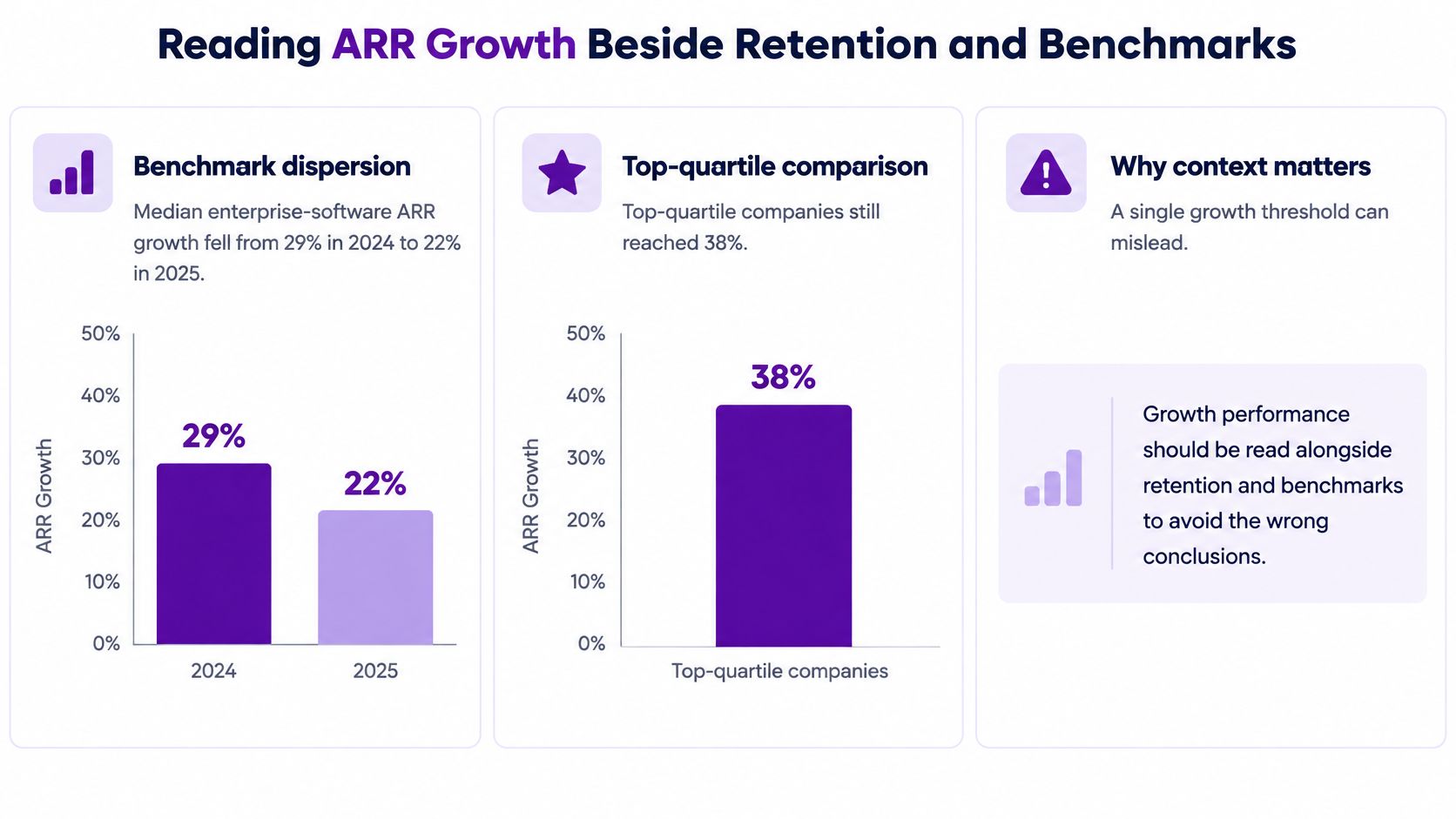
Median enterprise-software ARR growth fell from 29% in 2024 to 22% in 2025, while top-quartile companies still reached 38%, according to HSBC Innovation Banking's SaaS sector benchmarks. That dispersion makes a universal growth target less useful than a comparison that accounts for business stage, retention and efficiency.
Enterprise-software ARR growth benchmarks
| Benchmark | Year | ARR growth |
|---|---|---|
| Median enterprise software | 2024 | 29% |
| Median enterprise software | 2025 | 22% |
| Top-quartile companies | 2025 benchmark comparison | 38% |
Test the quality of growth
A founder can add new customers quickly while losing existing ones. Another can preserve recurring value through price increases even as customer count falls. The ending ARR figure alone won't distinguish those situations.
Read ARR beside gross revenue retention, net revenue retention, churn, customer concentration and sales efficiency. Gross retention excludes expansion; net retention includes expansion alongside churn and downsells. Our net revenue retention guide provides a useful basis for separating existing-customer performance from acquisition.
Revenue churn rate is churned MRR divided by MRR at the start of the period. It counts money rather than people. Pair it with customer churn so the team can tell whether losses involve many smaller accounts or fewer larger ones.
Run a segmentation test before celebrating aggregate growth:
- Acquisition channel: Which sources bring customers who continue paying?
- Plan: Are customers expanding, or moving to cheaper subscriptions?
- Cohort: Do newer customers retain as well as earlier groups?
- Customer size: Does growth depend heavily on a small group of large accounts?
For a small SaaS company, a handful of large annual agreements can materially change the headline without demonstrating broad customer durability. Treat ARR as a quality-adjusted operating measure, not a standalone scorecard.
Give account signals an owner
Segmentation only helps if someone investigates the changes. Captiwate's guidance on deciding who acts on account signals is useful when a founder, account manager and customer-success lead share responsibility for renewals and expansion.
A widening ARR-to-revenue gap deserves the same discipline. Aggressive annual pre-sales, delayed activation or delayed service delivery can create a larger distance between contracted value and earned revenue, a concern discussed in Metabase's ARR glossary.
A widening gap is a question to investigate, not proof that growth has improved.
Check whether contracts are active, whether delivery has begun and whether recurring value meets the company's stated definition. Strong sales activity and sound recognition are separate findings; one doesn't establish the other.
Where ARR and Revenue Diverge in Practice
A gap between the two figures calls for reconciliation rather than a verdict on business quality. A useful presentation explains the business situation, identifies the source of the gap and shows how each figure was measured.
A solo founder selling annual prepaid plans
A founder closes an annual prepaid subscription and the recurring base rises immediately by the full contract value. Cash arrives upfront too. Recognized revenue does not. It accumulates in monthly portions as service is delivered, so ARR runs ahead of the period's recognized figure for most of the contract.
Check the billing schedule against the service schedule. Don't describe annual prepayment as gradual cash collection unless the contract provides installments. Label collected cash, ARR and earned revenue separately, using a guide to revenue recognition to align the operating dashboard with the accounting schedule.
A small B2B team bundling implementation
A team sells subscription access alongside setup work. The period's recognized revenue can include delivered implementation services even though those services never enter the recurring base. One-off work lands in the revenue total and stays outside ARR entirely.
A revenue-only growth narrative can therefore imply more recurring momentum than the subscription contracts support. Check the recurring share of revenue, and inspect the allocation between subscription access and implementation before presenting the total. A rising revenue line built partly on projects flatters the run rate.
A business with revenue above ARR
Blackline Safety reported fiscal 2025 revenue of $150.5 million and ARR of $84.5 million in its fiscal-year results announcement. The relationship runs in the opposite direction from a newly activated annual subscription, but direction alone establishes neither strength nor weakness.
Revenue covers an earned amount across a fiscal period; ending ARR describes the recurring base at a particular date. A company can recognize product and service revenue that never enters the recurring base, so the two totals answer different questions. Check the measurement dates and company definitions, then use the company's own disclosures to identify revenue components outside ARR. Don't assume that services, usage or any other category explains the difference without verifying the composition.
A fractional CFO comparing clients
A fractional CFO may receive similarly labeled dashboards from clients with different discount policies. One may report the discounted recurring commitment; another may use a different basis that produces a higher headline. Identical labels can conceal different maths.
Check discount treatment before comparing clients. Keep a written definition for each business, and normalize the comparison where possible rather than treating identical labels as identical measures.
The practical lesson is broader than timing. Some gaps arise because the company delivered something outside its recurring product; others arise because teams define the recurring product differently. A composition gap calls for a revenue mix breakdown, and a definition gap calls for normalization. Those responses differ even when the dashboard discrepancy looks the same.
Choosing Which Figure to Report and When
Choose the metric that answers the audience's question, then provide enough context to prevent a misleading interpretation.
- Investor and board updates: Lead with ARR when discussing recurring scale and momentum. Include the movement bridge, retention figures, snapshot date and definition.
- External financial statements: Report recognized revenue under the applicable accounting framework. ARR can supplement the discussion, but it isn't a substitute.
- Internal planning: Track the recurring base alongside the service-delivery schedule. Don't use a current run rate as an automatic forecast of the period's accounting revenue.
- Day-to-day monitoring: Track MRR and its movements, then derive ARR consistently.
For broader planning, MakeAutomation's growth measurement guide for B2B founders offers context for placing recurring growth alongside other operating measures.
Put the reconciliation into the monthly close
- Write the definition. Record how your business handles discounts, usage commitments and one-time fees. Assign an owner to approve changes.
- Reconcile a completed month. Match billing records to the recognition schedule, list each movement and tag it ARR, revenue or both.
- Set an investigation threshold. Agree which unexplained differences require review, who investigates them and when the explanation must be ready.
Reporting tools can reduce repetitive data pulls, but your team remains responsible for the definitions and accounting judgments. Chartsy reads revenue directly from the customer's billing provider and shows MRR, ARR, churn, LTV, NRR and ARPU, giving the team operating measures to examine alongside its recognition schedule.
For your next report, use a precise sentence: We report ARR as the annualized recurring value of active subscriptions at the reporting date, excluding non-recurring fees and services; it is not revenue already earned.
Chartsy connects billing data with recurring-revenue and retention reporting so you can inspect the movements behind your ARR rather than relying on a headline total. Visit Chartsy to track your recurring base, examine expansion and losses, and bring clearer operating evidence to your next revenue reconciliation.

Written by
Chartsy TeamAnalytics team at Chartsy
The Chartsy Team writes guides, product updates, and resources to help SaaS and eCommerce founders make sense of their metrics, without SQL or spreadsheets.
Chartsy