Revenue recognition (rev rec) is the accounting process that determines when and how much revenue a business records from a customer contract, based on delivering the product or service rather than on billing or payment.
If a customer pays for an annual subscription today, why doesn't all that money count as today's revenue? That's the gap that trips up subscription founders: the bank balance, billing dashboard and income statement can all show different amounts without any of them being wrong.
Table of Contents
- What Revenue Recognition Means in Plain Terms
- Revenue, Billings, Cash and MRR Compared
- The Five Steps Behind Every Revenue Entry
- A Worked Annual Subscription, Quarter by Quarter
- Handling Upgrades, Refunds and Bundled Services
- Confirm Your Rev Rec Process Before Your Next Close
What Revenue Recognition Means in Plain Terms
Rev rec is about matching revenue to delivery. Consider a gym membership paid for a full year in advance. The gym has the money immediately, but it still owes the member access throughout the membership term.
As the gym provides that access, it earns the fee. The member doesn't need to visit every day for the gym to deliver its promise, provided the promised facilities remain available.
The same reasoning applies to a straightforward software subscription. Your customer pays for continuing access, and you fulfill that promise throughout the service period, not just when their card clears.

The accounting rule behind the timing
The international standard, IFRS 15, requires recognition when or as a business transfers control of promised goods or services; it became mandatory for annual reporting periods beginning on or after January 1, 2018, according to the IFRS Foundation's published standard. Its US counterpart, ASC 606, uses the same core control-transfer principle.
For a practical introduction to the US framework, Jumpstart Partners' ASC 606 five-step model explained is a useful companion resource.
Why founders should care
Investors, auditors and founders need a consistent revenue figure in the financial statements. Otherwise, switching customers from monthly to annual payment could make business performance appear to jump even though the underlying service hasn't changed.
Keep sales commitments separate through bookings tracking, and keep the recognition schedule tied to what you've delivered.
Practical rule: Receiving money settles a payment question. Earning revenue settles a delivery question.
A payment received today can therefore represent an obligation you still need to fulfill, rather than revenue you've already earned.
Revenue, Billings, Cash and MRR Compared
A $1,200 payment can make March look finished when the service has barely started. The founder's confusion usually comes from asking one event, a successful charge, to answer four different questions: what was promised, what was invoiced, what was collected and what was delivered.
Start with the customer journey. A customer signs, receives an invoice, pays it and consumes the service. Those events can land in different reporting periods, so each needs its own measure.
Revenue terms compared
| Term | What it measures | Counts as recognized revenue? |
|---|---|---|
| Bookings | Value of contracts signed in a period | No, recorded at signing for sales tracking |
| Billings | Invoices issued to customers | No, revenue is earned as service is delivered |
| Cash collected | Payments received from customers | No, cash can arrive before or after revenue is earned |
| Recognized revenue | Amount earned as obligations are satisfied | Yes, the financial-statement revenue figure |
| MRR | Monthly run-rate of recurring subscription fees | No, a management metric |
| ARR | Annualized recurring run-rate, usually MRR times 12 | No, a management metric |
Read the table from commitment to delivery. Bookings describe signed business, billings describe what you have invoiced and cash collected tells you what customers have paid. Recognized revenue answers the stricter question: how much of the contracted access or work have you delivered by the period end?
MRR and ARR sit beside that schedule, not inside it. They describe recurring subscription activity and are useful management metrics, so keep them separate from the recognized revenue line.
A concrete schedule makes the gap visible. Suppose a customer signs a $1,200 annual plan in March, is invoiced immediately and pays upfront, with service starting March 1 and delivered evenly.
| Month | Cash received | Recognized revenue | Still deferred |
|---|---|---|---|
| March | $1,200 | $100 | $1,100 |
| April | $0 | $100 | $1,000 |
| May | $0 | $100 | $900 |
| June | $0 | $100 | $800 |
The bank account says March was strong. The revenue schedule says only one twelfth had been earned.
Match the metric to the decision
A useful dashboard does not force every decision through the same headline number.
- Can we afford a hire? Review cash availability, expected collections, payroll commitments and recognized revenue. An annual prepayment can improve cash without proving that ongoing payroll is affordable.
- Is subscription growth healthy? Examine MRR movements, separating new subscriptions, expansion, contraction and churn.
- Did a price change work? Compare recurring revenue and average revenue per user, or ARPU, alongside retention and plan mix.
- Will investor reporting match the financial statements? Use recognized revenue for the accounting comparison, with management metrics clearly labeled.
MRR can rise while recognized revenue stays flat or falls, especially when new subscriptions start near period end or churn offsets expansion elsewhere. Implementation work can also lift recognized revenue without improving the recurring subscription base.
Build a reconciliation, not a blended total
Maintain a bridge from bookings to billings, noting signed commitments that have not yet been invoiced. Then reconcile billings with recognized revenue through changes in deferred revenue and, where applicable, unbilled amounts.
Keep the MRR movement report separate. Use it to investigate retention and expansion, then connect those customer changes to invoices and collections rather than adding MRR to accounting revenue.
A number describing future contract value, invoices issued or money received is not automatically the revenue line.
That separation makes the dashboard more useful, because you can see whether a change came from selling, billing, collecting or delivering.
The Five Steps Behind Every Revenue Entry
Use the contract as your starting document, not the payment notification. The recognition decision follows the promises you've made and the consideration you expect to receive.
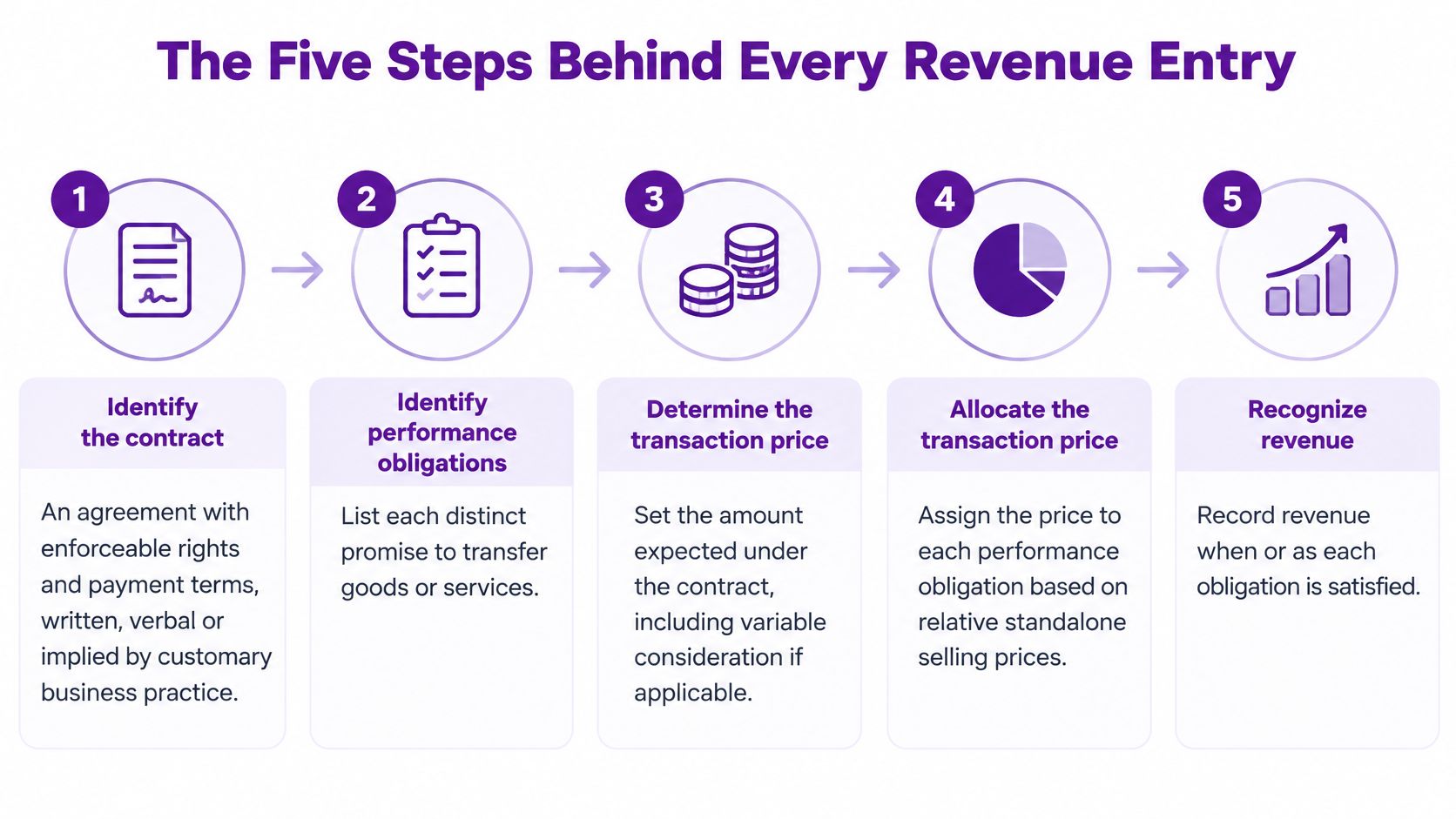
The process follows this sequence:
Apply the contract checklist
-
Identify the contract. Establish the agreement's enforceable rights and payment terms, whether written, verbal or implied by customary business practice. For a software subscription, examine the accepted order form and service terms rather than assuming an invoice contains the whole agreement.
-
Identify performance obligations. List each distinct promise to transfer goods or services. Software access, onboarding and support require assessment, because separately named invoice items aren't automatically separate accounting obligations.
-
Determine the transaction price. Establish the amount you expect in exchange for delivery, accounting for discounts, refunds and other variable consideration. A subscription with usage charges needs more judgment than a fixed-fee access plan.
-
Allocate the transaction price. Assign the price to the obligations using their relative standalone selling prices. If you sell access and a distinct implementation service together at a discount, don't allocate the entire discount arbitrarily to whichever line is easiest to adjust.
-
Recognize revenue when or as each obligation is satisfied. Tie the entry to transfer of control. Continuing software access will commonly be recognized over time, while a delivered item may qualify for recognition at a point in time.
Check timing and documentation
Point-in-time recognition captures a completed transfer. Over-time recognition follows progress toward satisfying the obligation, using a measure that reflects delivery rather than whichever billing interval is convenient.
ASC 606 became effective for public companies for fiscal years beginning after December 15, 2017, while private companies generally followed for fiscal years beginning after December 15, 2018, as described in this SEC-filed revenue-recognition disclosure. The framework also calls for disclosures about contract balances, remaining obligations and significant judgments.
This video offers another way to follow the recognition framework:
For each new contract type, save the agreement, obligation assessment, allocation method and recognition schedule together. That gives your accountant a reviewable explanation for the entry instead of a spreadsheet total with no supporting logic.
A Worked Annual Subscription, Quarter by Quarter
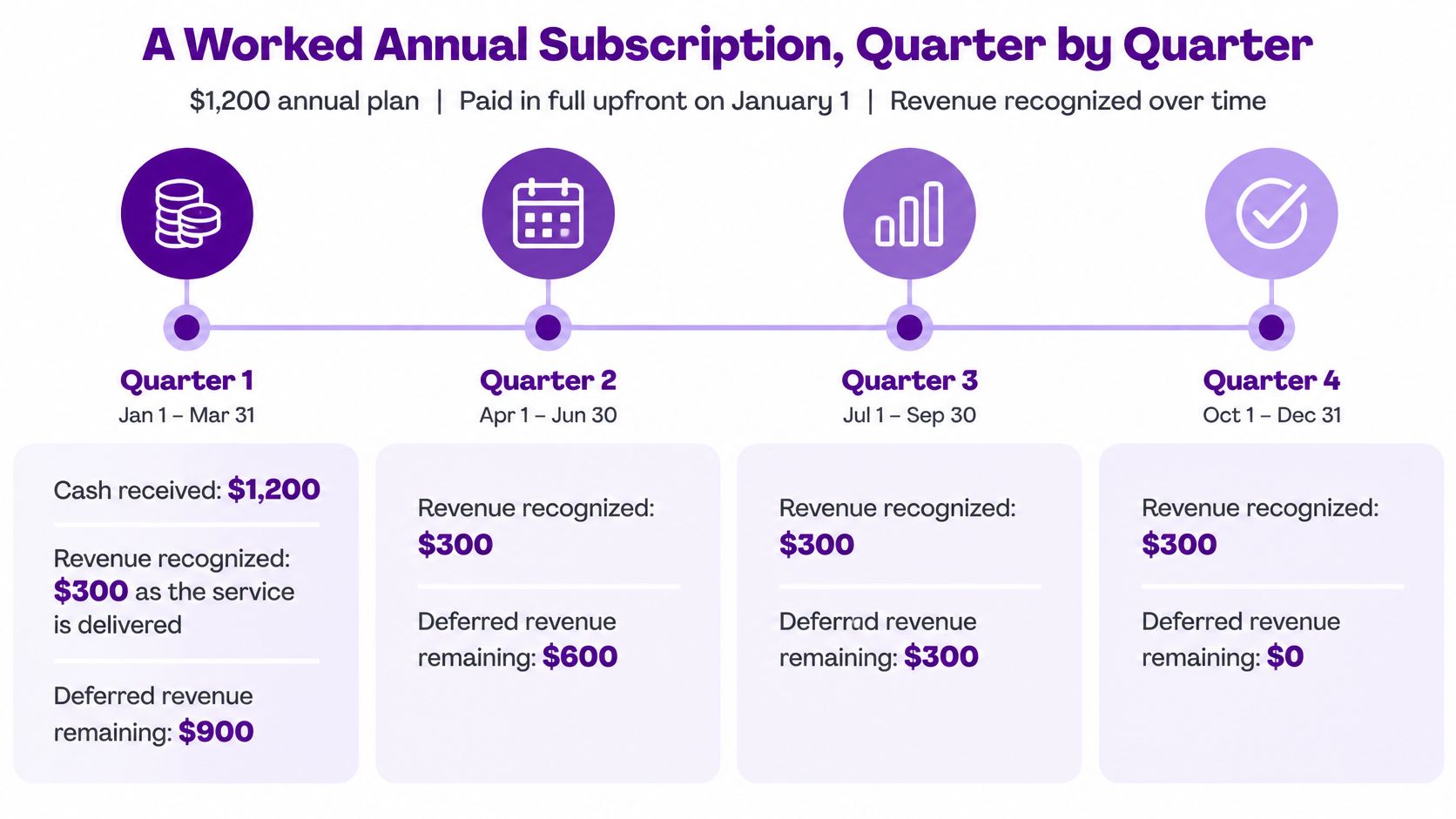
Suppose a customer buys a $1,200 annual subscription starting January 1 and pays in full upfront. Assume the contract contains only continuing access, delivery is even across the term, and there are no taxes, refunds, modifications or separate services.
The accounting basis is straightforward: advance payment creates a contract liability, commonly called deferred revenue, until the related obligation is satisfied, as the IFRS Foundation's IFRS 15 overview explains. The amounts below are hypothetical calculations illustrating that principle.
Follow the monthly schedule
| Month | Cash received | Revenue recognized | Deferred revenue at month end |
|---|---|---|---|
| January | $1,200 | $100 | $1,100 |
| February | $0 | $100 | $1,000 |
| March | $0 | $100 | $900 |
| April | $0 | $100 | $800 |
| May | $0 | $100 | $700 |
| June | $0 | $100 | $600 |
| July | $0 | $100 | $500 |
| August | $0 | $100 | $400 |
| September | $0 | $100 | $300 |
| October | $0 | $100 | $200 |
| November | $0 | $100 | $100 |
| December | $0 | $100 | $0 |
Cash received shows the customer's contribution to the bank account. Revenue recognized shows the amount entering the income statement as access is delivered. Deferred revenue shows the remaining service obligation on the balance sheet.
January's payment doesn't repeat, but delivery continues. That's why the income statement can show subscription revenue in February even though this customer sends no additional money.
Annual prepaid plan cash, revenue and deferred balance
The quarterly rollup of the same hypothetical schedule is:
| Quarter | Cash received | Revenue recognized | Deferred revenue at quarter end |
|---|---|---|---|
| Q1 | $1,200 | $300 | $900 |
| Q2 | $0 | $300 | $600 |
| Q3 | $0 | $300 | $300 |
| Q4 | $0 | $300 | $0 |
The timeline makes the shrinking obligation easier to follow:
Now suppose another customer pays $100 each month, with payment and service delivery aligned within each reporting month. Cash collected and recognized revenue would match monthly, with no deferred balance remaining at month end under those assumptions.
The difference is payment timing, not better or worse delivery economics. Annual prepayment improves immediate liquidity, but it also leaves you responsible for future service.
Close check: With no new advance billings or other adjustments, the deferred balance should fall by exactly the amount recognized.
Build this schedule for your largest annual plan and reconcile its deferred revenue to the ledger. Confirm that the balance reaches zero at the end of the service term, unless a documented contract change explains otherwise.
Handling Upgrades, Refunds and Bundled Services
Suppose a customer upgrades from $100 to $300 a month in month seven, or cancels and requests a partial refund. Your original schedule no longer captures the current agreement, so adding the new invoice to revenue will not solve the problem.
Under ASC 606, a modification can be a separate contract, a termination and replacement, or a continuation with a cumulative catch-up adjustment. The treatment turns on whether the additional services are distinct and priced at standalone value, as explained in BDO's revenue-recognition blueprint.
Review events that change the schedule
- Upgrades and downgrades can change the allocation and remaining recognition pattern.
- Discounts and service credits may reduce the transaction price.
- Partial refunds may affect previously recognized revenue, remaining deferred amounts, or both.
- Usage-based overages can require estimates of variable consideration.
- Implementation and setup fees need an assessment of whether they represent distinct obligations.
A failed payment doesn't determine recognition by itself. Assess collectibility and the applicable contract requirements rather than automatically treating every payment failure as an equal revenue reversal.
Check what you actually control
Bundled third-party services introduce another judgment: principal versus agent. A business that controls the service before transfer may recognize revenue gross; an intermediary that only arranges delivery generally recognizes its net fee.
Recheck the schedule after every contract change. Record the treatment, its rationale and the approval, because more billing often changes future recognition rather than creating immediate revenue.
Confirm Your Rev Rec Process Before Your Next Close
When someone asks, “What is rev rec?” the operational answer should include a repeatable close process, not just a definition. Start with a contract register and a schedule you can trace back to supporting documents.
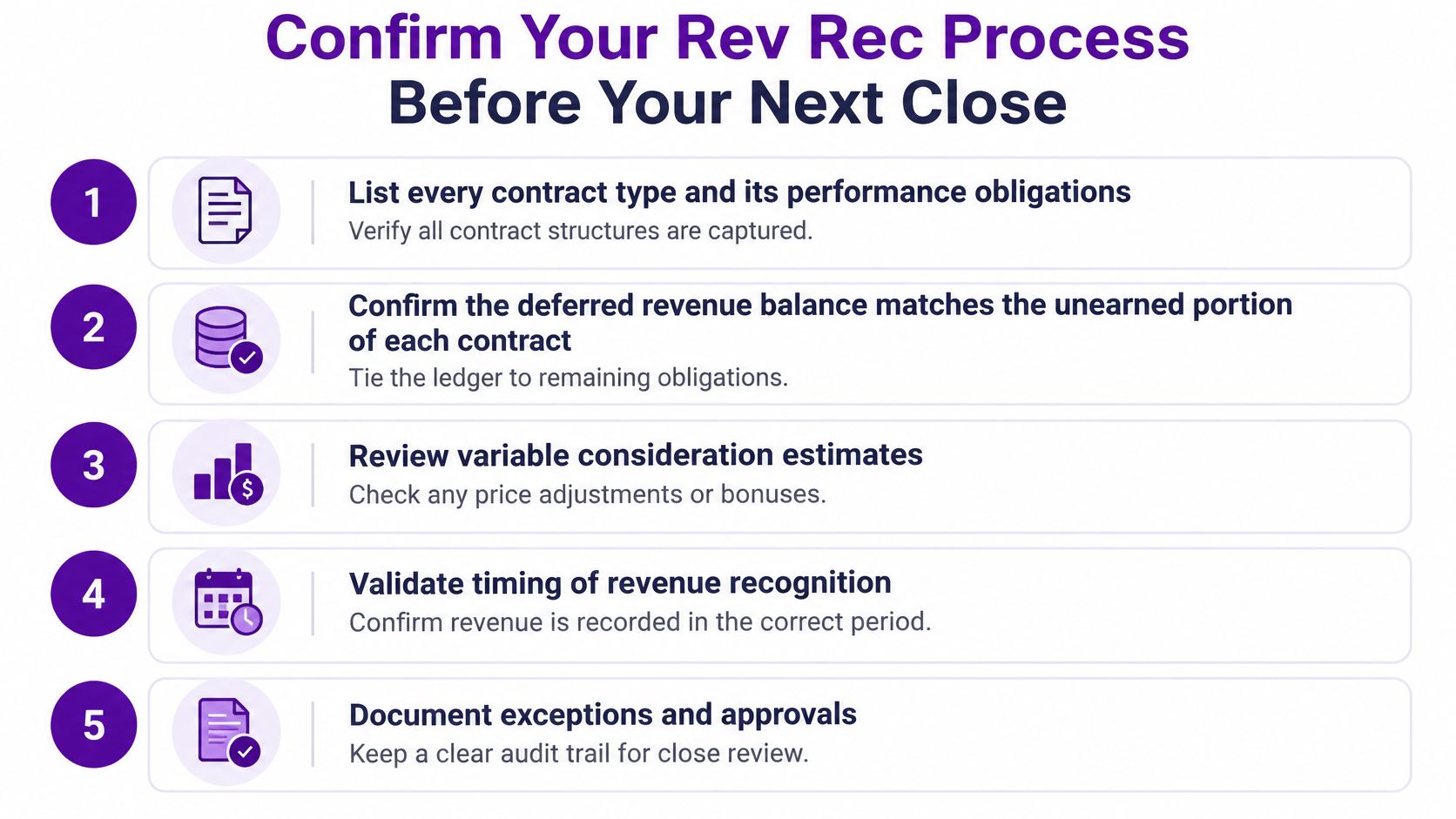
Run the close checklist
- List contract types and obligations. Capture subscriptions, implementation, usage charges and unusual service commitments.
- Confirm deferred balances. Match each prepaid plan's unearned portion to its remaining obligations.
- Review changes and estimates. Check upgrades, refunds, discounts and variable consideration against the relevant treatment.
- Reconcile monthly totals. Connect recognized revenue to billings and cash, documenting timing differences and exceptions.
- Compare recurring movements. Review new, expansion, contraction and churn alongside the recognized revenue trend.
Use this visual checklist to support the review:
Keep analytics in its proper role
A spreadsheet can work for a small contract base. For recurring-movement analysis, our Chartsy revenue analytics platform uses issued Stripe or Paddle invoices, handles proration, partial refunds, failed payments and mid-cycle changes, and explains new, expansion, contraction and churn movements. As a secondary feature, ChartsyAI provides AI-powered natural-language BI: ask in plain English about MRR, churn, LTV or top customers, and it calculates the metric, selects a chart and explains what changed.
This isn't a payment processor, CRM, accounting software, ad tracker or product analytics replacement. Terms such as unified data ecosystem, analytics engine and revenue intelligence don't establish accounting compliance.
Nor do labels like game-changing, ultimate, best-in-class, supercharge, 10x or guaranteed growth validate a calculation. Claims of perfect or 100% accurate attribution, predicts churn, or replaces all your analytics require substantiation under the FTC's advertising guidance.
Validate tool outputs against invoices and contracts. Confirm unusual terms with your accountant before closing.
Our recurring-revenue reporting helps you understand the subscription movements behind your financial results while keeping management metrics separate from recognized revenue. Visit Chartsy to explore invoice-based MRR, retention reporting and movement breakdowns alongside your accountant-reviewed recognition schedule.

Written by
Chartsy TeamAnalytics team at Chartsy
The Chartsy Team writes guides, product updates, and resources to help SaaS and eCommerce founders make sense of their metrics, without SQL or spreadsheets.
Chartsy