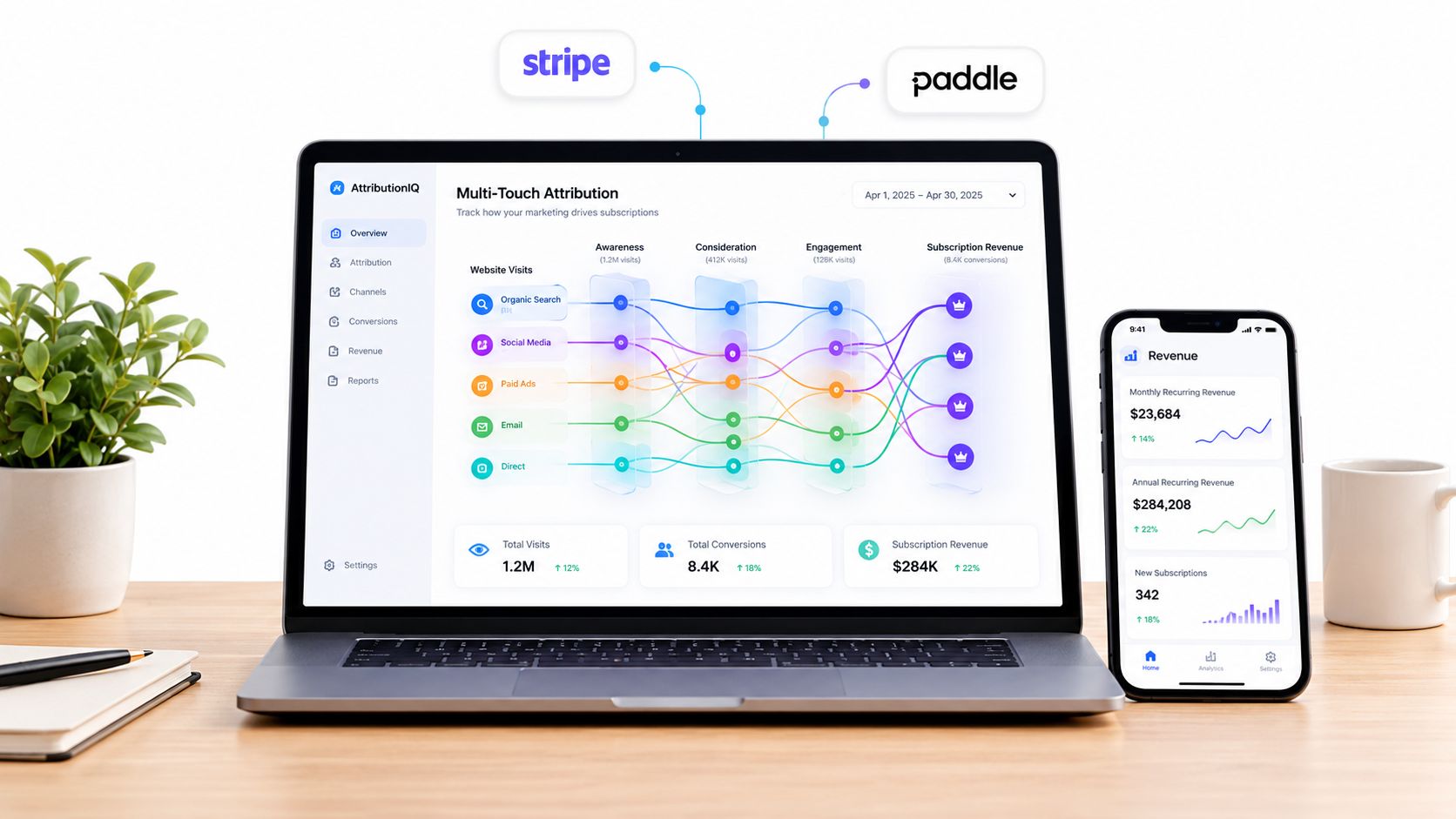
Traffic isn't the same as SaaS revenue. A visit shows that someone arrived. A signup shows interest. A paying customer creates a billing relationship, and recurring revenue shows whether that relationship continues, expands, contracts, or ends. Founders who optimize only for sessions or leads can easily favor channels that look busy while producing few durable subscriptions.
Marketing attribution tools for SaaS should connect marketing sources with those billing outcomes. They should help answer which sources bring paying customers, how acquisition connects to MRR and ARR, and which customer movements explain a change in revenue. Attribution still records relationships rather than proving causation. If a customer arrives through branded search after hearing about a product elsewhere, the dashboard may credit the search touchpoint even though it didn't create demand by itself.
This comparison evaluates Stripe and Paddle compatibility, MRR and ARR reporting, multi-touch versus last-touch models, data accuracy, setup effort, pricing transparency, and fit for small teams. The right choice depends less on the longest feature list than on the SaaS questions your data can support.
Table of Contents
- 1. Chartsy
- 2. Dreamdata
- 3. HockeyStack
- 4. Ruler Analytics
- 5. CaliberMind
- 6. HubSpot Marketing Hub Enterprise Attribution
- 7. Google Analytics 4
- 8. Factors.ai
- 9. SegmentStream
- 10. Adobe Marketo Measure
- Top 10 SaaS Marketing Attribution Tools, Quick Comparison
- Choose the Tool That Matches Your Revenue Data
1. Chartsy
Chartsy suits founders and small SaaS teams that need to connect website visits, signups, paying customers, and subscription revenue without building a warehouse or maintaining complex spreadsheets. Its practical question is which sources produce customers who pay, then how those customers affect recurring revenue over time.
Chartsy connects website and signup tracking with billing data from Stripe, Paddle Billing, and Paddle Classic. Its revenue attribution follows the customer lifecycle from visitor and signup through customer, MRR, revenue, and churn, rather than ending at the first payment. That helps distinguish a source that generates trials from one whose customers continue paying. The underlying SaaS revenue attribution concept is explained in the overview linked later in this article.
The platform reports MRR, ARR, churn, LTV, customer growth, and trial-to-paid performance. It also separates MRR movement into new business, expansion, contraction, and churn. That breakdown makes a revenue decline easier to investigate. Analysts can ask whether new sales slowed, existing customers downgraded, or cancellations caused the change.
Why small teams may choose Chartsy
Chartsy's plain-English AI assistant lets users ask questions and create charts or tables without SQL. Founders can examine acquisition, plans, customers, countries, and supported segments, then save views to dashboards or export reports for investor and operating reviews. These reports show recorded source relationships and revenue movements. They do not prove that a channel caused a purchase or cancellation.
Setup is designed for a small team. Users connect a read-only Stripe or Paddle account, install Chartsy's tracking script, and can start a 14-day free trial with no credit card required, according to the product information supplied for this comparison. The tracking method also limits historical analysis. If the script was not installed before relevant visits and signups, earlier source-to-revenue links may be incomplete.
Best fit: Solo founders, early-stage product teams, and marketing or operations teams that need revenue answers quickly and don't have a dedicated analyst.
Choose Chartsy if your billing stack is Stripe or Paddle, your main question is which sources lead to paying customers, and you want acquisition analysis alongside subscription reporting. Teams using another billing platform should confirm compatibility before setup. Its lightweight approach is more appropriate for direct revenue questions than for complex account-based journeys involving extensive CRM and sales-stage data.
2. Dreamdata
Dreamdata is designed for B2B SaaS companies whose buying journeys involve accounts, multiple stakeholders, CRM stages, and revenue that arrives after several marketing and sales interactions. Rather than focusing only on an individual signup, it models account-level journeys across advertising, web activity, CRM records, pipeline, and bookings or ARR.
That makes Dreamdata a natural consideration for sales-led SaaS and more complex hybrid motions. A content program might influence an account before a sales opportunity exists, while a paid campaign, product interaction, and sales activity appear later. Dreamdata's multi-touch reporting is intended to distribute attention across that journey instead of treating the final identifiable interaction as the entire story.
Where Dreamdata fits
Its capabilities include multi-touch attribution, revenue and content analytics, company identification, and an AI analytics agent for plain-English questions. Company identification can help connect otherwise anonymous website activity to organizations, which is more relevant to account-based SaaS than a simple visit report.
Dreamdata also offers a free tier, giving teams a way to validate whether its account and revenue views answer useful questions before committing to an advanced plan. That lowers the risk of evaluating the concept, but it doesn't remove the implementation work. The platform's value depends on coordinated CRM, advertising, and web integrations, along with reliable account and opportunity relationships.
Dreamdata is better suited to a team asking, “Which touches influenced this account's pipeline and ARR?” than to a solo founder asking, “Which source brought this new subscriber?”
Advanced plans are quote-based, and costs can scale with data scope and volume. A small SaaS team should therefore compare the operational value of account-level reporting with the ownership required to maintain CRM and campaign data. If the business has a short self-serve path and billing data is the main source of truth, a revenue-first product may be simpler. If several people influence each deal, Dreamdata's account journey model becomes more relevant.
3. HockeyStack
HockeyStack targets B2B SaaS go-to-market teams that want a connected view of marketing, sales, and buyer activity. It's particularly relevant when the organization runs account-based marketing, has multi-stakeholder deals, and needs more than a channel-by-channel lead report.
The platform brings web, advertising, and CRM activity into a connected buyer journey and supports multiple attribution models. Its account intelligence and ABM reporting are useful for enterprise SaaS teams where one person's form submission doesn't represent the whole buying group. A campaign may reach several people at the same account, with different interactions occurring before an opportunity is created.
The trade-off is organizational readiness
HockeyStack's AI assistant, Odin, provides narrative analysis and decision support across marketing and sales data. That can help teams move from dashboards to questions such as which accounts engaged with a campaign before entering pipeline, or which channels appear repeatedly in successful journeys. Those questions still require careful interpretation. A model can show that touches and revenue occurred in the same journey, but it can't automatically establish that every credited touch caused the deal.
The platform's positioning and customer examples are strongest for mid-market and enterprise software teams. It also makes SOC 2 availability relevant to organizations with formal security review requirements, though buyers should confirm the applicable package and current documentation directly with HockeyStack.
There's no public price card, so evaluation is sales-led. That can make budgeting harder for a small team and usually signals that the buyer needs an owner for data definitions, integrations, and governance.
Choose HockeyStack when attribution is part of a broader revenue-operations program, not when you simply need a quick answer about which source created a subscriber.
For a founder-led PLG product, its account and ABM depth may exceed the immediate need. For a SaaS company coordinating marketing, sales, and RevOps around complex accounts, the broader platform can justify the added process.
4. Ruler Analytics
Ruler Analytics combines bottom-up attribution with broader planning methods. Its appeal is that a SaaS team can examine identifiable journeys while also using marketing mix modeling, or MMM, for higher-level budget decisions. MTA follows recorded interactions such as clicks and forms. MMM looks at aggregated performance to inform spend planning when individual paths are incomplete.
Ruler supports multiple attribution models, including data-driven and impression-based approaches, and offers budget scenario planning with diminishing-returns analysis. It also connects with advertising platforms, CRMs such as Salesforce and HubSpot, and data warehouses. That breadth makes it useful for a more mature marketing organization that wants to compare channel paths with budget-level planning rather than rely on one model.
More methods also mean more decisions
The main strength is triangulation. If click-path attribution favors one channel but a broader budget model tells a different story, the disagreement becomes a reason to investigate rather than a reason to select whichever dashboard looks better. The broader attribution question is explained in this guide to how source data should connect to revenue.
Ruler publishes tiered pricing with USD amounts, which gives it an advantage over quote-only platforms during early vendor screening. However, the price card doesn't eliminate implementation requirements. Teams still need consistent tagging, clean CRM integration, and agreed definitions for leads, opportunities, customers, and revenue.
Impression attribution and MMM can add useful context for larger campaigns, but they may be unnecessary for a small SaaS team that mainly needs to connect tracked signups with Stripe or Paddle subscriptions. A founder should ask whether the business has enough channel activity and reporting maturity to act on scenario planning.
Ruler is a reasonable choice when the marketing question has two layers: which identifiable touches appear in revenue journeys, and how should the overall budget be allocated? If the immediate problem is disconnected billing data and MRR reporting, a SaaS billing-first tool may provide a shorter route to an answer.
5. CaliberMind
CaliberMind is built for enterprise B2B RevOps environments with complex Salesforce, Marketo, or HubSpot stacks. It combines multi-touch attribution with ABM insights, data unification, ETL, a warehouse layer, and role-based reporting. The platform is intended for organizations where attribution is part of a larger data architecture rather than a standalone marketing dashboard.
Its reporting supports single-touch and multi-touch models across the funnel. The composable approach is important for teams that don't want every result trapped inside a black box. Data can flow toward a BI environment, giving technical teams more control over how objects, custom fields, and business definitions are mapped.
A powerful fit with a heavy starting point
CaliberMind's strength is its ability to accommodate enterprise data models. A company may need to connect contacts, accounts, opportunities, campaign members, product signals, and revenue definitions while preserving role-based access for different teams. That is a different problem from measuring first visits and paid subscriptions for a small product.
The platform also supports B2B marketing mix modeling and custom reporting. Those capabilities can help larger teams compare granular touchpoint attribution with broader investment analysis, but they require data ownership and governance. Implementation includes mapping and stitching enterprise data, not merely switching on a report.
Pricing is quote-based and generally represents an enterprise investment. A small SaaS team should avoid choosing CaliberMind solely because it offers more modeling depth. If the organization doesn't have someone responsible for CRM hygiene, warehouse relationships, and model review, the additional flexibility may create maintenance work without improving decisions.
CaliberMind makes sense when the business already has a serious data stack and needs attribution that can participate in it. It's a poor fit for a founder who wants a lightweight path from a supported billing account to paying-customer and MRR analysis.
6. HubSpot Marketing Hub Enterprise Attribution
HubSpot Marketing Hub is a compelling option when the SaaS team already runs its campaigns, contacts, companies, deals, and marketing assets inside HubSpot. The Enterprise tier includes deal revenue attribution and deal-create attribution, so teams can analyze marketing influence without introducing another attribution database or waiting for an external sync.
HubSpot provides campaign-level attribution cards, model comparisons, and custom reporting across contacts, companies, deals, and marketing assets. For a sales-led SaaS organization whose CRM is well maintained, that native position can make adoption easier. Marketers already work in the system, and sales and operations can inspect results in the same environment.
Native doesn't mean automatically complete
The key limitation is plan access. Revenue and deal-create attribution are Enterprise features, and overall pricing scales with marketing contacts and plan level. A team should also distinguish CRM revenue attribution from subscription revenue analysis. HubSpot may show which activities relate to a deal, but SaaS operators often need billing-level MRR, expansion, contraction, and churn views as well.
A useful distinction is whether the question concerns deal creation or subscription performance after conversion. HubSpot is attractive for the first question when the CRM is already central. A billing-connected platform is more appropriate for the second when the team needs to follow recurring revenue after the deal.
For practical context on preserving source information through signup and billing, see this explanation of marketing revenue attribution. The workflow matters because source data can be lost when a visitor becomes an account or when customer details change.
Choose HubSpot Enterprise when the organization wants native campaign-to-deal reporting and already has the plan, CRM discipline, and sales process to support it. Choose another tool when the priority is lightweight subscription analytics rather than enterprise CRM attribution.
7. Google Analytics 4
Google Analytics 4 is a useful starting point, but it cannot answer every SaaS attribution question. It covers web and channel performance through property-level attribution settings, a data-driven default model, last-click reporting, lookback windows, attribution overviews, and model comparisons for configured events.
GA4 can show which campaigns, landing pages, and channels contribute to visits and conversion events. It also exports data to BigQuery, so teams with engineering support can join web activity to CRM, product, and billing records. That flexibility makes GA4 suitable for building a measurement layer, rather than treating it as a complete revenue system.
The billing gap is the deciding factor
GA4 does not natively provide the account-level and subscription reporting that SaaS operators often need. Connecting a signup with a later Stripe or Paddle outcome requires identity resolution, event design, and billing-data work. Without those links, the report may show a conversion while leaving the team unable to identify which sources produced paying customers, retained revenue, upgrades, or churn.
The distinction between a signup and a subscription outcome matters. A free trial, annual plan, upgrade, or cancellation can change the value of the original acquisition, so acquisition reporting and revenue reporting should not be treated as the same measurement.
GA4 is free to start and has a broad ecosystem, making it practical for early web measurement. GA4 360 targets larger, sales-led organizations, and small teams should not assume it removes the implementation work required for billing-aware analysis.
Choose GA4 when the immediate questions concern sessions, campaigns, landing pages, or event conversions, or when the team can build downstream analysis in BigQuery. Add a billing-connected attribution tool when decisions depend on MRR, ARR, retention, churn, or the sources that create paying customers.
8. Factors.ai
Factors.ai is a B2B marketing analytics and attribution platform with a strong ABM orientation. It combines multi-touch attribution with website visitor and account identification, firmographic segmentation, LinkedIn Ads analytics, CRM synchronization, and rule-based alerts or workflows.
That mix suits a SaaS team that wants to understand not only which campaign generated a form submission, but which organizations are visiting, how those organizations fit the target profile, and whether account engagement is reaching the CRM. The account perspective is especially useful for sales-led or hybrid SaaS motions where several people may interact before a deal exists.
A practical option for early ABM measurement
Factors.ai offers tiered plans, including a Lite option after trial, which gives smaller teams a clearer entry point than entirely quote-based platforms. Still, price is only part of the decision. Data retention and advanced capabilities vary by tier, so a buyer should match the plan to the reporting window and workflows the team requires.
The ABM emphasis can also be unnecessary for a small PLG product where the important identifiers are visitor, signup, account, plan, and billing status. In that case, account identification may add context without answering the central question of which sources create recurring revenue.
Factors.ai is a good candidate when LinkedIn visibility, firmographic segmentation, and CRM-connected account activity are central to growth reporting. It's less direct for a founder who wants built-in subscription metrics and a decomposition of MRR changes. The team should verify how billing data will enter the reporting model before treating it as a complete SaaS revenue attribution solution.
9. SegmentStream
SegmentStream is aimed at mid-market and enterprise SaaS organizations that need cross-channel measurement, conversion modeling, experiments, and budget optimization. Its warehouse-first orientation is useful when a company has mature data practices and wants attribution to work across media, CRM, web, and other business sources.
The platform supports configurable cross-channel attribution models and predictive visit scoring. It also includes conversion modeling intended to address missing conversions and provides LTV-aware metrics. For privacy-constrained environments, modeled conversion data can help teams reason about performance when directly observed clicks or conversions are incomplete.
Strong measurement ambition, substantial data requirements
SegmentStream also emphasizes geo experiments and incrementality testing. Incrementality asks a harder question than “which touchpoint appeared before conversion?” It asks whether changing exposure to a channel changed outcomes compared with an appropriate comparison group. That makes it more relevant to larger budget decisions, but it requires careful experimental design and enough operational maturity to interpret results.
AI and agent connectors, along with warehouse integrations, expand the platform's usefulness for technical marketing and analytics teams. They also raise the implementation bar. A small SaaS company with inconsistent tracking, limited paid media, or no warehouse owner may struggle to use the full system well.
There's no public pricing, and some modules are sold as add-ons through a sales-led process. That makes SegmentStream more suitable for teams evaluating a broader measurement program than for founders looking for immediate billing-connected reporting.
Choose it when the organization needs to compare modeled performance, incrementality, and budget optimization across a mature media operation. If the first unresolved question is which source brought a paying subscriber and how that subscriber affects MRR, a lighter revenue attribution workflow is likely more practical.
10. Adobe Marketo Measure
Adobe Marketo Measure, formerly Bizible, is a mature B2B attribution product within Adobe Experience Cloud. It's best suited to larger SaaS organizations already invested in Adobe and Marketo, with established CRM processes and a need for governed, multi-touch reporting across channels and funnel stages.
The platform supports multi-touch attribution, broad data ingestion, and data warehouse access for granular BI analysis. Integration with Adobe Real-Time CDP can help centralize data for organizations that already operate within that ecosystem. Its enterprise packaging is a meaningful advantage when security, governance, and standardized reporting matter across departments.
The ecosystem determines the value
Marketo Measure is not an obvious first purchase for a solo founder. Pricing is quote-based and generally sold in enterprise tiers, while implementation requires alignment between marketing operations, CRM administration, analytics, and Adobe stakeholders. The platform's value depends on those teams maintaining the data relationships that make touchpoint reporting credible.
The “Ultimate” packaging has an additional workflow consideration. It requires AEP data flows and may not write touchpoints back to the CRM directly, which can affect how sales and operations teams use attribution records inside their normal processes. Buyers should confirm the exact data flow and CRM behavior for their package before assuming that reporting and workflow needs are identical.
For an Adobe-centered SaaS organization, Marketo Measure can provide a governed attribution layer that fits existing investments. For a small subscription business using Stripe or Paddle and seeking fast MRR analysis, the enterprise architecture is likely more than necessary.
Top 10 SaaS Marketing Attribution Tools, Quick Comparison
| Product | Core focus & features | 👥 Target audience | ✨ Unique strengths / UX | 💰 Pricing & ★ quality |
|---|---|---|---|---|
| Chartsy 🏆 | Revenue-first attribution: Stripe/Paddle MRR, churn, LTV; signup→paying customer mapping | 👥 SaaS founders, solo builders, small marketing/ops teams | ✨ Plain‑English AI → charts/tables, read‑only billing, quick setup, dashboard & PDF exports | 💰 14‑day free trial (no card); competitive plans · ★4.5/5 |
| Dreamdata | Account-level multi-touch attribution, pipeline & ARR modeling | 👥 B2B SaaS RevOps, mid-market & enterprise | ✨ IP→company resolution, packaged dashboards, NL AI queries | 💰 Free tier; advanced plans quote-based · ★★★★ |
| HockeyStack | Buyer journey + multi-model attribution with ABM reporting | 👥 GTM teams in mid-market/enterprise SaaS | ✨ ABM reporting, account intelligence, AI assistant (“Odin”) | 💰 Sales-led pricing (no public card) · ★★★★ |
| Ruler Analytics | MTA + impression attribution + MMM (budget planning) | 👥 Marketing teams needing click-path + budget modeling | ✨ MMM scenario planning, broad ad/CRM integrations | 💰 Transparent tiered pricing (published) · ★★★★ |
| CaliberMind | Enterprise RevOps: ETL, warehouse, multi-touch & ABM insights | 👥 Large B2B firms with Salesforce/Marketo complexity | ✨ Composable data layer, enterprise BI-ready, role dashboards | 💰 Quote-based (enterprise) · ★★★★ |
| HubSpot Marketing Hub (Enterprise) | Native deal & multi-touch attribution inside CRM & campaigns | 👥 Teams already on HubSpot needing unified stack | ✨ In-CRM attribution, campaign-level cards, custom reports | 💰 Enterprise tier pricing (contact-based) · ★★★★ |
| Google Analytics 4 (GA4) | Baseline web/channel attribution; BigQuery export for analysis | 👥 All teams as baseline analytics source | ✨ Free ecosystem, model comparisons, BigQuery export | 💰 Free; GA4 360 enterprise quote-based · ★★★ |
| Factors.ai | ABM-focused attribution, website account ID, LinkedIn analytics | 👥 B2B teams focused on LinkedIn & ABM workflows | ✨ Firmographic segmentation, CRM sync, rule-based alerts | 💰 Tiered pricing (Lite available) · ★★★ |
| SegmentStream | Cross-channel attribution + ML conversion modeling & optimization | 👥 Mid-market/enterprise with large paid media budgets | ✨ Conversion modeling for lost conversions, warehouse-first | 💰 Sales-led pricing; add-on modules · ★★★★ |
| Adobe Marketo Measure (Bizible) | Enterprise multi-touch attribution in Adobe Experience Cloud | 👥 Large enterprise SaaS invested in Adobe/Marketo | ✨ Broad data ingestion, AEP integration, enterprise governance | 💰 Quote-based enterprise pricing · ★★★★ |
Choose the Tool That Matches Your Revenue Data
The most reliable way to choose among marketing attribution tools for SaaS is to start with the revenue question, not the brand name. A founder with Stripe or Paddle, a self-serve funnel, and no dedicated analyst usually needs a short path from source to signup to paying customer. That team should choose Chartsy when it wants a lightweight billing connection, source-to-paying-customer visibility, MRR movement analysis, dashboards, and plain-English exploration.
A SaaS company with account-based sales, several stakeholders per deal, and a CRM that already contains meaningful opportunity history may need Dreamdata, HockeyStack, HubSpot Enterprise, CaliberMind, or Marketo Measure. The choice then depends on whether the team values account journeys, native CRM reporting, composable data, or Adobe governance. Ruler Analytics and SegmentStream are better considered when marketing mix analysis, modeled conversions, experiments, or budget planning justify more involved measurement.
Implementation effort should be treated as a product requirement. Independent B2B SaaS guidance places full multi-touch implementations connecting GA4 with HubSpot or Salesforce in the 16 to 24 week range, reflecting integration and governance work rather than a simple software installation, as described in this implementation and attribution tooling benchmark. The same guidance places foundational single-touch setups at $5K to $15K annually with 2 to 4 weeks of implementation, integrated rule-based MTA at $20K to $50K annually with 6 to 12 weeks, algorithmic MTA at roughly $80K to $150K annually, and predictive incrementality or MMM at more than $150K to $300K annually. These figures are benchmarks from the linked guidance, not quotes for any specific vendor.
Compare models only after defining the data
Multi-touch adoption is no longer an edge case. One 2026 industry chart reported that 42% of B2B SaaS companies use multi-touch attribution for partner revenue, compared with 31% using first-touch and 19% using last-touch, according to this B2B SaaS attribution benchmark. MMA Global's 2023 State of Attribution survey also found that roughly 50% of marketers reported using MTA as part of their strategy, while evaluating vendors across actionability, scale, durability, integration, and incrementality in its State of Attribution survey.
Those figures describe adoption, not accuracy. A multi-touch model can distribute credit more broadly while still relying on incomplete tracking, weak identity matching, or a billing definition that doesn't reflect the business. B2B SaaS guidance also cites an average of 266 touchpoints to close a deal, which helps explain why a single-click model can be too narrow for long journeys, but it doesn't prove that every recorded touch caused the sale.
Document the rules before comparing dashboards:
- Source tracking: Decide how UTMs, referral sources, branded search, direct traffic, and self-reported discovery will be recorded.
- Signup identity: Preserve the first visit source through signup with a persistent visitor ID or first-party cookie, rather than relying only on names or emails that can change.
- Billing definitions: Define customer, active subscription, MRR, ARR, expansion, contraction, and churn before judging channels.
- Attribution windows: Set a window that reflects the actual buying journey, then keep it consistent while comparing tools.
- Causation limits: Treat attributed relationships as evidence for investigation, not proof that a channel caused revenue.
A SaaS team using Paddle should also understand what data is available. Paddle Billing provides access to Paddle Billing and Paddle Classic data, while subscription analytics, benchmarks, churn reports, dashboards, and downloadable reports are part of Paddle Billing's documented offering in this Paddle data mapping documentation. That makes Paddle compatibility worth checking at the billing layer, not just at the website analytics layer.
For a practical Chartsy workflow, connect a supported Stripe or Paddle account, install the tracking script, and verify the path from source to signup to customer. Then investigate MRR changes through new revenue, expansion, contraction, and churn. Use the findings to decide what to test next, but don't treat correlation as causation.
Chartsy connects website and signup sources with Stripe and Paddle subscription data so small SaaS teams can see which channels bring paying customers and how MRR changes over time. Visit Chartsy to explore revenue attribution, subscription dashboards, and plain-English analysis without building a separate BI workflow.

Written by
Chartsy TeamAnalytics team at Chartsy
The Chartsy Team writes guides, product updates, and resources to help SaaS and eCommerce founders make sense of their metrics, without SQL or spreadsheets.
Chartsy