
You can have a clean-looking dashboard and still not know which channel brought the customer who pays you every month. That gap is where a lot of SaaS teams get stuck. Traffic looks fine, signups are coming in, but the key question stays open: which sources create paying customers, which ones create recurring revenue, and which ones only look good because they're easy to count.
For a founder or small team, that matters because website analytics stop at the visit or signup, while the business lives in MRR, churn, expansion, and renewals. A channel that drives a lot of free trials isn't automatically the channel that grows revenue. A channel that looks weak in last-click reports might be bringing in the accounts that expand later.
Marketing revenue attribution is the attempt to connect those dots without fooling yourself. It's useful, but it's not magic. Attribution can assign credit to touchpoints that came before a conversion, yet it can't prove causation by itself, so the number on the report still needs judgment.
If you run SaaS without a dedicated analyst, the practical problem is simple. You need to know which sources create customers, how those customers affect subscription revenue over time, and whether your measurement setup is trustworthy enough to act on. That's what the rest of this guide is built to clarify.
Table of Contents
- What Marketing Revenue Attribution Means for SaaS
- Attribution Models Compared and When to Use Each
- Data You Need to Link Marketing to Paying Customers and MRR
- How to Implement Marketing Revenue Attribution Without an Analyst Team
- How Chartsy Simplifies SaaS Revenue Attribution in Practice
- Common Pitfalls and How to Verify Your Attribution Results
What Marketing Revenue Attribution Means for SaaS
Think of attribution like following a customer through a chain of events, not just counting the final step. A person sees a post, visits the site, signs up, starts paying, and later renews or upgrades. Marketing revenue attribution is the process of linking those earlier touchpoints to the revenue outcome so you can see which sources mattered along the way.
From first touch to recurring revenue
For SaaS, the useful unit isn't just a lead. It's the path from first visit to signup, customer, MRR, and churn. That's why SaaS attribution needs to look beyond the form fill and keep tracking after the account exists, because the business question is about revenue, not just traffic.
A helpful mental model is a receipt trail. The first touch is the place where discovery started, but the “real receipt” is the billing event and the subscription that follows. If you only look at the first pageview, you miss the part that matters most.
Practical rule: If a channel helps a trial start but never turns into paid usage, it's not the same as a channel that consistently produces customers who stay.
The distinction between attribution and incrementality matters here. Attribution assigns credit to touchpoints that preceded a tracked conversion. Incrementality asks a different question: whether the channel caused extra revenue compared with a credible control group. In other words, attribution is about credit, incrementality is about lift.
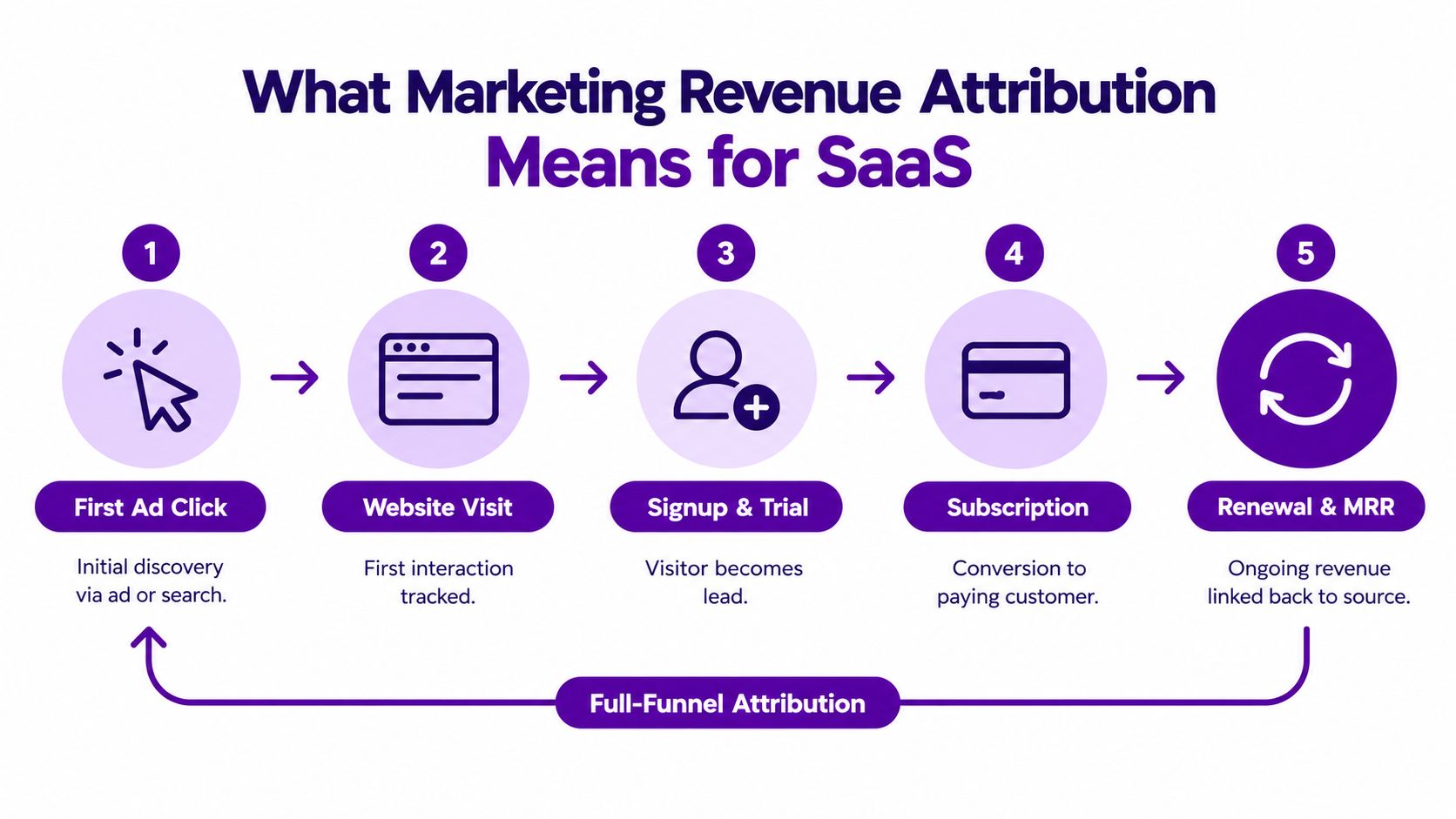
A useful technical clue is how far back you examine the path before signup. In one publisher study, about 10,000 subscriptions over 20 weeks were tied to sections or articles viewed in the seven days before signup, which shows why the analysis window matters when you want revenue attribution to reflect real pre-conversion behavior rather than only the last click (Chartbeat research).
The cleanest mental model is this. Attribution is a way to assign credit across the journey, then roll that journey forward into subscription revenue. It's not a verdict on truth. It's a structured way to ask better questions about how marketing becomes revenue.
Attribution Models Compared and When to Use Each
Different attribution models answer different SaaS questions, and the wrong one can distort the decision in front of you. A founder asking which channel created a trial, which one closed the customer, and which one helped expand MRR needs a model that matches that question, not a generic traffic report. The shift from single-source tracking toward multi-touch models reflects how messy buyer journeys have become, and Ruler Analytics attribution stats reports that multi-touch approaches are widely preferred, while last-click remains the most-used model among 41% of marketers surveyed.
The main trade-offs
First-touch tells you what introduced the brand. Last-touch tells you what was closest to the conversion. Multi-touch spreads credit across several interactions, while data-driven models try to infer patterns from observed journeys. None of them gives the whole picture on its own.
For SaaS founders, the question is usually not which model is perfect. It is which model answers the decision you are trying to make. If you want to know what creates awareness, first-touch is useful. If you want to know what closes the signup, last-touch is blunt but clear. If you want a broader view of what influenced the customer journey, multi-touch is usually more honest.
| Attribution Models at a Glance for SaaS Teams | Model | How Credit Is Assigned | Best For | Limitation to Watch |
|---|---|---|---|
| First-touch | First interaction gets all the credit | Awareness and source discovery | Hides what happened later |
| Last-touch | Final interaction gets all the credit | Conversion-trigger analysis | Ignores the earlier journey |
| Multi-touch | Credit is shared across interactions | Broader journey visibility | Can feel abstract without good data |
| Data-driven | Credit is inferred from observed behavior | Mature teams with strong tracking | Depends on data quality and volume |
The history helps explain the confusion. Marketing mix modeling can be traced to mid-20th-century advertising research and became more common as marketers tried to understand cross-channel impact more fully. Chartsy's attribution concept guide is a useful reference for the SaaS-specific workflow, especially if you want a practical way to connect attribution to subscriptions rather than impressions alone. Single-touch reporting is often too thin for subscription businesses because it hides the path from first visit to paying customer, then to later MRR movement.
Good heuristic: If your team is asking “where did this customer come from?” use a simpler model. If your team is asking “which mix of channels consistently creates paying customers?” you need broader attribution.
A founder does not need to start with the most advanced model. Start with the question, match the model to that question, then check whether the result still makes sense against your signup and billing data.
Data You Need to Link Marketing to Paying Customers and MRR
Attribution only works when the data plumbing is solid. The model matters, but the inputs matter more. If you lose the source at signup, or you can't match the signup to billing, the whole chain breaks and the report starts telling a story you can't trust.
The path has to stay connected
The minimum viable path is straightforward. Capture the first visit source, preserve it through signup with a persistent visitor ID or first-party cookie, then match the account to billing data in Stripe or Paddle so later subscription outcomes can be rolled back to the original source (Chartsy SaaS revenue attribution).
That path is what lets you move from “this campaign brought traffic” to “this campaign brought customers who became revenue.” Without that bridge, marketing and finance end up arguing from different spreadsheets. With it, you can at least talk about the same account history.
Billing data also needs to be read as movement, not just totals. For SaaS, MRR changes come from new MRR, expansion MRR, contraction MRR, and churned MRR, and net revenue retention is commonly expressed as starting MRR plus expansion minus churn and contraction, divided by starting MRR, then multiplied by 100 (SaaS metrics reference).
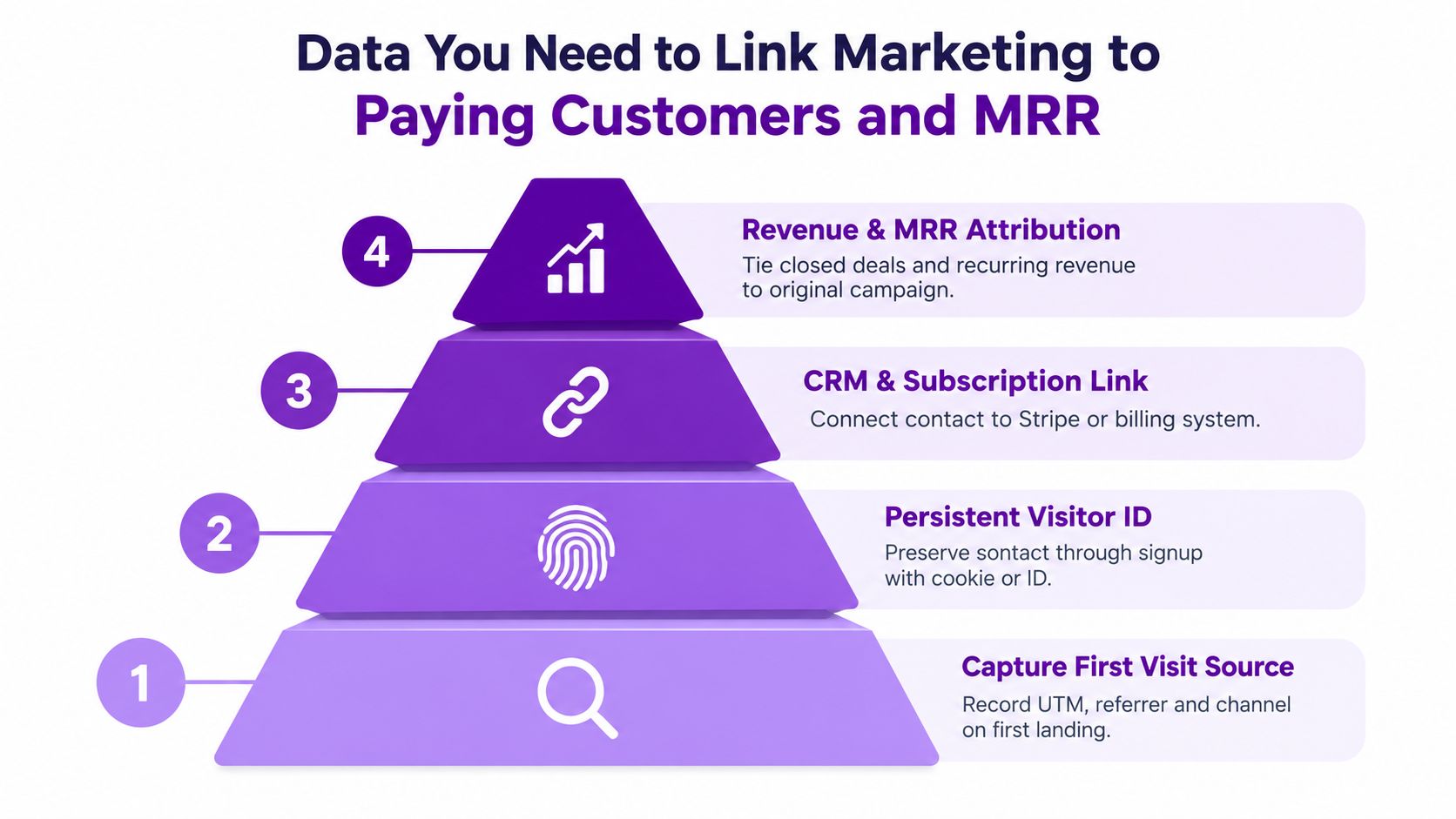
The useful takeaway is that revenue attribution shouldn't stop at the first payment. It should show how original acquisition sources connect to later subscription outcomes, including upgrades, downgrades, and cancellations. That's the part that tells you whether a source is bringing in durable customers or just short-lived signups.
Data-first rule: Fix identity resolution and event tracking before you argue about the model. A bad pipeline with a fancy model is still a bad pipeline.
If you're checking whether your setup can support revenue attribution, the practical benchmark is simple. You should be able to answer, from one account record, where the visitor came from, how signup happened, which billing system holds the subscription, and how that subscription changed over time. For a deeper walkthrough of source tracking, the guide at UTM tracking connected to revenue is the most relevant next read.
How to Implement Marketing Revenue Attribution Without an Analyst Team
Small teams don't need a giant measurement program. They need a sequence they can finish. Start with the business question, then wire the data, then check whether the numbers behave like reality.
A workable sequence for a small SaaS team
First, define the conversion event you care about. For some SaaS products that's a trial start, for others it's a paid signup or a booked demo that reliably leads to payment. If you can't name the conversion clearly, every report after that will wobble.
Next, standardize your channel taxonomy. Decide what counts as paid social, organic search, referral, partner, direct, or email, and keep that naming consistent across campaigns and forms. If one person tags the same source three different ways, attribution turns into cleanup work.
Then connect the billing system and verify the identity handoff. Stripe and Paddle data should line up with the visitor or account record so you can see source-to-revenue paths without manual stitching. That's also where read-only access matters, because the point is analysis, not changing billing records.
Here's a short readiness checklist you can use:
- Conversion event defined: You know which action counts as a meaningful step toward revenue.
- Source capture in place: First visit data is stored when the visitor lands.
- Billing connection works: Subscription data is coming from Stripe or Paddle.
- Identity handoff survives signup: The visitor record still matches the account.
- Dashboard is readable: A founder can inspect the chart without a SQL query.
Plain-English exploration helps here. Tools that let you ask questions in natural language and get a chart or summary back are a strong fit for founders and operators who don't want to maintain SQL or a BI layer (no-SQL SaaS analytics overview). That matters most when marketing, finance, and operations all need the same answer quickly.
A final checkpoint is whether your reports reflect invoices and subscriptions, not just exports. Paddle's Metrics feature is included with Paddle Billing and covers subscription analytics, benchmarks, and churn reports, which is useful when you want recurring-revenue reporting without building the whole layer yourself (Paddle billing analytics overview).
How Chartsy Simplifies SaaS Revenue Attribution in Practice
Some teams need a shared place where traffic, signups, customers, MRR, and churn can be looked at together without a separate analyst building everything by hand. Chartsy is one option for that workflow, because it connects website acquisition sources to signups and billing data, then lets you inspect recurring revenue by source, plan, customer, and country through plain-English analysis and charts. It supports Stripe, Paddle Billing, and Paddle Classic, which makes it relevant for SaaS teams that already keep subscription data in those systems.
Where it fits and what it helps answer
The practical value is not just “seeing traffic.” It's being able to ask which source brought the paying customer, then follow that account into MRR and churn reporting. If a founder wants to compare paid search against organic or partner referrals, the useful question is whether those sources produced customers with durable subscription revenue, not just visits.
That becomes more valuable when you need quick answers across segments. A small team might want to compare performance by plan, customer group, or country without writing SQL. Chartsy's plain-English interface is built for that kind of review, and saved dashboards make it easier to keep those checks recurring instead of rebuilding them every time.
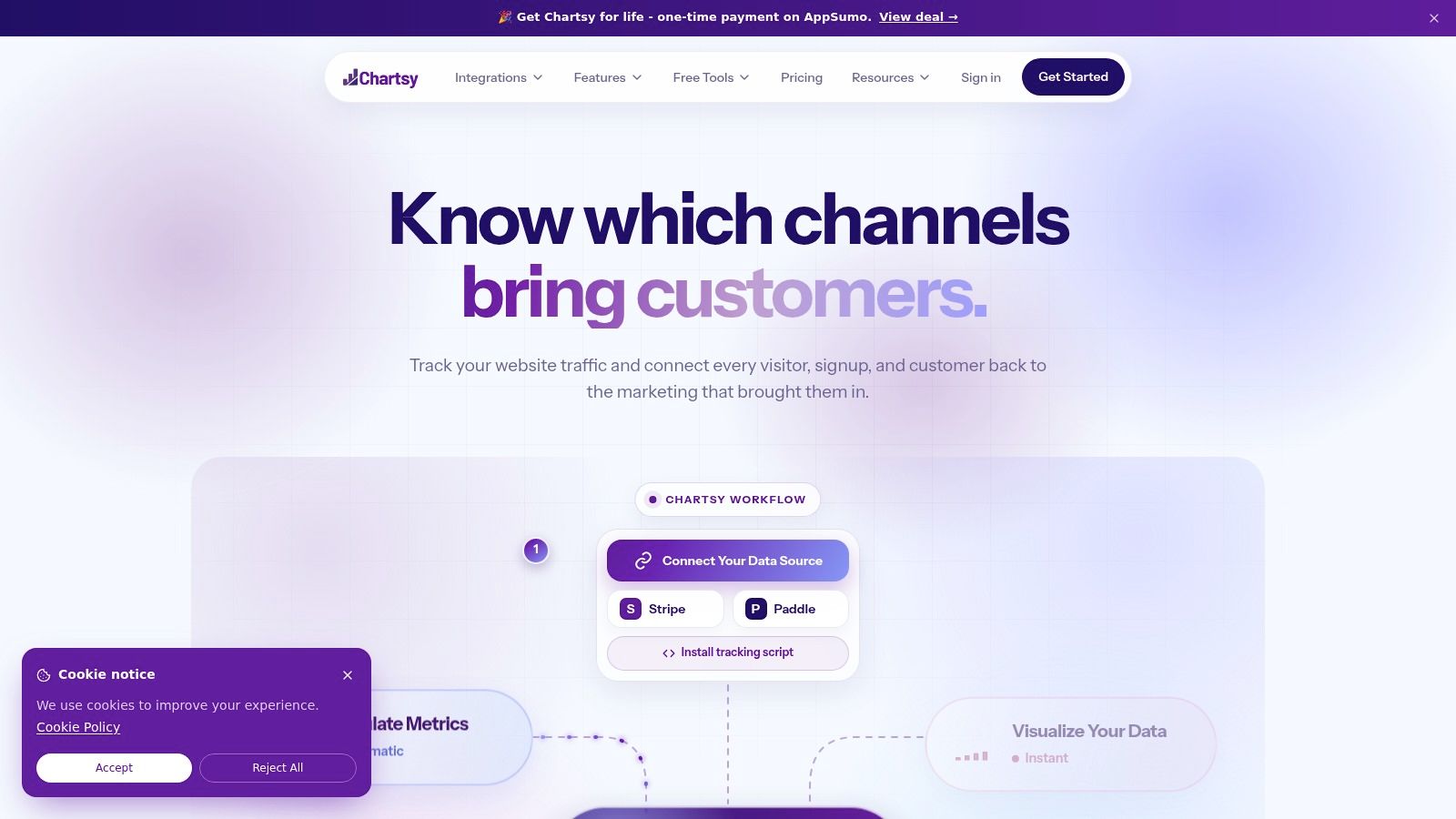
The best fit is a team that already has website tracking and billing data, but doesn't have the time or headcount to maintain a bespoke analytics stack. That's especially true when the recurring question is, “Which acquisition sources lead to paying customers and subscription revenue?” If you need that answer weekly, not quarterly, the workflow needs to stay simple.
The product page at Chartsy's growth attribution feature is the relevant place to look if you want the feature-level view of how acquisition and billing are connected.
Useful filter: If a tool can't help you connect source to signup, and signup to billing, it's not doing revenue attribution. It's doing traffic reporting with extra steps.
Common Pitfalls and How to Verify Your Attribution Results
The biggest attribution mistakes usually come from assuming the data is cleaner than it really is. Privacy changes, identity loss, and cross-device behavior can all create gaps, and recent coverage has also noted that AI-search referrals may show up as direct or branded-search traffic instead of being credited to the discovery moment itself (attribution gaps and privacy coverage).
How to sanity-check the numbers
Start by auditing identity resolution. If a visitor becomes a signup, then a customer, then a churned account, you should still be able to trace that path in one system or one joined view. If you can't, the report might be mixing separate people together or losing the original source entirely.
Then review your event instrumentation and channel taxonomy. A surprising number of problems are really tagging problems, not model problems. A spreadsheet full of manually reported channels can also hide gaps that make the final dashboard look more precise than it is, especially when teams are still stitching attribution together by hand (attribution reporting gaps summary).
Platform totals also need skepticism. Summed conversions from ad platforms can exceed CRM reality, so don't treat platform-reported success as proof that revenue happened. When the question is whether a channel added revenue, incrementality checks are the safer companion to attribution.
Verification habit: Pick one source, one signup, and one paid account. If you can't follow that path cleanly end to end, don't scale the report yet.
A practical next step is simple. Connect billing, validate one source-to-revenue path, and build one dashboard you'll use every week. If the result is clear enough to explain without a spreadsheet war, you're close enough to make decisions from it.
If you want a simpler way to connect acquisition, subscriptions, MRR, and churn in one place, Chartsy is built for that workflow. It helps SaaS teams trace paying customers back to source, then review recurring revenue with plain-English analysis instead of manual spreadsheet work.

Written by
Chartsy TeamAnalytics team at Chartsy
The Chartsy Team writes guides, product updates, and resources to help SaaS and eCommerce founders make sense of their metrics, without SQL or spreadsheets.
Chartsy