A tier price is the number attached to one package in a tiered pricing model. The same product comes in several packages, and each one differs by usage limits, features, or level of service. Think of a coffee shop board with small, medium, and large cups, each with its own price. Nobody buys more coffee than they want, and nobody pays for a size they won't finish.
Table of Contents
- Tier Prices Explained with Everyday Examples
- The Three Ingredients Inside a Tier Price
- What a Single Price Leaves on the Table
- Why Buyers Gain from a Lower Entry Point
- When the Ladder Stops Working
- What Separates One Tier from the Next
- Packages Versus the Pricing Strategy
- A Subscription Software Example
- Everyday Tiers You Already Recognize
- The Same Pattern in Cloud and Business Software
- Where Subscription Software Adds a Second Dimension
- How to Read Any Pricing Page
- Signals That Point Toward Tiers
- Where Tiers Go Wrong
- Tiered Pricing Compared with Flat and Usage-Based Pricing
- Separate Expansion from New Customer Revenue
- Connect Billing Events with Customer Behavior
- Is a Tier Price the Same as Price Discrimination?
- How Many Tiers Should a Business Offer?
- Does Tiered Pricing Hurt Smaller Customers?
- When Should Tier Boundaries Be Reviewed?
- Can AI Help Evaluate Tier Pricing?
Tier Prices Explained with Everyday Examples
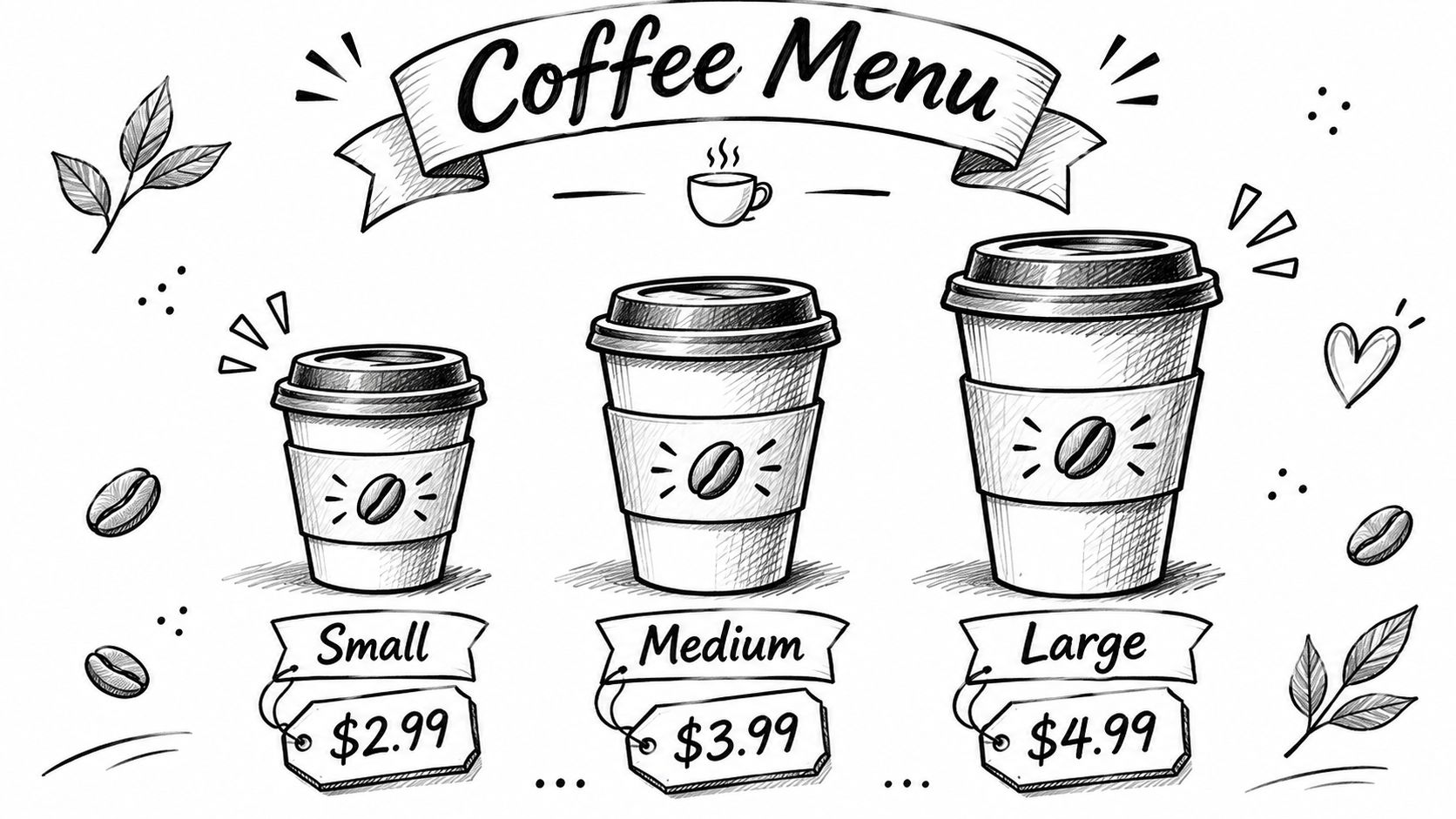
Tiered pricing takes one product and cuts it into a short ladder of options. Each rung is a tier, and the figure on its price tag is the tier price.
You see this well beyond the coffee counter. Airline cabins, cloud storage plans, gym memberships, and most software subscriptions you've paid for all follow some version of the same idea.
A tier price usually bundles three ingredients at once. Pull them apart, and any pricing page becomes much easier to read.
Tier Pricing at a Glance
Here's a quick reference for what sits behind each number. Keep it handy the next time you compare plans.
| Element | What It Answers | Why It Matters |
|---|---|---|
| Usage limit | How much can a customer consume | Sets the ceiling on what the tier allows |
| Feature access | What can a customer do | Separates basic tasks from advanced work |
| Service level | How much help comes with it | Higher tiers carry faster or deeper support |
Once you know what each row answers, the prices stop looking arbitrary. A jump in cost almost always means one of these three has grown.
The Three Ingredients Inside a Tier Price
Usage comes first. It answers how much of the product someone can consume, whether that means seats, projects, storage, or monthly events.
Features come next. Higher tiers unlock capabilities the lower ones hold back, such as deeper reporting, extra integrations, or team permissions.
Service comes last. Faster support, onboarding help, and account reviews tend to ride along with the top package rather than the entry one.
A tier price is a published choice, not a negotiation. That's why a pricing page reads like a menu rather than a quote.
The gaps between tiers matter more than the names on them. Starter, Growth, and Premium mean little by themselves. What counts is the measurable difference behind each label.
Buyers get room to start small and move up later. Sellers get a way to serve heavy users at a higher price without pricing out the ones still finding their feet.
Chartsy's plans follow this shape, with monthly event tiers running from 10,000 up to 1 million and beyond. A slider updates the price as you move along it.
The rest of this guide moves from the label to the mechanics. It covers how tiers get built, where tiered pricing already surrounds you, when the model suits a business, and how to check whether your tiers are working.
Most customers don't share the same budget, usage, or appetite for support. A two-person team and a fifty-seat company might both want your product, but they care about very different extras.
A single price forces a hard trade-off. Set it high, and you shut out budget-conscious buyers. Set it low, and your heaviest users pay less than the product is worth to them.
Tiers get you out of that bind. The lower package gives smaller customers a real way in. The higher one asks more from people who need extra capacity, features, or hands-on help.
Think of a restaurant with three menus. The set lunch covers a quick meal. The standard dinner adds more courses. The chef's tasting menu is for guests who want the whole experience and are happy to pay for it.
Nobody gets charged for dishes they won't eat. That's the logic behind a tier price. Each package has its own number, and the buyer picks the one that fits their appetite and budget.
What a Single Price Leaves on the Table
When everyone pays the same amount, you lose out in a couple of ways at once.
- Light users leave because the price assumes more usage than they need.
- Heavy users stay, but you collect less than they'd happily pay for a richer package.
- Support-heavy accounts get the same help as self-serve ones, so your service costs climb without a matching price.
Tiers separate these groups instead of averaging them out. The entry plan stays affordable, and the top plan charges for seats, usage, or faster support that only some buyers actually need.
Tiers work when the price gap reflects a real difference in value, not when the package names are the only thing that changes.
Why Buyers Gain from a Lower Entry Point
It's not just the seller who benefits. A small team can start on a modest plan rather than waiting until it can justify an all-inclusive price.
That lower door matters a lot for subscriptions. People can try the product, see what they really use, and move up once the need is obvious. Upgrading feels like a decision they made, not a penalty for starting small.
Published prices help, too. Buyers can see what they gain by moving up and what they give up by staying put. A hidden quote never offers that kind of clarity.
If you want to dig deeper into matching those gaps to customer value, check out our guide on value-based pricing for SaaS.
When the Ladder Stops Working
Tiers fall apart when the menu is hard to read. Too many nearly identical packages make people hesitate, and hesitation kills the sale.
Big price jumps that don't line up with extra value cause the same problem. If the next tier costs much more but adds little a buyer can point to, upgrades stall and trust erodes.
Keep the packages few, the differences concrete, and the gaps fair. That's when a tier price becomes a clear choice instead of a puzzle.
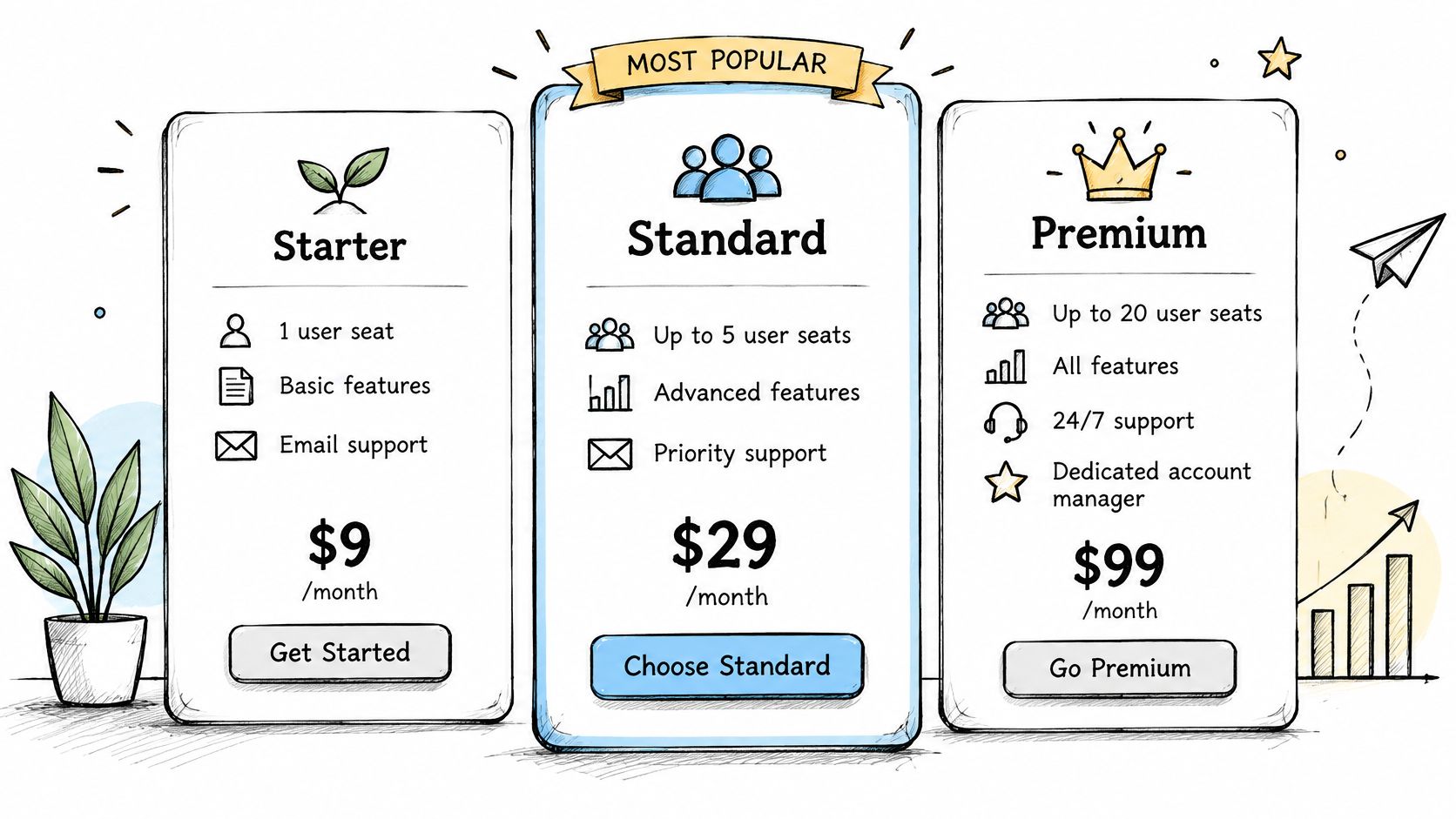
Software suits tiered pricing well, and the reason is simple. You build the product once, and each extra customer costs you very little to serve. That makes it practical to run one system for a wide range of buyers.
Think of it like a coffee shop menu with small, medium, and large cups. The small cup gets people through the door, the medium cup is what most regulars order, and the large cup is for the customers who want more. Each size is the same drink, just scaled to what the buyer needs.
In practice, the starter tier is the low-risk entry point. The middle tier usually captures the largest group of customers. The premium tier is for buyers with bigger needs, such as more seats, heavier usage, or faster support.
What Separates One Tier from the Next
Most pricing pages adjust the same few levers. Once you learn to spot them, the logic of a page becomes much easier to read.
- Usage limits cap how much a customer can consume, whether that's events, storage, or projects.
- User seats determine how many people can share one account.
- Feature access keeps advanced tools locked until a higher plan.
- Integrations control which other systems can connect.
- Reporting depth sets how far a buyer can dig into their own data.
- Support levels range from self-serve docs to faster replies or a dedicated contact.
A good pricing page does more than rename the plans. If only the labels change and the contents stay vague, buyers have no idea what they're actually paying for.
Packages Versus the Pricing Strategy
These two ideas get mixed up a lot, so it helps to separate them. Tiered pricing describes how your packages are structured. Pricing strategy describes how your overall price levels are set and which customers you're aiming for.
Structure tells you what goes in each box. Strategy tells you who the box is for and what it should cost.
When the two blur together, a pricing page becomes hard to evaluate. You might admire the package design and still choose the wrong numbers. Keeping them apart lets you fix one without breaking the other.
This service-pricing guide is a helpful reference if you want to see how price levels can be built around value and buyer confidence, including setting a cost floor for services.
A Subscription Software Example
Chartsy is a good illustration of how usage and plan level can fit inside one structure. Here, plans are priced on tracked website events rather than on revenue.
The Starter plan begins at $9 per month and includes 10,000 events, 2 websites, and 2 billing sources. The Growth plan begins at $29 per month and adds room for more sources and sites.
Both plans follow the same event ladder, which makes the trade-offs easy to compare:
| Events per Month | Starter | Growth |
|---|---|---|
| 10,000 | $9 | $29 |
| 100,000 | $29 | $49 |
| 500,000 | $59 | $109 |
| 1,000,000 | $79 | $149 |
Move the slider and the price updates right away. On day 14 of the trial, you land on the plan and event tier you chose.
That split is the anatomy of tiered pricing in practice. Both pieces, the plan level and the usage level, belong on the same page.
See how price, churn, and fees interact in our guide on pricing a SaaS product.
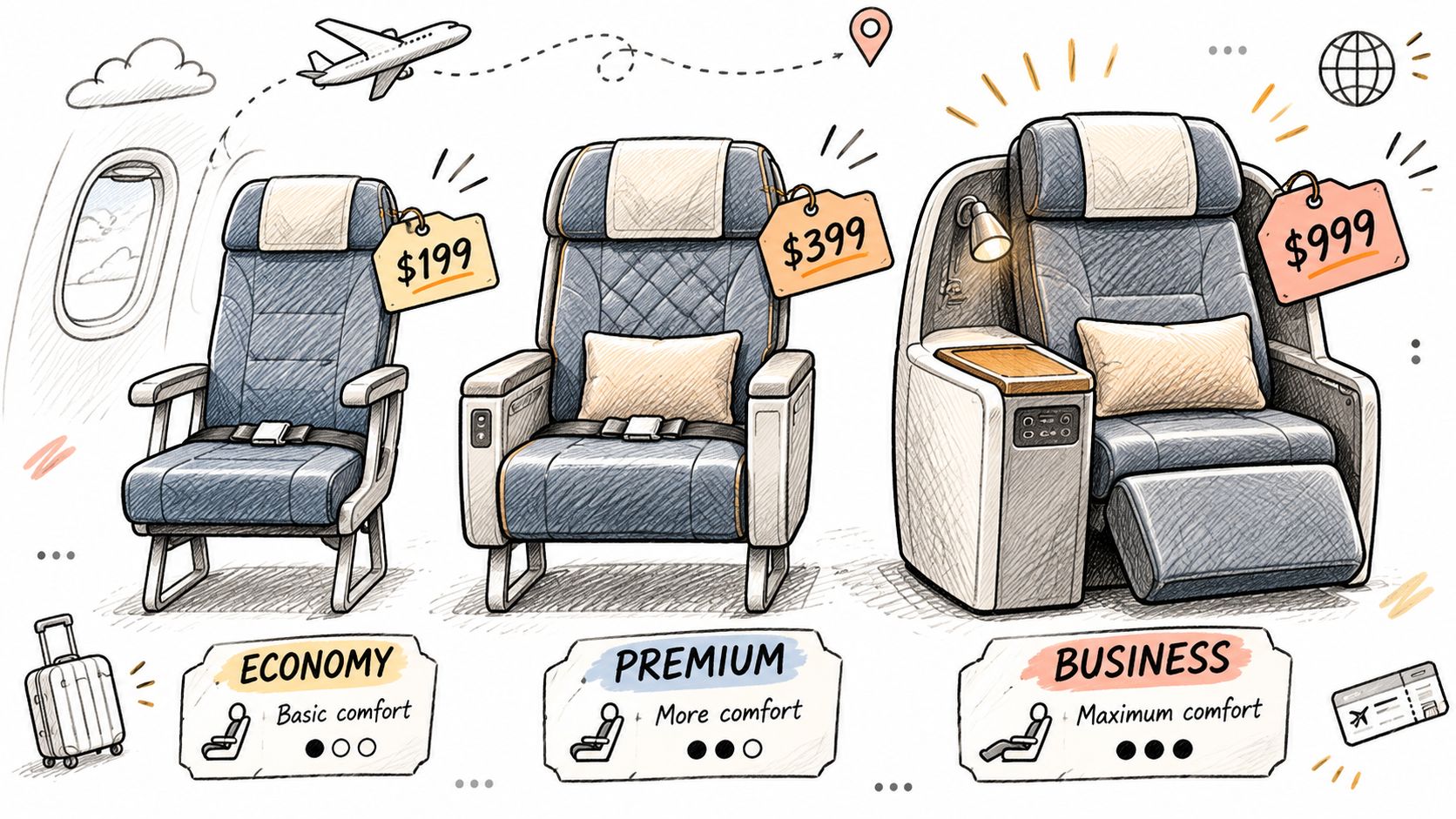
Air travel makes tiered pricing easy to spot. One plane, one route, several cabins, and each seat category carries a different fare.
No one expects every passenger to get the same experience. A consultant on a work trip may pay for legroom, lounge access, and a ticket that can change without a penalty, while a holiday traveler chooses the cheapest acceptable seat. The airline is selling comfort and freedom in bundles, which is what a tier price looks like once it leaves the spreadsheet.
Everyday Tiers You Already Recognize
Once the pattern clicks, you start seeing it all over the place:
- Cinemas charge extra for recliners, premium rows, or a better view.
- Student discounts and family plans change the price based on who is buying.
- Cloud storage plans raise the allowance as you move up.
In each case, only one variable really moves: comfort, eligibility, or access. The core product stays familiar.
The Same Pattern in Cloud and Business Software
Cloud computing follows the same logic. A higher monthly plan may allow more users, more projects, or faster answers from support.
Business subscriptions do it too. The entry plan might cover one person doing focused work, while the next level adds seats, admin controls, and priority help.
Storage labels such as hot and cool in cloud platforms are technical settings, separate from the pricing package. Check the plan name and limits if you want the commercial tier.
Where Subscription Software Adds a Second Dimension
Subscription software usually blends two ideas at once. One is a measurable usage unit, such as events, seats, or projects. The other is the feature set or service level attached to the plan.
Chartsy makes the split easy to see. Its monthly event tiers run from 10,000 up to 1 million or more, while the Growth plan supports up to 20 connected data sources and 20 websites.
Usage sets how much you can do. Plan level sets what you can do with it.
How to Read Any Pricing Page
Most pricing pages can be decoded in under a minute. Start with the cheapest plan, then move up one step and ask what changed.
- Find the usage limit that increases between tiers.
- Check which features or support options open at each level.
- Decide whether the price jump matches value you would actually use.
Prices will move over time, and package names come and go. The structure is more stable. If you can explain the difference between two neighboring plans in plain language, you already understand what a tier price buys. On the next pricing page you open, the useful question is simple: what does the next step give me that this one cannot?
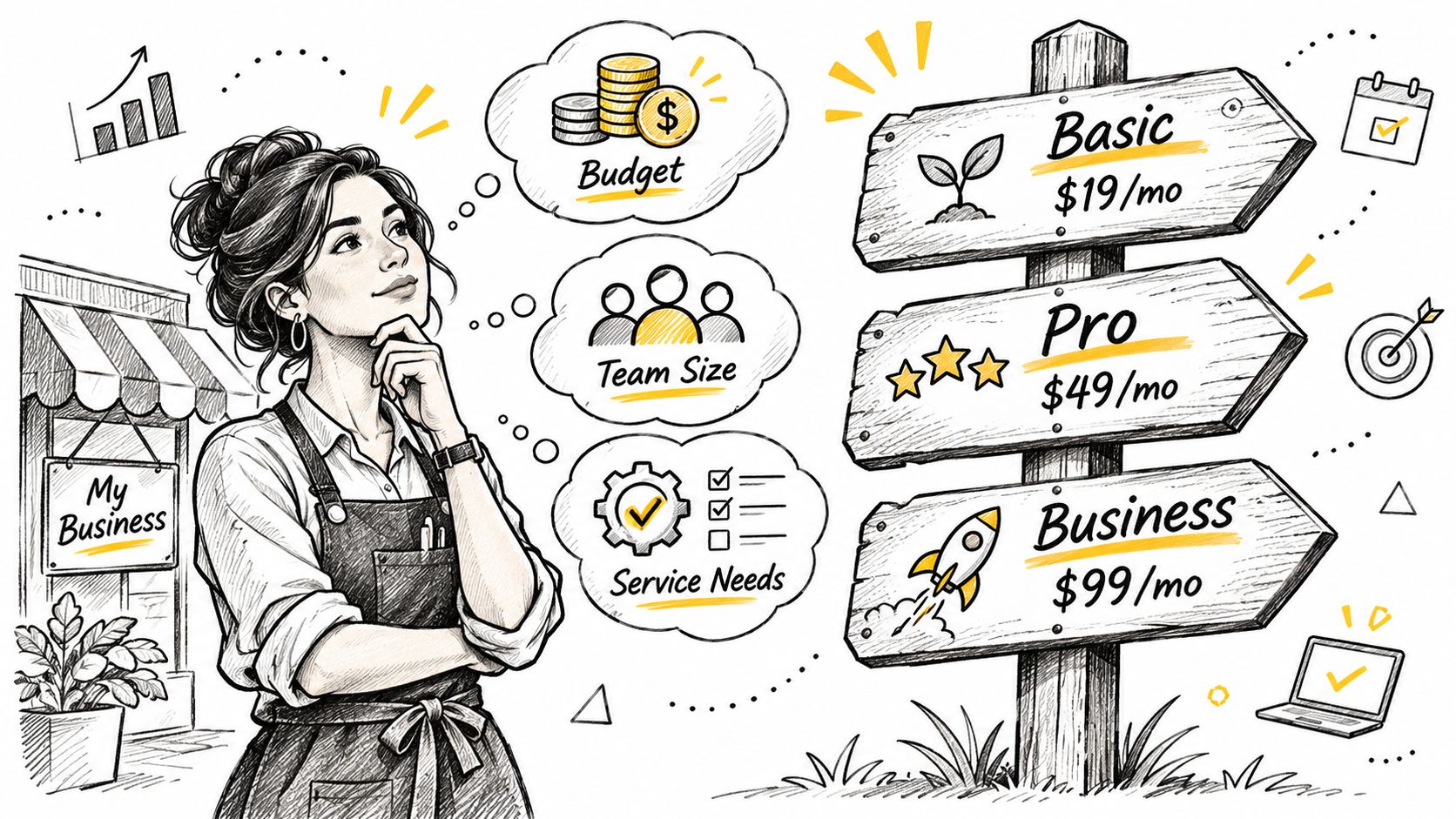
A tiered pricing structure is a choice, rather than a default. Before building a ladder of packages, check whether customer needs and operating costs can support one.
Signals That Point Toward Tiers
A few clear signs suggest the model will earn its keep.
- Buyers differ in real ways. Some need two seats, others need forty, and budgets usually follow that split.
- Delivery costs stay manageable. Each new customer adds little expense, so lower tiers can still make money.
- You can name the usage unit. Seats, projects, or monthly events give buyers a meter they already understand.
- You can report by plan. Revenue and retention need to be visible per tier, rather than only in total.
If most of those boxes stay empty, a flat price may serve you better. Tiers reward variety and punish businesses where every buyer wants the same thing.
Memberships, cloud services, and subscription software fit naturally because customers can pick a package without a sales call.
Where Tiers Go Wrong
A pricing page fails when buyers cannot tell two plans apart in one sentence.
Three mistakes cause most of the damage.
- Too many packages. Six near-identical options create hesitation, and hesitation turns into a lost sale.
- Gaps that ignore value. If the next step costs far more while adding little a buyer can point to, upgrades stall.
- Discounts dressed as tiers. A plan that exists only to lower the price, with no added capability, erodes trust.
Keep the packages few and the differences concrete. Every step should answer a need the buyer can name.
Tiered Pricing Compared with Flat and Usage-Based Pricing
The right model depends on how predictable demand is, how different buyers really are, and how much explanation the sales motion can handle.
| Pricing Model | How Customers Pay | Best Fit | Main Risk |
|---|---|---|---|
| Tiered | A fixed price per package | Buyers with distinct needs | Gaps that miss real value |
| Flat | One price for everyone | Similar, simple usage | Losing price-sensitive buyers |
| Usage-based | Only for what they consume | Unpredictable demand | Bills that scare off buyers |
Choose tiers when the packages answer different needs, rather than when you simply want more price points. If your buyers look alike and your costs barely move, a single price is easier to explain and easier to sell.
Put your middle package in front of a few buyers and listen for the questions. If they ask what changes between plans, the tiers need work. If they ask which one fits their team, you are on the right track.
Your pricing page tells visitors what they can buy. Plan-level reporting tells you whether those options are working, meaning whether they bring in revenue, keep customers around, and encourage people to spend more over time.
Think of total monthly recurring revenue (MRR) as a scoreboard. A flat score can hide a lot. Your entry tier might be losing customers while a handful of premium upgrades quietly cover the gap.
Measure the movement between tiers, not just the number of subscriptions.
Each month, it helps to review a few signals separately:
- MRR by plan shows where recurring revenue actually sits.
- Customer distribution shows whether most subscriptions cluster in one package.
- Upgrade and downgrade flow separates expansion from contraction.
- New customers by plan shows which packages attract buyers.
- Churn rate by plan shows where customers leave.
- Average customer lifetime by plan gives context to retention and customer lifetime value.
Use the same reporting period for every comparison. Keep new arrivals separate from existing customers who switch plans, too. Otherwise, a rising count on your premium plan can look like a sales win when it's really current customers moving up.
Separate Expansion from New Customer Revenue
Picture a small business with 100 customers paying $20 a month. Its starting MRR is $2,000, assuming everyone stays active.
Now imagine 10 of those customers upgrade to $50 a month. Nobody new signs up, nobody cancels, and there are no discounts or other changes.
| Scenario | Calculation | MRR |
|---|---|---|
| Before upgrades | 100 × $20 | $2,000 |
| After upgrades | 90 × $20 + 10 × $50 | $2,300 |
That $300 increase comes entirely from expansion. A subscription count would miss it completely, since the business still has 100 customers.
Higher prices don't automatically make a tier healthier, though. A price increase can lift revenue right away and still push people out the door a few months later. That shortens customer lifetimes and eats into future revenue.
Compare the customers affected by the change with earlier groups over similar periods. Look at refunds and downgrades alongside cancellations before deciding the change worked.
- Note when the price or package changed.
- Review revenue movements and retention for each affected plan.
- Reassess after several renewals, not just the first invoice.
Connect Billing Events with Customer Behavior
Chartsy separates new revenue, expansion, contraction, and churn in its reporting, and its Pricing & Plans template includes plan-level revenue and retention views. You can dig into these movements with the pricing and plan mix prompts.
Before you touch another tier price, line up your recent billing events against what customers actually did. Who upgraded, who downgraded, and who left? Pick the plan that's struggling most, find its biggest revenue leak, and let that finding shape your next pricing test.
Is a Tier Price the Same as Price Discrimination?
Not quite. Tier pricing sorts your offer into packages at different levels, while price discrimination means charging different people different prices for essentially the same thing. Tiers can separate buyers by need or budget, but a student discount is not the same as Starter, Standard, and Premium plans because eligibility changes while the product scope stays close.
How Many Tiers Should a Business Offer?
For most companies, two to four clearly different tiers beat a long menu. Each level should add real value through usage, features, or service rather than cosmetic differences. When plans look nearly identical, buyers end up comparing line items instead of finding a better fit.
Does Tiered Pricing Hurt Smaller Customers?
It does not have to. A good entry tier gives a small team affordable access to something genuinely useful, while a higher plan supports heavier operations. The Starter package should still solve a meaningful problem, not feel like a gated version built to push an upgrade.
When Should Tier Boundaries Be Reviewed?
Check them on a regular cycle, then revisit sooner if customer behavior shifts. Watch a few signals closely:
- New subscriptions by plan
- Upgrades and downgrades
- Cancellations and churn by tier
- Revenue per plan
- How quickly entry-level customers hit limits
If most Starter users run into the ceiling right away, the boundary may need more room, clearer positioning, or both.
Can AI Help Evaluate Tier Pricing?
Yes. AI-powered natural-language BI lets founders ask in plain English which plan drives expansion or where churn differs. Chartsy connects subscription and traffic data, providing revenue intelligence through dashboards and plain-English analysis without SQL.
That turns a unified data ecosystem into practical decisions without requiring a dedicated analyst or a separate business intelligence setup for every team.
Ask revenue questions in plain English. Clear answers matter more than sophisticated charts.
Ready to turn pricing data into better tier decisions? Use Chartsy to connect billing and website traffic, create a unified data ecosystem, and review plan performance with AI-powered charts and explanations, without rebuilding the spreadsheet.

Written by
Chartsy TeamAnalytics team at Chartsy
The Chartsy Team writes guides, product updates, and resources to help SaaS and eCommerce founders make sense of their metrics, without SQL or spreadsheets.
Chartsy