
You can have a dashboard full of signups and still not know if marketing is doing its job. That's the trap most SaaS founders fall into, the numbers look busy, the channels all claim credit, and the only thing that really matters, recurring revenue, stays blurry.
Marketing attribution software exists to fix that gap, but only if you use it the right way. For subscription businesses, the core question isn't which channel got the click, it's which source brought a paying customer, which source drove expansion, and which source generated churn.
Table of Contents
- Why SaaS Founders Need Attribution Beyond Signups
- How Attribution Models Actually Work
- The Data Stack Attribution Software Requires
- Connecting Marketing Sources to MRR Movements
- Core Features That Matter for Small SaaS Teams
- Common Attribution Pitfalls and Misleading Claims
- Where Chartsy Fits in the Attribution Landscape
- Evaluating and Choosing Your Attribution Setup
Why SaaS Founders Need Attribution Beyond Signups
A founder sees 2,000 signups last month and feels like the top of the funnel is healthy, but MRR barely moved. That usually means the traffic was cheap, the intent was weak, or the signup source didn't translate into real subscription value. A different channel can produce far fewer signups and still be the one that matters because those users pay, stay, and expand.
That's why SaaS attribution can't stop at visits or trial starts. Subscription businesses live on downstream revenue, and the important events happen after the first form fill. If you only look at acquisition volume, you end up rewarding the channels that create activity, not the ones that create durable cash flow.
Practical rule: treat signups as a checkpoint, not the verdict.
The market has already moved in that direction. One industry estimate valued the global marketing attribution software market at USD 3.53 billion in 2023 and projected it to reach USD 9.13 billion by 2030, while another placed it at USD 4.74 billion in 2024 and forecast USD 10.10 billion by 2030 (market estimate). That growth says something simple, founders are spending real money because they want revenue answers, not vanity dashboards.
For SaaS, the right lens is the one that ties source to new revenue, expansion, contraction, and churn. If a podcast drives slower signups but better retention, that channel deserves a different budget decision than a campaign that floods your product with free users who never convert. Attribution software matters because it lets you compare those outcomes on the same revenue terms your business already uses.
How Attribution Models Actually Work
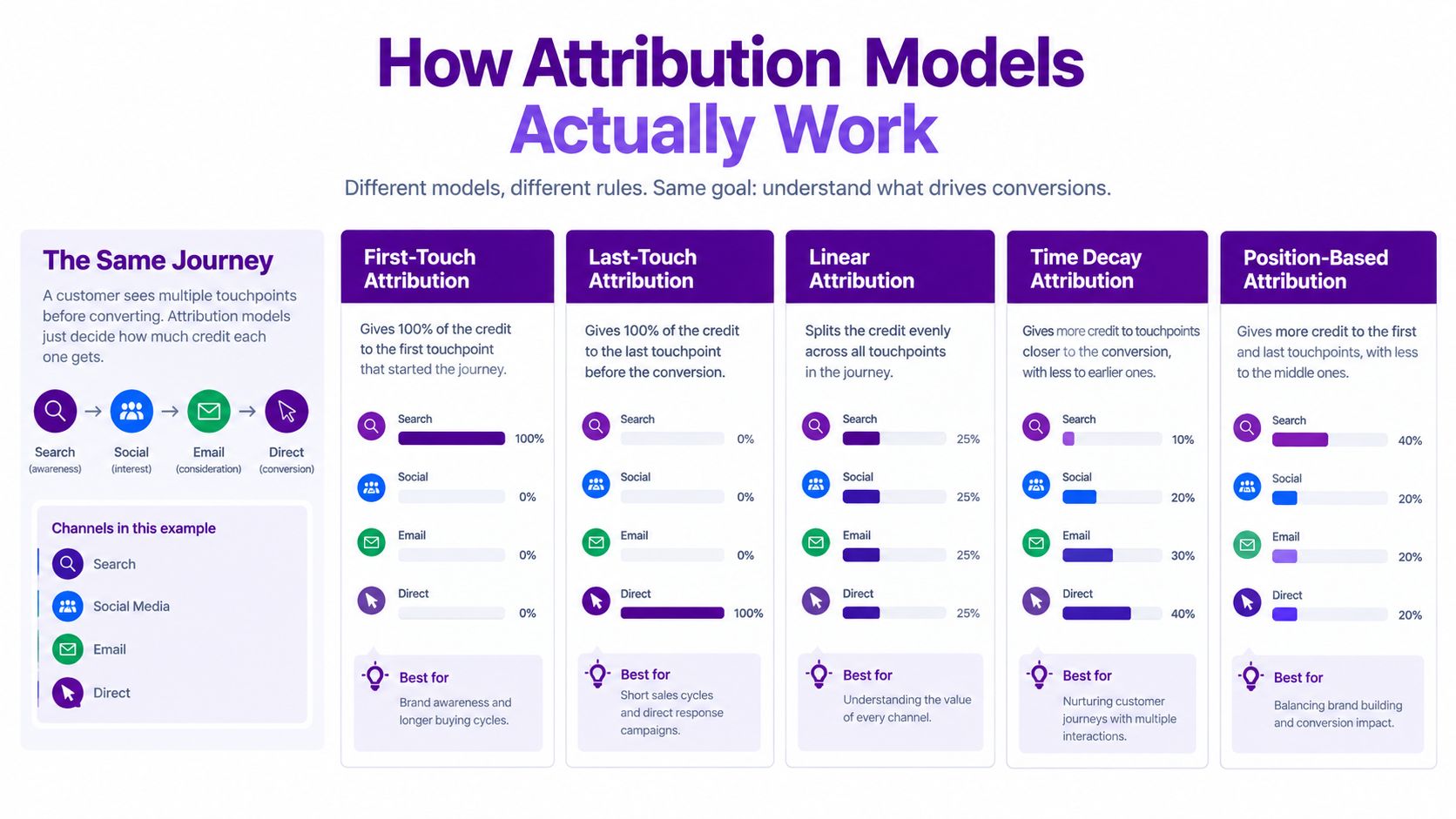
Attribution models answer the same journey in different ways. A founder might first discover your product through a competitor comparison post, come back after reading a case study, then finally click a branded search ad and convert. Each model assigns credit differently, and that changes which channels look effective.
The simple models are blunt on purpose
Last-click gives everything to the final touchpoint. It's easy to understand, but it makes branded search and retargeting look stronger than they really are, because they often close the loop rather than start it.
First-click does the opposite. It's useful when you want to know which channel starts awareness, but it ignores the follow-up touches that convinced the buyer to sign up or buy.
Multi-touch models spread credit
Linear attribution splits credit across every touchpoint. U-shaped gives more weight to the first and last touches. W-shaped adds more weight to a key middle milestone, often lead creation in B2B workflows. Time-decay gives more credit to the touches closest to conversion.
Those are all rule-based models. They're useful, but they're still just rules. Around 2010 to 2012, data-driven attribution models started appearing, using methods such as Markov chains, logistic regression, and Shapley values to estimate each channel's role from actual conversion-path data (model evolution). That's the point where attribution got more interesting, because software stopped pretending every path was identical.
A SaaS founder should care about the trade-off, not the jargon
The question isn't whether a model sounds advanced. It's whether it helps you make a better spend decision next week. A simple model can be honest if your data is thin, while a fancy model can be misleading if your tracking is broken.
Chartsy's attribution concept guide is useful here because it keeps the discussion close to how founders read dashboards, not how analysts write white papers. That matters, because attribution should help you decide where to put the next dollar, not force you into a statistics seminar.
The Data Stack Attribution Software Requires
Attribution only works if the data stack is stitched together properly. For SaaS, that means three layers: website and product activity, billing and subscription events, and ad platform spend. If one of those is missing, the picture gets distorted fast.
You need billing data, not just traffic
Website analytics can tell you where someone came from and what they clicked. Billing data tells you whether they became a customer, upgraded, downgraded, renewed, or churned. That distinction is everything, because the same signup source can look excellent in a traffic report and mediocre in a revenue report.
SaaS attribution software works best when it integrates website, CRM, and billing data into one event stream, because that's what connects the original touchpoint to later lifecycle outcomes such as trial start, paid conversion, renewal, upgrade, expansion, and churn (subscription attribution). Without that linkage, you can end up optimizing for signups that never become meaningful revenue.
Founder rule: if the tool doesn't connect to billing, don't trust it with revenue decisions.
The stitching problem is real
UTM parameters break. Users switch devices. A visitor reads your ad on mobile, signs up on desktop, then pays later from a billing link that never sees the original campaign tag. Identity matching is never perfect, so any tool promising total coverage should make you cautious.
| Data Layer | What It Captures | Example Sources |
|---|---|---|
| Web and product analytics | Visits, events, signups, trial starts | Website analytics, product event tracking |
| Billing and subscription data | Plans, upgrades, renewals, churn | Stripe, Paddle Billing, Paddle Classic |
| Ad platform spend | Campaign cost and source performance | Google Ads, LinkedIn Ads, Meta Ads |
Small teams should be strict about integrations
The best setup for a small SaaS team is boring in the right way. Connect the billing source first, then the main traffic source, then the ad platforms where you spend money. Anything more ambitious before the basics are clean usually just creates prettier confusion.
This UTM tracking guide for SaaS founders is worth using as a checklist if your campaign tagging is messy. Clean tags won't solve attribution by themselves, but broken tags will ruin the whole system.
Connecting Marketing Sources to MRR Movements
MRR isn't one event. It moves in pieces, and that's why SaaS attribution should be built around revenue movement, not just acquisition. A channel that generates lots of trials but weak renewal behavior is not the same as a channel that feeds a smaller but sturdier customer base.
Subscription revenue usually changes through new MRR, expansion MRR, contraction MRR, and churned MRR (MRR movements). New MRR comes from first-time paying customers. Expansion comes from existing customers paying more. Contraction and churn reduce the base. That's the revenue reality your dashboard needs to reflect.
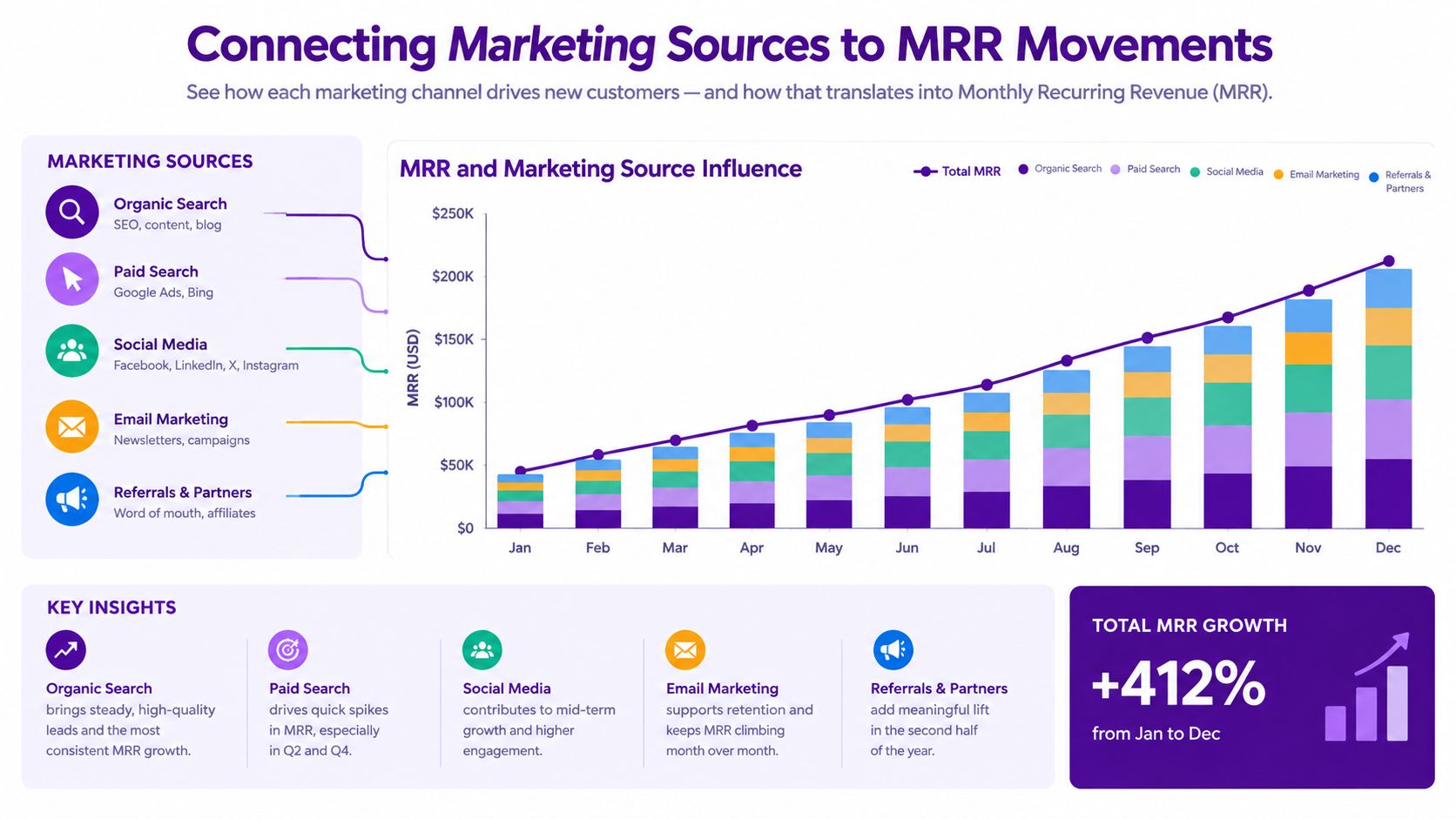
A simple example makes the distortion obvious. A self-serve signup lands from a blog post, buys a $99 monthly plan, then later upgrades to a $499 team plan after seeing a retargeting ad. If you only credit the blog post, you miss the channel that influenced expansion. If you only credit the retargeting ad, you miss the source that started the relationship.
That's why serious attribution needs to track sources against lifetime value cohorts, not just conversion counts. A podcast, for example, might not create fast signups, but if those users stick around and upgrade, it deserves credit in a way that last-click reports usually miss. For founders, that's not a philosophical point, it changes whether a channel gets cut or scaled.
Core Features That Matter for Small SaaS Teams
Small teams don't need a feature zoo. They need a tool that tells them which sources bring paying customers, how those customers affect MRR, and what changed when revenue moved. Anything else is decoration.
Start with billing-first attribution
For SaaS, the essential integration is billing. Stripe and Paddle are the obvious examples because they hold the revenue truth, not just the signup signal. Stripe Billing includes built-in analytics for MRR, subscription failure rates, and churn rates, and those reports can be filtered by segment (Stripe Billing). Paddle Billing treats subscriptions as a first-class entity, which means the recurring relationship is stored as a core object, not an afterthought (Paddle Billing).
That matters because the best dashboard in the world is useless if it can't see who paid. If you're choosing between more ad integrations and a deeper billing connection, pick billing depth every time.
Plain-English analysis beats dashboard clutter
A founder shouldn't need SQL to ask a simple question like, “Which campaign drove upgrades last quarter?” If the tool forces you into exports and spreadsheets for every answer, it's not really helping. It's just shifting the work somewhere else.
Here's the minimum bar I'd want:
- Billing connector first: It should connect to Stripe or Paddle before anything else.
- Revenue views by source: You need to see sources against MRR, not just signups.
- Plain-English queries: Someone on a small team should be able to ask questions without code.
- Dashboard clarity: A cleaner, narrower dashboard usually beats a bloated enterprise UI.
- Model flexibility: Last-click, first-click, linear, and position-based cover most small-team decisions.
Don't overbuy on model count
A platform can support ten attribution models and still be the wrong fit if your data is dirty. For most small SaaS companies, the bottleneck is not model sophistication, it's whether the billing and traffic data are matched correctly enough to trust. Focus on the questions you need answered, not the longest feature list.
If you want a concrete example of the kind of setup this section is talking about, Chartsy is positioned as a SaaS analytics and revenue attribution platform that connects website traffic and signups to paying customers and subscription revenue, with plain-English analysis for non-analysts. That's the right category of tool for teams that need revenue visibility without building a reporting stack from scratch.
Common Attribution Pitfalls and Misleading Claims
Attribution gets messy the moment someone claims it's cleaner than it is. The biggest mistake is treating a strong-looking channel as proof that the channel caused the revenue. Correlation is not causation, and in SaaS that distinction matters more than people admit.
A second trap is false precision. When a tool assigns 23% here and 17% there, it can look scientific while mostly hiding judgment calls inside a formula. That doesn't mean the model is useless, but it does mean you should be skeptical of any vendor who talks like the numbers are exact truth.
Privacy has made some touchpoints invisible
Recent industry coverage says cookie deprecation, Apple's App Tracking Transparency, and walled-garden reporting have made probabilistic and cross-platform attribution less reliable, and platform-reported conversions can exceed CRM-confirmed totals (privacy signal loss). Another takeaway from that coverage is that AI-driven discovery through tools like ChatGPT and AI Overviews is becoming harder to attribute cleanly. That's the real world now, not an edge case.
Attribution is useful, but it's no longer a complete view of the journey.
The third problem is vendors flattening different journeys into one polished report. SaaS buyers don't all behave the same. A self-serve startup founder, a finance lead evaluating a team plan, and an enterprise ops manager each leave different signals behind, and any tool that pretends those paths are identical is oversimplifying the business.
The defense is straightforward. Test budget changes instead of trusting attribution alone, ask vendors how their methodology works, and treat attribution as one input among several. If the numbers can't survive a budget shift or a billing check, they're not strong enough to run the business on.
Where Chartsy Fits in the Attribution Landscape
Chartsy fits where the question is revenue, not abstract channel credit. It connects website acquisition sources with billing data from Stripe, Paddle Billing, and Paddle Classic, so small SaaS teams can look at visitors, signups, paying customers, MRR, revenue, and churn by source (Chartsy growth attribution). That makes it relevant for founders who want a practical read on which sources bring recurring revenue, not just leads.
Good fit for small teams that need the revenue story
Chartsy is a good fit when you don't have a dedicated analyst and you still need answers quickly. The plain-English AI interface is useful here because it lets people ask questions without SQL and turn the answers into charts. For a small marketing or operations team, that's the difference between using the data weekly and ignoring it because the workflow is too heavy.
It also lines up well with SaaS finance reality. If you already think in terms of MRR changes, subscription movements, and churn, Chartsy gives you a way to bring marketing sources into that same conversation. That's cleaner than making the team reconcile separate traffic and billing tools by hand.
Where the fit stops
Chartsy is not the right answer if you want a giant enterprise warehouse project or a product-led analytics stack that goes far beyond marketing and billing. If you need custom data engineering, bespoke pipelines, or broader product instrumentation, look elsewhere. For a focused subscription-revenue workflow, though, the scope is sensible.
The main trade-off is simple. Chartsy gives you a tighter attribution loop around acquisition and subscription revenue, while broader platforms may give you more flexibility at the cost of complexity. If your team's real question is, “Which sources bring paying customers and how do they change MRR?”, the narrower tool is often the smarter buy.
Evaluating and Choosing Your Attribution Setup
Start with billing integration depth. If the software can't connect cleanly to your subscription system, everything else is guesswork dressed up as reporting. Stripe and Paddle coverage should be checked before you look at dashboards or attribution models.
Next, test model flexibility. You don't need every model under the sun, but you should have enough options to compare first-touch, last-touch, and at least one multi-touch view. That gives you a way to see whether your channel story changes when the model changes.
What to check before you buy
- Billing connection quality: Can it read subscription events, not just signups?
- Dashboard clarity: Can a founder understand it in one sitting?
- Time to value: Can you get useful answers in days, not months?
- Source-level reporting: Does it tie sources to revenue movement, not just traffic?
- Workflow fit: Will the team use it every week?
Then check how fast you can get to the first useful dashboard. If setup drags on for weeks, the tool will lose momentum before it earns trust. Small teams need a reporting system that starts paying rent quickly.
The last filter is pricing logic. Prefer tools that scale with the team rather than punishing you for every extra visitor if your real need is subscription revenue analysis. For a SaaS founder, the right setup is the one that makes the next budget decision sharper, not the one that looks impressive in a demo.
If you want to connect acquisition, signups, paying customers, MRR, and churn in one place, Chartsy is built for that workflow. It's a practical fit for SaaS founders and small teams that need revenue attribution without the overhead of a heavy analytics stack. Visit Chartsy and see how it handles your billing and source data before you spend another week arguing with dashboard numbers.

Written by
Chartsy TeamAnalytics team at Chartsy
The Chartsy Team writes guides, product updates, and resources to help SaaS and eCommerce founders make sense of their metrics, without SQL or spreadsheets.
Chartsy