Customer lifetime value rises when customers stay longer, pay more, or cost less to serve. The hard part is knowing which lever deserves attention first. This guide shows you how to increase customer lifetime value with five steps, starting with a clean baseline and ending with cohort-level decisions.
Table of Contents
- Step 1: Calculate Your Current Customer Lifetime Value
- Step 2: Increase Revenue Per Customer With Pricing and Expansion
- Step 3: Improve Onboarding and Customer Experience to Reduce Churn
- Step 4: Use Segmentation, Loyalty, and Referrals to Expand Customer Value
- Step 5: Measure LTV Changes and Act on the Right SaaS Cohorts
- Frequently Asked Questions
- Conclusion
Step 1: Calculate Your Current Customer Lifetime Value
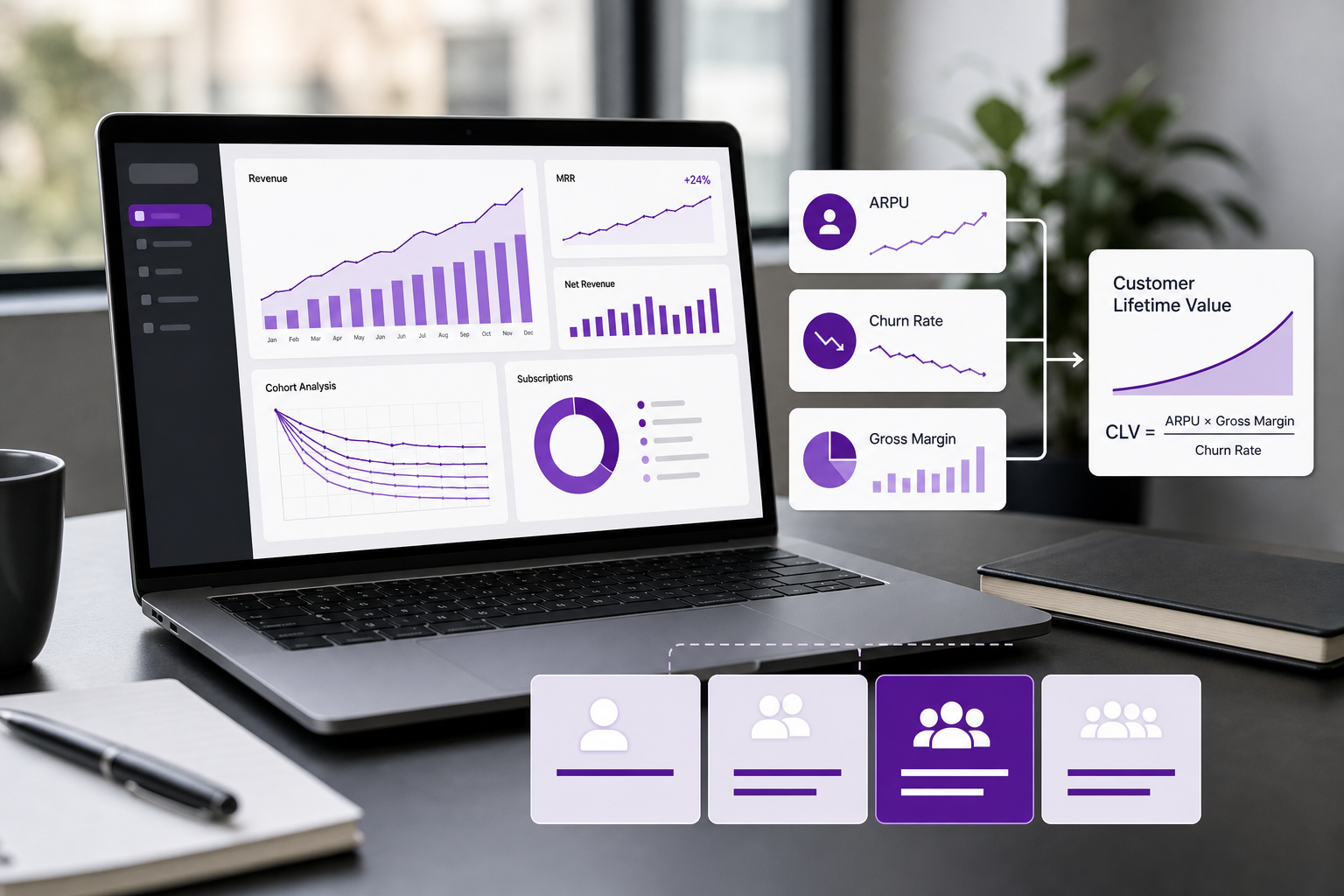
Before you try to increase customer lifetime value, calculate what one customer is worth today. In a SaaS business, the starting formula is revenue LTV (ARPU ÷ monthly customer churn rate), or margin-adjusted LTV once you factor in gross margin. For the full step-by-step walkthrough with a worked example, see how to calculate LTV for SaaS — this guide picks up from there and focuses on what moves the number.
Pull the inputs from the same period. Use paid subscription revenue for ARPU. Exclude trials and failed payments. Define churn clearly, then keep that definition fixed. You can also compare your calculation with this SaaS explanation of the customer lifetime value formula.
Now split the result by plan, signup month, acquisition source, and customer type. A blended LTV can hide a weak segment behind a strong one. One plan may have high ARPU but poor retention. Another may start small but expand after six months.
For a deeper modeling view, you can review this modeling resource. You don't need a complex model on day one. First, make sure your basic numbers are correct.
By now you should have a baseline LTV, a margin-adjusted LTV, and a short list of segments worth investigating.
Step 2: Increase Revenue Per Customer With Pricing and Expansion
To increase customer lifetime value, raise revenue per account only when the product earns it. The main inputs are price, billing frequency, upgrades, add-ons, and expansion usage.
Start with your value metric. Customers may pay for seats, usage, storage, transactions, or access to a higher service level. If the price metric has little connection to the value customers receive, expansion will feel forced. If it matches the value they get, an upgrade can feel like a natural next step.
Review MRR by plan. Look for plans with many customers but little revenue. Then look for plans that produce a large share of MRR with a smaller customer count. These patterns may point to weak packaging, a missing tier, or a price that no longer matches the product.
Test pricing with care. A price increase can lift ARPU, but it can also raise new customer churn or trigger contraction among existing accounts. Test a new price with new customers first. For current customers, consider an upgrade path tied to added value instead of an abrupt change.
Annual billing can improve cash flow and reduce the number of monthly renewal decisions. It also creates a tradeoff because an annual plan often includes a discount. Compare the discount with the retention change. Don't assume annual billing is better until your own cohorts show it.
Expansion revenue needs a clear reason to happen. Use product limits that match customer growth. Show an upgrade when a team reaches a seat limit. Recommend an add-on after a customer uses the feature it supports. Keep the offer close to the moment of need.
Down-selling matters too. A customer who can't afford the current plan may accept a smaller plan instead of canceling. That preserves some revenue and gives the account a path back up later. In some cases, a trusted referral partner can solve the customer's need when your product isn't a fit.
Track expansion MRR, contraction MRR, upgrades, downgrades, and reactivations separately. A higher ARPU can look good while existing customers quietly move to cheaper plans. The full MRR movement view tells you what changed.
Decision rule: don't judge a pricing test by new MRR alone. Check conversion, early churn, expansion behavior, and gross-profit LTV together.
Step 3: Improve Onboarding and Customer Experience to Reduce Churn
Reducing churn is often the fastest way to increase customer lifetime value because a customer who stays longer has more time to pay and expand.
Find the first point where new customers stop moving forward. It might be a missing integration, an unclear setup task, or a report they never reach. Use product events and support tickets to find the gap. Then shorten the path to the first useful outcome.
Good onboarding has one clear goal for each stage. Ask the customer to connect data first. Then guide them toward a useful report. Once they reach that milestone, show them the next action. Too many setup choices create delay.
Personalize the path by plan or use case. An agency may need account-level reporting. A SaaS founder may care about MRR movement and failed payments. A finance lead may need exports and a consistent month-end view. The first screen should reflect that job.
Support also affects retention. Make it easy for customers to report a problem. Reply with a clear next step instead of sending a long help article with no direction. Track time to first response, time to resolution, repeated complaints, and churn after a support case.
Closed-loop feedback is worth the effort. When a customer complains or gives a poor survey response, contact them before the issue turns into a cancellation. Record the reason. Then decide if the fix belongs in the product, the onboarding flow, or the support process.
Research from Qualtrics describes customer experience management as an ongoing process of listening, monitoring, and making changes that improve how customers feel about the relationship. That idea fits SaaS well, but sentiment alone isn't enough. Connect each experience change to a retention metric.
For example, if you rewrite onboarding, compare early churn for customers who saw the new flow with a similar group on the old flow. Watch activation, trial conversion, and support volume too. A better experience should change customer behavior, not just survey scores.
By now you should know which step in the customer journey creates the most avoidable churn and which metric will prove that your fix worked.
Step 4: Use Segmentation, Loyalty, and Referrals to Expand Customer Value
Segmentation helps you increase customer lifetime value without sending the same message to every account. Group customers by behavior, value, risk, or need. Then give each group a clear action.
Start with four useful groups:
- High-value customers: protect the relationship and look for relevant expansion.
- New customers with strong usage: guide them toward deeper adoption.
- At-risk customers: investigate the cause before offering a discount.
- Low-fit customers: reduce service cost or offer a smaller plan.
Don't define segments by revenue alone. Add tenure, plan, usage, support history, payment status, and expansion behavior. A large account with falling usage may need help more urgently than a small account that uses the product every day.
Loyalty programs can work in SaaS when the reward supports retention. Early access, extra reporting capacity, preferred support, or a useful annual-plan benefit may fit better than a blanket discount. Track renewal rates by loyalty group. If renewals don't improve, change the program.
Referrals need a clear trigger. Ask after a successful implementation, a strong support outcome, or a visible business win. Make the introduction easy. A referral should help the existing customer protect their reputation, not make them feel like a sales channel.
Targeted offers can also recover value. An at-risk account might need training. A price-sensitive account might need a smaller plan. A growing team might need more seats. Sending the same discount to all three groups wastes margin and may teach healthy customers to wait for a deal.
A review of 24 tactics in the supplied research found that only 10, or 42%, named a key metric. Loyalty programs were one of the few tactics tied to a specific measure, renewal rates. That gap is common in SaaS: teams launch a retention idea, then fail to decide how success will be measured.
Chartsy can help teams inspect LTV, churn, ARPU, and plan behavior by segment using Stripe or Paddle data. The point isn't to collect more charts. It's to spot a group that needs a different action this week.

By now you should have a segment map with one owner, one action, and one success metric for each group.
Step 5: Measure LTV Changes and Act on the Right SaaS Cohorts
The final step in increasing customer lifetime value is to measure change by cohort instead of trusting one company-wide average.
A cohort is a group of customers who share a start point, such as signup month, plan, channel, or product version. Compare their retention and revenue over the same time window. This shows whether new customers are getting better or worse.
Build a weekly or monthly scorecard with:
- Customer churn and revenue churn
- Gross revenue retention and net revenue retention
- ARPU by plan
- Expansion and contraction MRR
- Failed payment recovery
- LTV by signup cohort
- LTV to CAC ratio
Separate voluntary churn from failed-payment churn. A payment failure needs a recovery flow. A cancellation after a poor product experience needs a product or service response. Combining them makes both problems harder to fix.
Review changes against a baseline. If onboarding improved, compare the next three signup cohorts with earlier cohorts. If you changed pricing, watch conversion and retention by price exposure. If you launched an upgrade path, measure expansion among customers who reached the related usage threshold.
Keep the review tied to decisions. A dashboard that only reports last month's numbers won't change behavior. Add a question to each meeting: which cohort moved, why did it move, and what will we change before the next review?
Chartsy is useful here because founders can ask plain-English questions of Stripe and Paddle data instead of waiting for a custom report. For example, compare LTV by plan, check churn after a pricing change, or find accounts with falling revenue and recent failed payments. The answer should lead to an owner and a task.
Use modeling only when the data can support it. Predictive LTV can help with larger datasets, but a bad churn definition will produce a precise-looking mistake. Start with clean event definitions and stable cohorts. Add complexity after the basic view has earned trust.
Measure the lever you changed. If you changed onboarding, watch activation and early churn. If you changed pricing, watch ARPU and retention. If you added an upgrade path, watch expansion MRR and contraction.
Frequently Asked Questions
What is customer lifetime value?
Customer lifetime value is the total revenue or gross profit a business expects from a customer over the relationship. For SaaS, a basic estimate uses ARPU divided by monthly customer churn. A margin-adjusted version includes gross margin, which gives a better view of the money available after direct delivery costs.
How can I increase customer lifetime value in SaaS?
You can increase SaaS customer lifetime value by reducing churn, raising revenue per account, or improving gross margin. Start with the weakest input in your formula. If churn is high, fix onboarding and product adoption first. If retention is strong, test pricing, annual billing, upgrades, or add-ons with clear customer value.
What is the best formula for SaaS LTV?
The simplest SaaS LTV formula is ARPU divided by monthly customer churn. For a more useful business view, multiply ARPU by gross margin before dividing by churn. Use the same churn definition each month. Also split the result by plan and cohort because one blended number can hide poor retention or costly customer groups.
Does raising prices increase customer lifetime value?
Raising prices can increase customer lifetime value when the extra revenue outweighs any added churn. Test the change with new customers or a small group first. Check conversion, early retention, expansion, and gross-profit LTV. A higher price is not a win if it brings in customers who cancel before recovering acquisition and delivery costs.
How do I track LTV by customer cohort?
Track LTV by grouping customers around a shared start point, such as signup month or plan. Compare each group's retention, ARPU, expansion, contraction, and churn over the same age range. This shows whether recent customers behave better than older groups and helps you connect changes in pricing, onboarding, or acquisition to customer value.
Conclusion
Start with one baseline LTV calculation, then fix the weakest driver rather than launching several tactics at once. This week, split your numbers by plan and signup cohort, assign one owner to the clearest retention problem, and review the result next month. If you need a deeper formula walkthrough, use Chartsy's SaaS metric resources before building your scorecard.

Written by
Chartsy TeamAnalytics team at Chartsy
The Chartsy Team writes guides, product updates, and resources to help SaaS and eCommerce founders make sense of their metrics, without SQL or spreadsheets.
Chartsy