Customer acquisition cost looks simple until your team has to decide what counts as acquisition spend. The basic formula is total sales and marketing cost divided by new customers, but the useful answer depends on clean dates, matching customer groups, and full cost data. Follow these five steps to calculate CAC you can trust.
Table of Contents
- Step 1: Define the CAC Period and Customer Segment
- Step 2: Add Up Your Customer Acquisition Costs
- Step 3: Count the New Customers Acquired
- Step 4: Apply the CAC Formula and Calculate It by Channel
- Step 5: Interpret CAC Alongside LTV, Payback Period, and Retention
- FAQ: Calculating Customer Acquisition Cost
- Conclusion
Step 1: Define the CAC Period and Customer Segment
To calculate customer acquisition cost, start by fixing the time period and the type of customer you want to measure. This stops unrelated spend and customers from getting mixed into one number.
Pick a period that matches your sales cycle. A month may work for a self-serve SaaS product. A quarter often works better when deals take weeks or months to close. Write down the start date and end date before pulling any data.
Next, define the customer in your denominator. For most SaaS teams, that means a new paying account, not a lead, trial, or signup. If a free trial starts in March but converts in April, count the customer in April if your CAC period tracks paid conversions.
Be clear about account structure, too. If one company buys five seats, count one customer when your business sells to accounts. If you sell separate subscriptions to individual users, count each paying subscription instead.
Make a short measurement rule that your team can reuse:
- Period: one calendar quarter.
- Customer: a new account with its first successful paid invoice.
- Acquisition date: the date of that first successful payment.
- Scope: all sales and marketing costs tied to acquiring those accounts.
This rule also helps with refunds and failed payments. A failed invoice isn't a new paying customer. A refunded first payment may need to be removed from the customer count, depending on your finance policy.
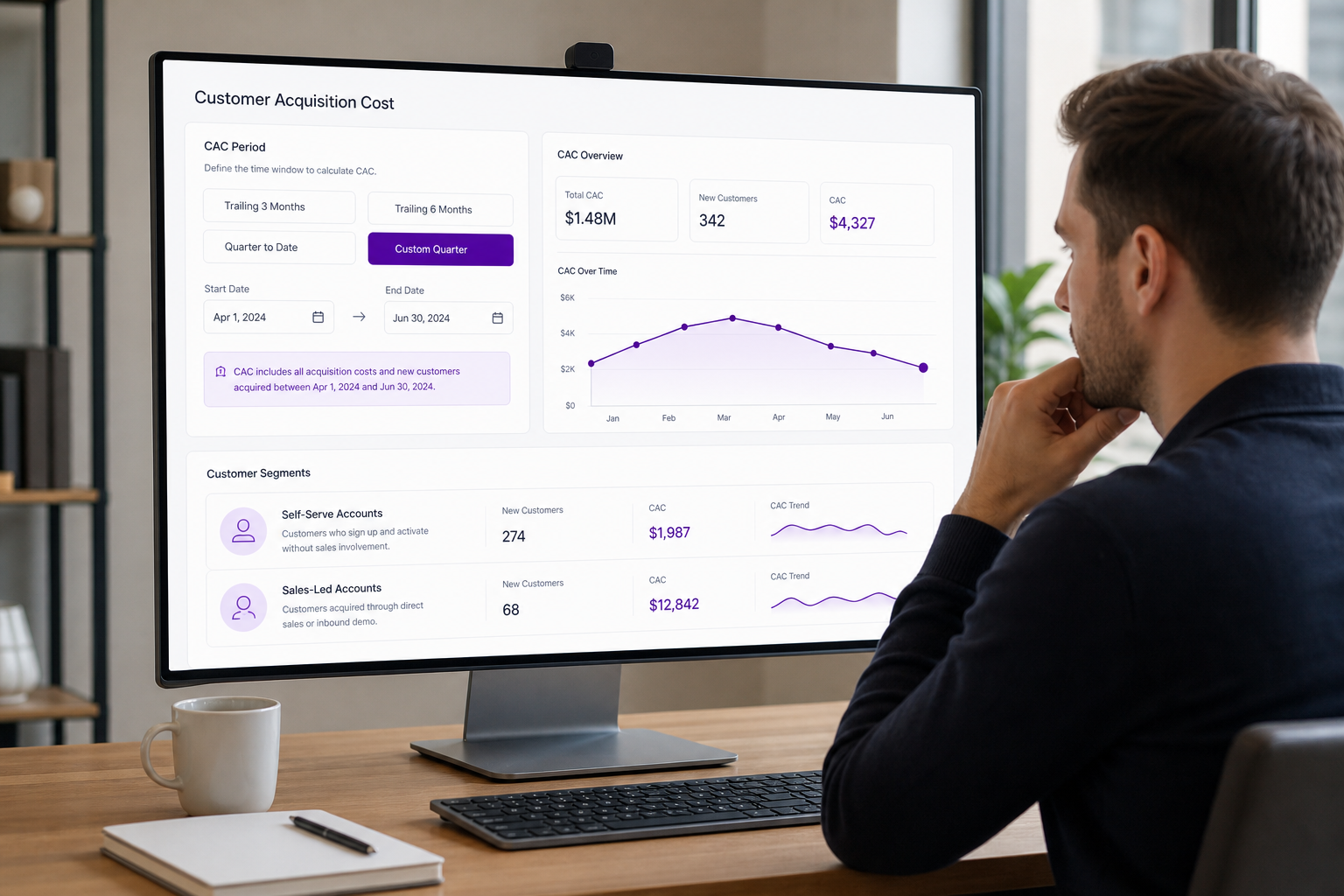
Key Takeaway: A CAC number is only useful when its period, customer definition, and payment rule stay consistent.
Step 2: Add Up Your Customer Acquisition Costs
Customer acquisition cost includes the money your business spends to turn prospects into new paying customers. Don't use ad spend alone unless paid ads are truly your only acquisition cost.
Start with direct marketing costs. Pull the amount spent on paid campaigns during the period. Then add costs for content made to attract prospects, event fees, affiliate payouts, and referral rewards when those costs help win new accounts.
Sales costs need the same treatment. Include the share of sales salaries tied to the period. Add commissions and sales tools when they support new business. If a tool supports both sales and customer success, allocate only the part tied to acquisition or document a consistent split.
A useful cost sheet might include:
- Paid search and social campaigns.
- Marketing staff time or salaries.
- Sales salaries and commissions.
- Content production made for demand generation.
- Lead generation fees and referral payouts.
- Marketing automation, CRM, and sales software.
- Trade shows, sponsorships, or sales events.
- Agency fees tied to customer acquisition.
Keep retention costs out of basic CAC. Customer success salaries, support tools, and renewal work belong in retention or service costs unless a role has a clear acquisition function. Product development also stays out unless the work directly supports a campaign or sales process.
Use cash paid or accrued cost consistently. Mixing a paid media invoice from one month with a yearly software bill from another can distort the result. For annual tools, spread the cost across the months they cover, or state that you are using cash accounting.
For a SaaS company using Stripe or Paddle, export the spend data separately from subscription revenue. Billing data tells you who paid. It doesn't automatically tell you which staff, agency, or campaign costs produced those customers.
Chartsy can help teams turn Stripe and Paddle data into charts and reports from plain-English questions. It won't fix a missing cost ledger, so keep the source data clean before asking for CAC views.
Step 3: Count the New Customers Acquired
The denominator in the CAC formula is the number of new customers acquired during the same period and under the same customer rule.
Use successful first payments as the cleanest count for self-serve SaaS. For sales-led businesses, use closed-won accounts that have paid, rather than signed contracts that may never collect. This matters when your sales team closes annual deals but payment happens later.
Remove duplicates. A customer who upgrades from a starter plan to a higher plan is still one new customer. A reactivated account is usually separate from a brand-new customer, so track it in its own group unless your company defines acquisition differently.
Trials need care. A trial signup shows interest, not acquisition. If you divide spend by trials, you're calculating cost per trial. That can be a useful funnel metric, but it isn't customer acquisition cost.
Use a table like this when checking the denominator:
| Record type | Count in new customers? | Reason |
|---|---|---|
| New account with successful first payment | Yes | It meets the paid-customer rule. |
| Free trial with no payment | No | It is a prospect or trial, not a paying customer. |
| Existing customer upgrade | No | It creates expansion revenue, not a new logo. |
| Reactivated account | Usually no | Track reactivation as a separate customer movement. |
| Refunded first payment | Usually no | It may not represent a retained paying customer. |
Check the count against your billing system and CRM. The two systems may disagree because one records the payment date while the other records the close date. Choose one source for the formula, then use the other to explain differences.
If you sell through recurring billing, define whether taxes, refunds, discounts, and failed payments affect the customer count or only revenue. Subscription billing can involve recurring invoices and payment status changes, which is why a raw subscription count may need review.
By now, you should have one verified number for new paying customers. Keep the list of excluded records so someone else can audit the result later.
Step 4: Apply the CAC Formula and Calculate It by Channel
Now apply the main formula: CAC equals total acquisition cost divided by new customers acquired.
Use your actual sales and marketing spend for the period, then divide it by the new paying accounts gained during that period.
CAC = total acquisition cost ÷ new customers acquired
Your blended CAC gives you a company-wide view, but it can hide major differences between channels.
Calculate channel CAC when you can connect a customer to a source. For example, suppose paid search has an allocated cost and brings new accounts. Its CAC is that cost divided by the accounts acquired. Organic content has its own allocated cost and customer count, giving it a channel-specific CAC.
Don't call organic acquisition free. Staff time, freelance work, tools, and agency fees still cost money. If you leave those costs out, the channel will look better than it is.
Use a channel table with the same rules across every row:
| Channel | Allocated cost | New customers | CAC | Decision question |
|---|---|---|---|---|
| Paid search | Calculate from actual spend | 20 | Calculate from allocated cost ÷ new customers | Does retention support the cost? |
| Organic content | Calculate from actual spend | 40 | Calculate from allocated cost ÷ new customers | Are staff costs fully included? |
| Sales outreach | Calculate from actual spend | 25 | Calculate from allocated cost ÷ new customers | Is the sales cycle worth the payback time? |
Channel attribution is imperfect. A prospect may read your content, click a paid ad, attend a webinar, then speak with sales. Pick an attribution rule and keep it stable. First-touch, last-touch, and multi-touch models answer different questions, so don't compare their CAC figures as if they were the same.
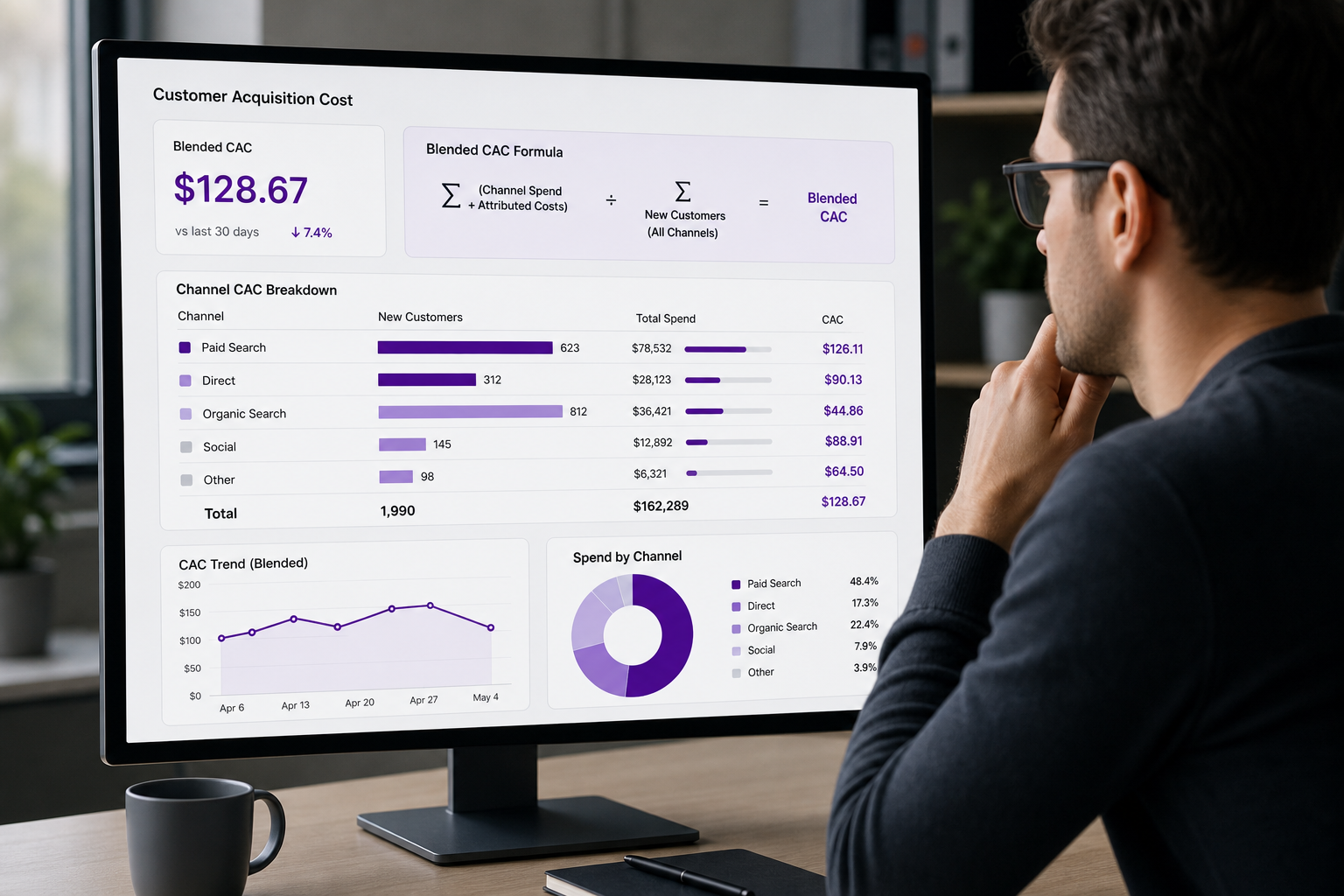
Pro Tip: Report channel CAC beside the number of customers, not by itself. A cheap channel with weak retention can cost more than an expensive channel that brings durable accounts.
Step 5: Interpret CAC Alongside LTV, Payback Period, and Retention
A CAC figure doesn't tell you if acquisition is healthy by itself. Compare it with customer lifetime value, gross margin, payback time, and retention.
LTV estimates the value a customer produces during the relationship. A simple SaaS estimate is average revenue per user divided by monthly customer churn. A margin-adjusted version multiplies average revenue per user by gross margin before dividing by churn.
For example, a customer paying $100 per month with 80% gross margin produces $80 in monthly gross profit. If monthly churn is 2%, the simple margin-adjusted LTV estimate is based on that monthly gross profit and churn. With a $500 CAC, the LTV to CAC ratio is 8 to 1.
That result may look strong, but don't rush to raise the ad budget. Early LTV estimates can be unstable, especially when a young SaaS product has few mature cohorts. Review retention by signup month and by acquisition channel. A channel may have a low CAC because it brings short-lived customers.
CAC payback gives you a cash view instead of a ratio: how many months it takes each new customer to repay what you spent acquiring them. See What Is CAC Payback Period? for the formula and how to read the result — as a rule of thumb, a payback period under 12 months is comfortable for most venture-backed SaaS companies, while anything past 18-24 months puts real strain on cash flow between funding rounds.
Retention changes the decision. Track customer churn alongside revenue churn because a small number of large accounts can hide many small cancellations. Also check expansion revenue, downgrades, failed payments, and reactivations. These movements shape the value you get after the first sale.
Founders often ask why CAC rose. The answer may be a higher ad price, a slower sales cycle, lower trial conversion, or weaker onboarding. Break the metric into stages before cutting a channel. A campaign may be working while the checkout flow loses buyers.
A useful definition of customer acquisition cost is the cost tied to gaining a new customer. Your internal version should go further by stating what costs, customers, and dates it includes.
Chartsy is useful when you want to ask plain-English questions of subscription data, then inspect revenue and customer patterns in charts. Pair those views with your marketing cost sheet and cohort checks. No dashboard can supply attribution data that your systems never captured.
Decision rule: Increase acquisition spend only when the channel's retention and payback support the cash cost, not because its headline CAC looks low.
FAQ: Calculating Customer Acquisition Cost
What is the formula for customer acquisition cost?
The customer acquisition cost formula is total sales and marketing spend divided by new customers acquired in the same period. For example, divide a defined amount of spend by the number of new paying customers gained. State what you included in spend and how you defined a new customer so the result can be repeated.
Should CAC include sales salaries?
Yes, CAC should include the share of sales salaries used to win new customers. Add commissions and sales tools when they support acquisition. If a sales role also handles renewals, allocate the acquisition share with a consistent rule. Using ad spend alone can make a sales-led SaaS business look cheaper to grow than it is.
Do free trials count as new customers for CAC?
Free trials usually don't count as new customers until they become paid accounts. Dividing spend by trial starts gives you cost per trial, which is a different metric. For CAC, use the number of new customers who meet your payment rule, such as a first successful invoice within the chosen period.
How do I calculate CAC by channel?
Calculate channel CAC by dividing each channel's allocated cost by the new customers attributed to that channel. Use the same attribution model for every channel. Include staff and tool costs where they apply. Then compare each result with retention, gross margin, and payback time before changing budgets.
What is a good CAC for SaaS?
There is no single good CAC for every SaaS company. A $1,000 CAC may work for a high-margin account with strong retention, while $100 may be too high for a low-priced plan with fast churn. Compare CAC with LTV, payback period, gross margin, and cohort retention.
Conclusion
Build one trusted CAC report with a fixed period, a clear paid-customer rule, and fully loaded acquisition costs. Then review it by channel beside payback and retention. If you want to keep exploring SaaS unit economics, Chartsy's guide to customer lifetime value and the LTV:CAC ratio is a useful next step. After that, run the same CAC check against your latest Stripe or Paddle data.

Written by
Chartsy TeamAnalytics team at Chartsy
The Chartsy Team writes guides, product updates, and resources to help SaaS and eCommerce founders make sense of their metrics, without SQL or spreadsheets.
Chartsy