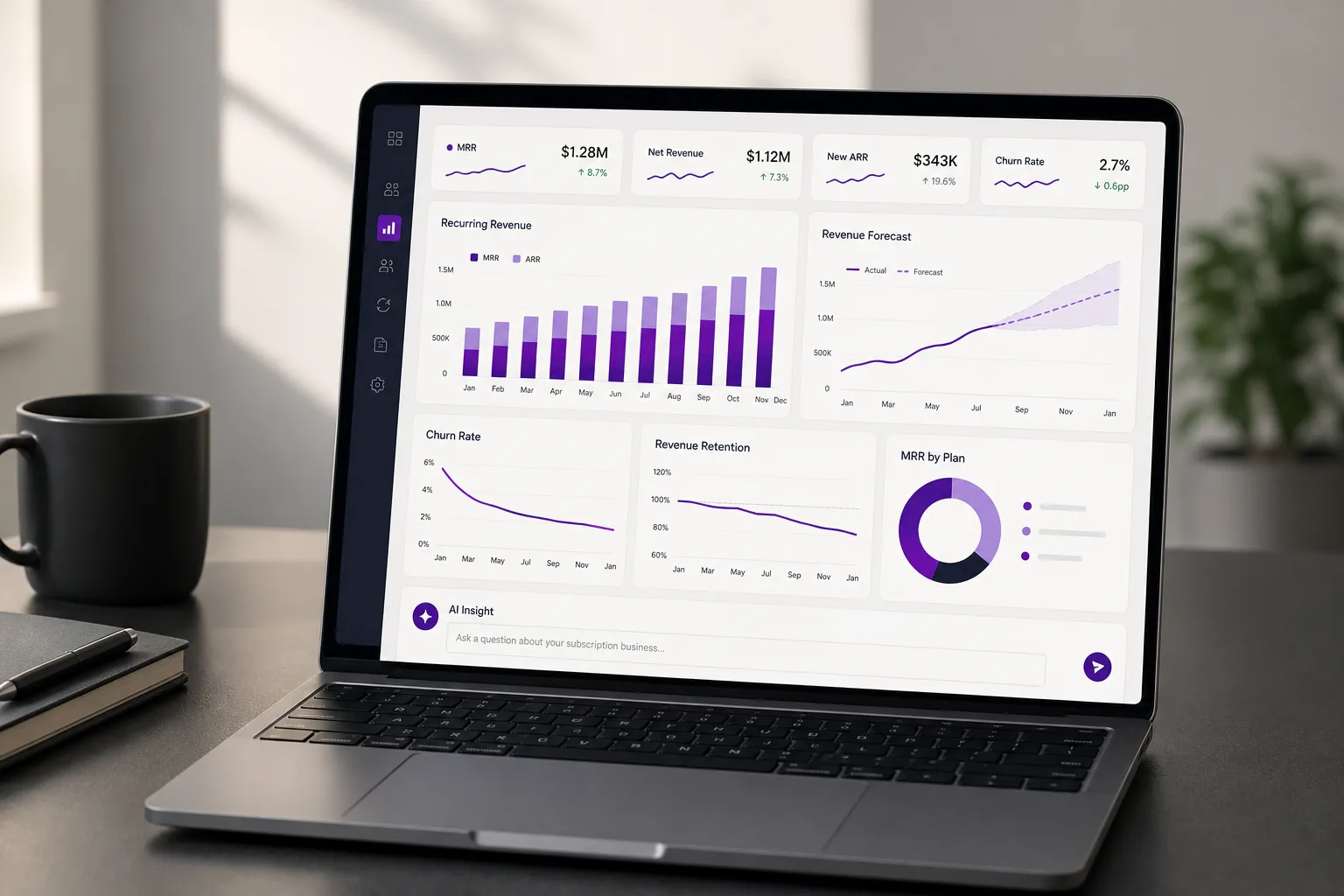
If you're weighing Baremetrics against Paddle, the first thing to settle is simple: do you need clearer revenue answers, or a billing system that handles more of the payment work?
Here’s how the two options differ on analytics, billing, pricing, integrations, risk, and day-to-day SaaS work.
Table of Contents
- Baremetrics, subscription analytics and pricing intelligence
- Paddle, merchant-of-record billing and compliance
- Baremetrics vs Paddle, features, pricing, risk, and growth
- FAQ
- Conclusion
1. Baremetrics, subscription analytics and pricing intelligence
Baremetrics is built for subscription analytics. In the Baremetrics vs Paddle choice, it fits teams that already have billing in place and want a clearer view of revenue health.
Baremetrics is associated with metrics such as MRR, churn, LTV, and forecasting. Its research profile also lists engagement management through email and lifetime value management through social media. Those features point to a broader revenue workflow than a simple payment report.
A typical Baremetrics workflow starts with a question such as, “Are downgrades rising among older customers?” The team reviews the trend, checks the customer group behind it, then decides whether to change onboarding, pricing, or account outreach.
That kind of analysis is useful because a single churn number rarely tells you what to do. Customer churn can rise while revenue churn stays flat if smaller accounts leave. Revenue can grow while retention weakens if expansion from a few large customers hides losses elsewhere.
Baremetrics has also been linked with payment recovery and cancellation-focused workflows in the wider product discussion around its suite. Failed payments deserve their own review because a card failure is not always a true cancellation. A retry, payment update prompt, or clear recovery flow may bring the subscription back.
Still, teams should check the current product scope before they buy. Before buying, confirm the full monthly cost, including any recovery or cancellation features you would need.
Baremetrics is strongest when you want a polished set of standard SaaS views. It is less suited to teams that constantly ask new questions about custom metadata or need one analytics layer across several payment systems.
Its documented Stripe connection makes it a natural fit for Stripe-first companies. You can review the Baremetrics Stripe integration guide when checking setup and data flow before migration.
One caution: don’t treat a clean dashboard as proof that your metric model is correct. Confirm how the tool handles refunds, pauses, trials, reactivations, and plan changes. Two platforms can show different churn rates while both are working as designed.
For teams that value preset reports and forecasting over open-ended exploration, Baremetrics remains a credible choice.
2. Paddle, merchant-of-record billing and compliance
Paddle takes a different role in the Baremetrics vs Paddle comparison. It is primarily a billing and payments platform, with subscription management and compliance support at the center.

That distinction matters. An analytics tool explains what happened to revenue. A billing platform helps process subscriptions, manage checkout, handle invoices, and support payment operations.
Paddle’s listed strengths include subscription management, compliance and governance, helpdesk management, and training or onboarding support. It also provides billing-related reporting, which can be enough for teams that want analytics close to their payment data.
The merchant-of-record model can reduce the work your own team must handle around international tax and payment compliance. But it also changes the commercial setup, customer relationship, and operational dependencies. Finance and legal teams should review the contract, settlement terms, refund rules, and chargeback process.
Paddle can make sense for a lean SaaS company selling across many markets. Instead of building every tax and billing process in-house, the team can focus on the product while Paddle handles more of the payment layer.
There is a tradeoff. Once billing, checkout, invoices, and customer payment records sit inside one system, moving away can take work. Export the data you may need before migration. Map customer IDs, plan names, subscription states, invoices, refunds, and transaction dates.
Pricing also needs careful review. Review transaction fees, payment scope, tax needs, currency support, and contract terms before calculating the total cost.
Paddle is a better fit when the main pain is billing complexity. It is not the best answer when your team needs deep questions about acquisition sources, retention cohorts, or customer metadata across Stripe and Paddle.

If you already use Paddle, its built-in reporting may cover headline needs. When the team starts asking why revenue changed by source, segment, or customer group, a dedicated analytics layer on top of your billing data becomes more useful.
3. Baremetrics vs Paddle, features, pricing, risk, and growth
These products solve different problems, so a direct feature count can mislead. Baremetrics sits closer to subscription insight. Paddle sits closer to billing operations.
| Decision area | Baremetrics | Paddle |
|---|---|---|
| Primary job | Review subscription metrics and forecasts | Run billing and payment operations |
| Best fit | Stripe-first teams using standard SaaS reports | Teams that need billing and compliance support |
| Subscription management | Not its main job | Yes |
| Integration tradeoff | Stripe and Braintree are listed | Best when billing runs through Paddle |
| Pricing visibility | Confirm current plan details | Confirm transaction and contract terms |
| Main risk | May not fit multi-processor needs | Can increase dependence on the billing provider |
Integration breadth is one of the clearest differences. The research lists each product's supported connections at a different scope. More integrations help if your data is spread across systems. They also add more mapping, testing, and maintenance.
Migration risk deserves the same care as feature fit. Before switching, run both systems for a short overlap period if possible. Compare total MRR, active subscriptions, churned accounts, refunds, and failed payments. If the numbers differ, find the rule causing the gap before you trust the new dashboard.
Security and privacy need a separate review. Ask where customer data is stored, which staff can access it, how exports work, and what happens when an account is closed. Keep payment card details inside the payment provider where possible. Your analytics tool should receive the fields it needs, not every piece of customer data.
The growth question is also different for each product. Baremetrics can help you spot expansion, contraction, churn, and lifetime value patterns. Paddle can reduce billing work and support international selling.
Pricing intelligence goes beyond showing a plan table. You need to know which segments expand after a price change, which plans create support work, and whether a discount brings durable revenue. Track conversion first. Then check retention and expansion after the new customers have had time to renew.
Failed charges can affect revenue, so test recovery claims against your own failed-payment rate and recovered MRR.
Key Takeaway: Choose the system that matches the question you need answered most often. Billing complexity points toward Paddle. Standard subscription reporting and forecasting points toward Baremetrics.
There is no need to force one tool to do every job. Some SaaS teams use Paddle for billing and a separate analytics tool for deeper questions. Others keep Stripe, add Baremetrics for standard reporting, and use a separate process for finance controls.
FAQ
Is Baremetrics better than Paddle?
Baremetrics is better for subscription analytics, while Paddle is better for billing and payment operations. Baremetrics helps teams inspect MRR, churn, LTV, and forecasts. Paddle focuses on subscriptions, checkout, invoicing, and compliance support. The right choice depends on whether your main gap is revenue insight or billing infrastructure.
Can Paddle replace Baremetrics?
Paddle may replace some basic reporting needs if your subscriptions already run there. It may not replace a dedicated analytics workflow when you need custom segments, acquisition-source analysis, or comparisons across Stripe and Paddle. Test the exact questions your team asks each week before removing Baremetrics or another analytics tool.
Does Baremetrics work with Paddle?
Confirm its fit with Paddle directly before purchase. If Paddle data is central to your business, check whether the connection supports the fields you need, including refunds, plan changes, failed payments, and reactivations.
What should I check before switching SaaS billing or analytics tools?
Check metric definitions, data export, customer IDs, plan mapping, refunds, failed payments, and access controls before switching. Run a sample reconciliation against your current system. Compare MRR and active subscriptions first, then review churn and retention. A migration is ready when the team can explain every material difference.
Conclusion
Choose Paddle when billing, tax, and compliance work are slowing your SaaS team down. Choose Baremetrics when you want established subscription views and forecasting. Some teams end up running both - Paddle for billing, Baremetrics for the reporting layer on top - rather than forcing one tool to do both jobs.

Written by
Chartsy TeamAnalytics team at Chartsy
The Chartsy Team writes guides, product updates, and resources to help SaaS and eCommerce founders make sense of their metrics, without SQL or spreadsheets.
Chartsy