Cash collected is not the same as revenue earned. That gap causes many SaaS reporting errors, especially when customers pay for a full year upfront.
Subscription revenue recognition records income as you deliver access to the service. The sections below explain the rules, show the journal logic, and point out where upgrades, refunds, and failed payments can change the result.
Table of Contents
- What Is Subscription Revenue Recognition?
- How Does Subscription Revenue Recognition Work?
- Deferred Revenue, MRR, and Cash: What Is the Difference?
- How Do Upgrades, Downgrades, Cancellations, and Refunds Affect Recognition?
- Where Subscription Revenue Recognition Goes Wrong in SaaS
- Subscription Revenue Recognition FAQ
What Is Subscription Revenue Recognition?
Subscription revenue recognition is the accounting process of recording subscription income when the customer receives the promised service, rather than when the invoice is sent or cash arrives.
For a typical SaaS plan, the promised service is access to the software over a set period. If a customer pays $1,200 for 12 months on January 1, the business normally recognizes $100 per month as the service is delivered. The remaining balance starts as deferred revenue.
This approach follows the central idea in ASC 606 and IFRS 15: revenue should reflect the transfer of promised goods or services to a customer. The exact treatment depends on the contract, the service terms, and the business's accounting policy. A finance lead should review the policy with a qualified accountant before using it for statutory reporting.
Think of the payment as a promise with two sides. The customer has paid. The company still owes service. Until that service is delivered, the unearned amount remains a liability.
- Booking: the value agreed when the customer signs.
- Billing: the amount invoiced under the payment schedule.
- Cash: the amount collected by the payment processor.
- Recognized revenue: the part earned through service delivery.
For most simple SaaS subscriptions, one continuous performance obligation exists: providing access during the subscription term. A bundle may be harder. Support, storage, consulting, or a separate implementation service may need separate treatment if they are distinct promises.
A revenue waterfall helps show the movement. It starts with the billed amount, places unearned value in deferred revenue, then releases that balance into revenue as each service period passes.
Chartsy can help founders inspect the operating side of this picture through Stripe and Paddle data. It turns plain-English questions into charts, dashboards, and reports about subscription activity. It doesn't replace an accounting policy or an auditor, but it can make the underlying revenue patterns easier to see.
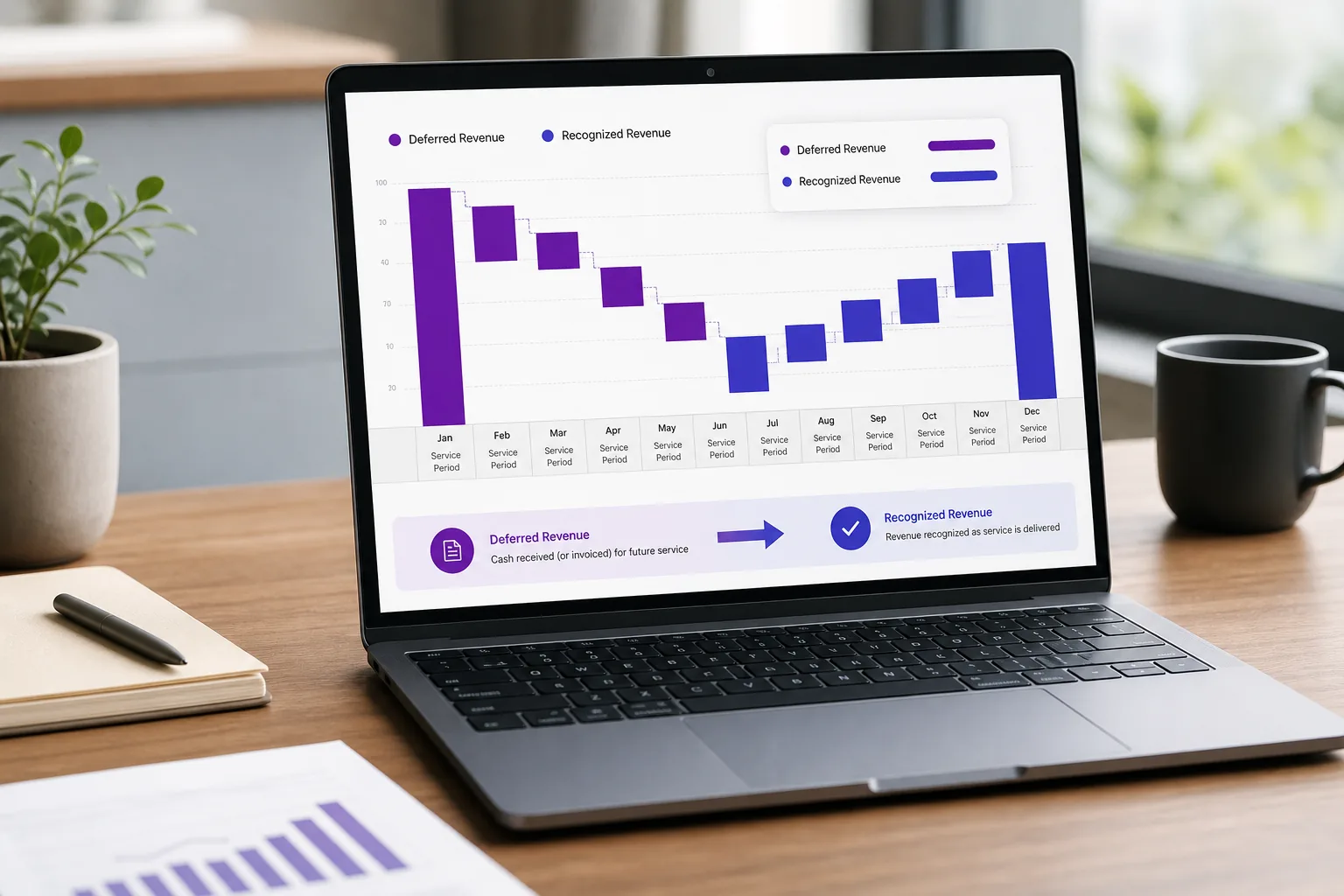
Key Takeaway: A customer payment becomes recognized revenue as the company delivers the subscription service, not simply when the payment clears.
How Does Subscription Revenue Recognition Work?
Subscription revenue recognition usually follows a five-part contract review. The framework helps an accounting team decide what was promised, how much the customer owes, and when the company earns that amount.
- Identify the contract. Confirm that the agreement creates enforceable rights and payment terms.
- Identify the performance obligations. List each promised service. A standard software plan may contain one ongoing access obligation.
- Determine the transaction price. Use the net amount the company expects to receive after discounts, credits, or variable amounts.
- Allocate the price. If the contract has more than one distinct obligation, assign part of the transaction price to each one.
- Recognize revenue. Record the allocated amount as each obligation is satisfied.
For a single SaaS service, recognition is often straight-line over the service term. Daily recognition may be more accurate when a contract starts or ends mid-month. The accounting policy should state which method the company uses and apply it consistently.
| Transaction event | Typical accounting effect | Review question |
|---|---|---|
| Annual invoice issued | Debit accounts receivable or cash, credit deferred revenue | Has the service period begun? |
| Month of access delivered | Debit deferred revenue, credit subscription revenue | How much service was delivered? |
| Discount applied | Lower transaction price and lower periodic revenue | Was the discount spread across the promised term? |
| Mid-term upgrade | New or revised schedule, based on contract assessment | Is the added service distinct? |
| Refund approved | Cash outflow plus revenue reversal or refund liability | Was any past revenue earned? |
Suppose a customer pays upfront for one year of access. The initial entry does not put the full amount on the income statement. It records the amount as deferred revenue. Each month, the business moves the applicable portion from deferred revenue to subscription revenue.
If the customer receives three free months inside a 12-month term, the total consideration is spread across the full period when the service is provided. The paid months don't automatically determine the recognition pattern.
Revenue recognition guidance explains how contract terms, performance obligations, and estimates affect revenue treatment. Use technical guidance as a reference, then have your accountant apply the rules to your actual contracts.
For an internal operating view, a team can compare recognized revenue with billings each month. A gap isn't automatically an error. Annual prepayments should create a larger deferred balance, while monthly plans usually create a smaller timing gap.
Pro Tip: Keep a contract-level schedule with the start date, end date, net price, recognition method, and every later change. A general ledger balance alone won't explain why the number changed.
Deferred Revenue, MRR, and Cash: What Is the Difference?
Deferred revenue, MRR, and cash answer different questions. Mixing them creates reports that look precise but describe different parts of the business.
Cash tells you what reached the bank or payment processor. It helps you assess liquidity. Cash can arrive before the related service is delivered, so it isn't the same as earned revenue.
Deferred revenue is the unearned part of a customer payment. It sits on the balance sheet as a liability because the company still owes access or another promised service. As the company delivers that service, the liability falls and recognized revenue rises.
MRR is an operating metric for expected recurring subscription income. It isn't a GAAP revenue line. A company may calculate MRR from active paid subscriptions, while recognized revenue follows the service period and accounting policy.
| Measure | What it shows | Common mistake |
|---|---|---|
| Cash | Money collected | Treating a full annual prepayment as current-month revenue |
| Deferred revenue | Service still owed to customers | Ignoring it because cash has already arrived |
| MRR | Recurring run rate from active subscriptions | Calling it recognized revenue |
| Recognized revenue | Service earned during the reporting period | Using invoice date instead of service delivery |
Say a customer pays on January 1 for access through December. Cash rises by the amount collected. Deferred revenue also rises by the amount collected. January recognized revenue is usually the applicable monthly portion under a straight-line monthly method. MRR may also reflect the monthly subscription amount if the company defines the plan that way, but the measures still have different meanings.
Chartsy is useful when a founder needs a clean view of recurring activity from Stripe or Paddle. Its dashboards can help compare MRR movement, refunds, failed payments, and plan changes. That view should sit beside, not replace, the deferred revenue schedule in the accounting system.
For a closer look at how these metrics differ, the bookings, billings, and revenue breakdown gives the terms a shared frame. That makes finance and growth meetings much less prone to crossed wires.
How Do Upgrades, Downgrades, Cancellations, and Refunds Affect Recognition?
Contract changes can alter subscription revenue recognition because they may change the promised service, the transaction price, or both. The accounting team must assess the change instead of applying one rule to every event.
Upgrades and added modules
An upgrade may add a distinct service at a price that reflects its stand-alone selling price. In that case, the added service may be treated as a separate contract or separate performance obligation. The original schedule can continue while the added module gets its own schedule.
For example, a customer pays for a 12-month base plan. Four months later, the customer adds a distinct module for the remaining eight months. If the module qualifies for separate treatment, its revenue may be recognized over that period while the original plan continues unchanged.
Downgrades and price changes
A downgrade can reduce the transaction price for future service. A price change may be prospective if it affects only the remaining distinct service. If the change relates to obligations that are not distinct from those already delivered, the company may need a cumulative catch-up adjustment.
Cancellations and refunds
Cancellation timing matters. If access continues until the end of the paid term, revenue may continue through that period. If the customer receives a refund for unused service, the company must reverse any amount that was recognized too early and record the remaining obligation correctly.
Refunds also need a clear link between the payment record and the recognition schedule. A refund issued by the processor without an accounting adjustment can leave revenue too high and deferred revenue too low.
Contract changes require judgment. Distinctness, revised consideration, and the remaining obligations drive the treatment.
Teams should log each change with its effective date, old terms, new terms, reason, approval, and accounting decision. This record matters during close because a billing event rarely explains the full revenue effect by itself.

Key Takeaway: Treat every mid-term change as a contract review event, not as a simple billing adjustment.
Where Subscription Revenue Recognition Goes Wrong in SaaS
Most errors come from broken handoffs. Sales changes a term, billing applies a credit, and finance sees the result only during month-end close.
Posting invoices straight to revenue
This mistake is common with annual plans. It inflates revenue in the invoice month and creates weak results in later months. Post the unearned amount to deferred revenue first, then release it as service is delivered.
Using billing data as the accounting answer
Billing tells you what was charged. It may not tell you what was earned. Discounts, refunds, plan changes, service dates, and failed payments can all create differences between processor reports and the general ledger.
Missing contract modifications
A spreadsheet may track the original plan but miss an extension, free period, price concession, or added module. That leaves the recognition schedule tied to terms that no longer exist.
Counting failed payments as revenue
A failed attempt isn't the same as collected consideration. Keep the failed event for audit history, but make sure the accounting entry follows the actual contract and collection policy.
Ignoring multiple elements
Implementation work, support, storage, and software access may not share the same recognition pattern. List each promised item before allocating the transaction price.
Good controls are plain but firm. Assign one owner for the policy. Reconcile the sub-ledger to the general ledger each month. Require approval for changes that affect price, term, or service scope.
- Keep a contract and amendment record.
- Store the recognition schedule beside the source invoice.
- Review refunds and credits before close.
- Test a sample of schedules against customer terms.
- Document exceptions instead of hiding them in manual entries.
Chartsy can add an operating check for founders who need to spot unusual changes in recurring revenue. A sudden MRR drop beside a refund spike may point to a billing issue worth sending to finance. It won't decide the accounting treatment, but it can help the right person find the event sooner.
Subscription Revenue Recognition FAQ
What is subscription revenue recognition?
Subscription revenue recognition records income as a company delivers access or another promised service. A yearly payment is usually spread across the service term rather than recorded in full on the collection date. The unearned balance stays in deferred revenue until the company satisfies the related obligation.
Is cash collected the same as recognized revenue?
Cash collected is not the same as recognized revenue. Cash measures when money arrives, while recognized revenue measures when the service is earned. For an annual prepayment, cash arrives at once, but subscription revenue recognition usually releases the amount across the months covered by the customer agreement.
How does deferred revenue affect SaaS reports?
Deferred revenue appears as a liability because the company still owes service to the customer. Each completed service period reduces that liability and increases recognized revenue. A rising deferred balance may reflect strong upfront billings, but it also represents future delivery work.
Do upgrades change revenue recognition?
Upgrades can change revenue recognition when they add service or change the price. The accounting team must assess whether the added item is distinct and whether the modification is separate or part of the existing contract. A distinct module may receive its own schedule, while other changes may require reallocating the remaining contract value.
Can Chartsy replace revenue recognition software?
Chartsy shouldn't replace an accounting policy, general ledger, or professional review. It connects to Stripe and Paddle to show subscription activity through charts, dashboards, and natural-language reports. That makes it useful for spotting MRR movement, refunds, and failed payments before finance reviews the related accounting entries.
Keep the policy simple, but make the schedule traceable. Start with one contract type, reconcile its billed amount to deferred revenue, and test the monthly release before expanding the process. Use Chartsy for a clear operating view of subscription activity, then have a qualified accountant confirm the treatment used in your financial statements.

Written by
Chartsy TeamAnalytics team at Chartsy
The Chartsy Team writes guides, product updates, and resources to help SaaS and eCommerce founders make sense of their metrics, without SQL or spreadsheets.
Chartsy