
If your MRR dropped and the dashboard only shows the total, you're stuck with the same bad question every founder hates, was it new sales, downgrades, failed payments, or churn? That's why people start comparing chartmogul alternatives in the first place. They don't just want prettier charts, they want a clearer answer about where paying customers came from and why recurring revenue changed.
For SaaS founders, solo builders, and small ops teams, the right tool depends on three things, the billing system you already use, how well it ties marketing sources to paying customers, and how much setup work you can tolerate without an analyst. In subscription software, MRR means monthly recurring revenue, and churn is the revenue or customers you lose when subscriptions end or shrink. Those basics matter because the SaaS market keeps expanding, with one estimate putting it at $464.7 billion in 2025 and projecting $1.109 trillion by 2033 (Grand View Research), which is why recurring-revenue tracking has become core operations, not a nice-to-have.
This roundup moves fast. Each tool gets judged on billing model fit, attribution depth, and the amount of work it takes to get useful answers. If you care most about linking traffic and signups to paid customers, Chartsy is the one to look at first.
Table of Contents
- 1. Chartsy
- 2. Baremetrics
- 3. ProfitWell Metrics by Paddle
- 4. Chargebee RevenueStory
- 5. Recurly Analytics
- 6. Stripe Billing Analytics and Revenue Reporting
- 7. Maxio
- 8. MRR.io
- 9. FirstOfficer
- 10. RevenueCat
- Top 10 ChartMogul Alternatives Comparison
- Match the Tool to Your Billing Setup
1. Chartsy
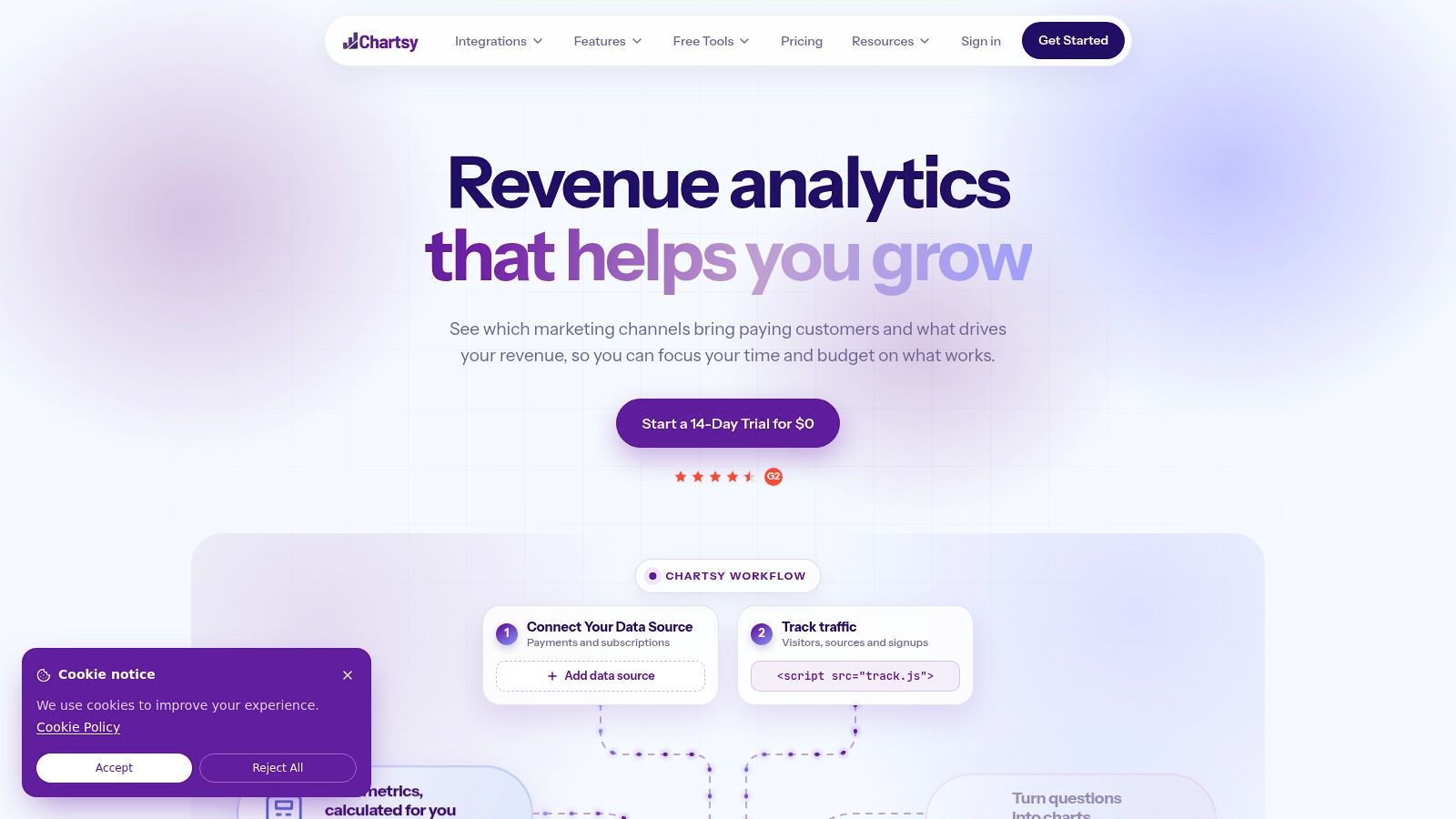
Chartsy fits teams that want subscription analytics plus revenue attribution, not just a deeper MRR dashboard. It connects website traffic and signups to billing data from Stripe, Paddle Billing, Paddle Classic, or Freemius, and it can also accept other billing systems through a Custom API. That makes it useful when the underlying question is not “What is MRR?” but “Which channels brought paying customers, and why did recurring revenue move this month?”
Its biggest practical advantage is that it breaks MRR changes into new revenue, upgrades, downgrades, reactivations, and churn, so founders can trace movement instead of staring at a top-line number. Stripe's own analytics framework uses a similar breakdown for net MRR change, including new, reactivation, expansion, contraction, churn, and foreign-exchange adjustment (Stripe analytics metrics). That matters because a drop in revenue can come from different causes, and each one points to a different fix.
Why it works for small teams
The plain-English AI interface is the reason small teams use it. You can ask questions without SQL, then save the answers as charts and dashboards, which is handy when nobody on the team wants to live inside a spreadsheet. Chartsy's Stripe and Paddle connections are read-only, so the billing data isn't modified while you analyze it.
Practical rule: choose Chartsy when the goal is not just reporting, but deciding which acquisition sources deserve more budget and which subscriptions are weakening.
A few trade-offs are worth stating plainly. Native connectors cover the main SaaS billing setups well, but unsupported systems still require work through the Custom API, so it isn't zero-setup for every stack. It's also a better fit for founders and small teams than for enterprises that want a full warehouse-heavy BI layer. For a direct comparison with another subscription analytics tool, see the Chartsy vs Baremetrics breakdown.
- Best fit: Stripe, Paddle, Freemius, and mixed billing setups that need attribution.
- What it solves: linking traffic, signup, and revenue data without SQL.
- What it doesn't try to be: a heavyweight enterprise BI suite.
- Website: Chartsy
2. Baremetrics
Baremetrics fits teams that want subscription analytics with billing models already covered, including Stripe, Paddle, and Braintree. It is built for SaaS companies that need MRR, churn, cohorts, and recovery tools without defining every metric themselves. MRR means monthly recurring revenue, and churn is the revenue or customer loss that shows up when subscriptions end or fail to renew.
For a small team, the main advantage is speed. You get standard dashboards, movement breakdowns, forecasting, and payment recovery in one place, so the team can act on subscription data instead of spending time reconciling definitions. Baremetrics is opinionated, which helps if you want a clear default. It is less helpful if you need precise attribution from marketing source to paid customer.
The trade-off shows up fast in practice. Baremetrics works well when the job is to monitor subscriptions and recover failed payments, but it does not try to be a full attribution layer. If you care about where paying customers came from, you may still need another tool to connect acquisition and revenue. For a direct comparison with a Chartsy setup, see the Chartsy vs Baremetrics breakdown.
Baremetrics is a practical fit for founders who need subscription reporting working now, especially on Stripe, Paddle, or Braintree. Teams with heavier acquisition analysis needs usually outgrow the built-in view and add separate source tracking. Pricing can also rise as ARR increases, so the billing model fit is good for early visibility, but the cost trade-off matters more as revenue scales.
- Best fit: subscription SaaS on Stripe, Paddle, or Braintree.
- What it solves: standard SaaS reporting plus recovery workflows.
- What it doesn't try to be: a flexible attribution-first analytics system.
- Website: Baremetrics
3. ProfitWell Metrics by Paddle
ProfitWell Metrics fits teams that want free core subscription analytics before they commit to a heavier reporting stack. It covers standard dashboards, cohorts, and benchmark-style views, so a small SaaS team can get a working read on recurring revenue without much setup. That makes it a practical default for founders still testing pricing, retention, or their first reporting workflow.
Paddle's metric rules are useful context for this category. Paddle treats a customer as churned only after the paid subscription ends, and it keeps past-due users active during the dunning window, with at least 15 days recommended for recovery attempts (Paddle churn and timing rules). It also converts subscription periods into monthly values, so a $120 annual subscription contributes $10 to MRR (Paddle MRR rules). MRR, or monthly recurring revenue, is the normalized monthly value of subscription revenue. Churn is the revenue or customer loss when a subscription ends. Those rules matter because a cancellation click and a real revenue loss are not always the same event.
Good default, limited depth
For a team without an analyst, ProfitWell Metrics keeps the basics simple. The trade-off is less control than a DIY BI setup and slower freshness on the free plan. If you need exact attribution from visitor to signup to paid customer, the built-in view will not carry that load for long.
For a side-by-side look at how that attribution limit compares with Chartsy, see the Chartsy vs ProfitWell comparison. ProfitWell Metrics is the cleaner choice when free core metrics and benchmark data answer the questions you have now. It becomes a stopgap once you need to know which campaigns produced paying customers.
- Best fit: early-stage SaaS on common billing systems.
- What it solves: free core SaaS metrics and cohort reporting.
- What it doesn't try to be: a deep attribution tool.
- Website: ProfitWell Metrics
4. Chargebee RevenueStory
Chargebee RevenueStory makes the most sense when billing and analytics should live in the same vendor. It fits teams already using Chargebee for subscription billing, and it gives them revenue, signup, churn, and cohort reporting without pushing them into a separate analytics stack. For finance and operations, that single-vendor setup can reduce friction.
The main advantage is operational simplicity. If billing, invoicing, and reporting are all in one system, there's less to reconcile and fewer integration points to maintain. That matters for teams with more complex pricing or a growing number of plans, because the reporting model can stay closer to the billing model.
A fair caution is that this is best when you want Chargebee as your billing layer. If your subscriptions already run on Stripe or Paddle and you only want analytics, moving billing just to use the dashboard is too much. The packaging is also less transparent than some lightweight tools, so this tends to be a sales-led evaluation rather than a quick self-serve choice.
Teams usually choose RevenueStory for convenience, not for attribution depth. If you need to know which marketing source created the paying customer, billing-native reporting alone may not be enough.
- Best fit: teams standardizing billing and reporting in Chargebee.
- What it solves: bundled subscription intelligence and reporting.
- What it doesn't try to be: a standalone attribution-first analytics layer.
- Website: Chargebee
5. Recurly Analytics
Recurly Analytics is a good fit for teams already committed to Recurly as their billing platform. It covers standard SaaS metrics like MRR, churn, retention, trials, and LTV, and it's especially relevant when billing events and analytics need to stay tightly connected. If you're already on Recurly, setup is straightforward compared with stitching together separate tools.
The main draw is consistency. Because the analytics layer sits next to the billing system, the metric definitions tend to be more dependable than a hand-built spreadsheet workflow. That matters when you're trying to compare plan performance or understand whether a subscription segment is weakening.
Usage-based billing is part of the picture too, which makes Recurly a reasonable fit for SaaS products that blend fixed subscriptions with usage-based models. The trade-off is that advanced analytics and exports can sit behind higher tiers, so the full value isn't always available at the cheapest level. If you aren't already in the Recurly ecosystem, migration effort becomes the true cost.
For founders comparing chartmogul alternatives on operational simplicity, Recurly is a decent answer when the billing system is already decided and you just want dependable reporting. It's less compelling if your bigger issue is attribution from marketing source to paying customer.
- Best fit: teams already using Recurly billing.
- What it solves: native billing-linked SaaS metrics and reporting.
- What it doesn't try to be: a broad attribution platform.
- Website: Recurly
6. Stripe Billing Analytics and Revenue Reporting
If your billing already runs through Stripe, this is the quickest route to working revenue analytics. Stripe gives you billing metrics such as MRR, which is recurring revenue, churn, which shows customers leaving, subscribers, trials, and retention cohorts, and it also offers Revenue Recognition for accrual reporting under standards like ASC 606 and IFRS 15 (Stripe Billing analytics). That makes it a practical fit for teams that want native reporting without adding another subscription platform.
The main strength is proximity to the source of truth. Stripe updates as billing activity happens, and the numbers already live beside your payments. That keeps setup light, which matters if nobody on the team wants to maintain a separate analytics stack. The trade-off is that Stripe is built around billing, not around full customer acquisition analysis.
Stripe gives you the revenue side clearly, but it does not connect marketing source to paying customer in the way a tool like Chartsy is designed to do. For a team that wants to know which campaigns, channels, or landing pages produced subscribers, that gap matters. Stripe also becomes more useful with Sigma or external BI tools once you need deeper segmentation or custom analysis, and that adds work.
For Stripe-only SaaS, the default is strong enough. For teams that need attribution across traffic, signups, and billing, it is only part of the answer.
For a fuller take on where Stripe analytics stop and specialized tools begin, see the best Stripe analytics tools guide. If chargebacks are part of your workflow, the Disputely chargeback alerts page is a useful adjacent resource.
- Best fit: Stripe-only SaaS that wants native reporting.
- What it solves: basic billing analytics and revenue recognition.
- What it doesn't try to be: a deep attribution or multi-source analytics platform.
- Website: Stripe
7. Maxio
Maxio suits SaaS companies that need finance-grade reporting and are already operating at a level where investor and board reporting matters. It combines billing and financial operations, and it can also operate as a reports-only product if you want the metrics without replacing your billing system. That flexibility makes it a serious option for more mature SaaS teams.
The useful part is the movement breakdown. If you care about new, expansion, contraction, and churn, Maxio is built for that kind of analysis. It's also broad enough to support a larger reporting surface, which is handy when multiple stakeholders want consistent SaaS numbers.
The downside is fit. Maxio can feel like too much for a smaller product or an early-stage founder who mainly wants to know which acquisition source produced paying customers. It's also a sales-led product, so the buying process is more involved than lightweight self-serve tools.
Practical rule: choose Maxio when the metric conversation has moved from “What happened?” to “What do we need to report to finance, investors, and leadership?”
- Best fit: mid-market and finance-heavy SaaS teams.
- What it solves: investor-grade revenue management and metrics.
- What it doesn't try to be: a lean tool for quick attribution checks.
- Website: Maxio
8. MRR.io
MRR.io is a straightforward pick for solo founders and small teams who want basic subscription analytics without paying enterprise prices. It supports Stripe and Paddle, adds cohort analysis and forecasting, and keeps the setup light. That makes it appealing when you need enough reporting to make decisions, not a giant platform to manage.
The most attractive part is the low-friction pricing model and the fact that it offers a free tier for smaller customer counts. For early SaaS businesses, that's often enough to keep an eye on core metrics while you're still learning which channels convert. It also supports manual data entry and API-based paths for non-native gateways, which gives it some flexibility beyond the default integrations.
The limitation is obvious. It's narrower than the bigger subscription analytics suites, and it doesn't try to solve attribution in depth. If your real goal is to connect a signup source to a paying customer and then to recurring revenue, you may outgrow it once your reporting questions get more specific.
MRR.io is the kind of tool you pick when simplicity matters more than breadth. It's not trying to be the center of your analytics stack, it's trying to keep recurring revenue visible without much effort.
- Best fit: solo founders and small SaaS teams.
- What it solves: basic SaaS KPIs with low setup effort.
- What it doesn't try to be: a broad, attribution-heavy analytics suite.
- Website: MRR.io
9. FirstOfficer
FirstOfficer is a clean fit for Stripe-first SaaS teams that want read-only metrics and a simple reporting layer. It focuses on standard SaaS numbers like MRR, churn, and LTV, and it keeps the workflow lightweight. If you want to avoid changing Stripe data while still getting dependable analytics, that's a sensible design choice.
The strength here is focus. There's less surface area to learn, and for a small team that doesn't want a complex system, that's a real advantage. Historical backfill also helps keep the numbers consistent, which is important when a dashboard is only as useful as the trust people place in it.
The trade-off is narrowness. It's primarily Stripe-centric, so if your billing stack is broader or your attribution questions are more demanding, you may find it too limited. It also doesn't try to be the most expansive feature set on the market, which is fine if your goal is dependable Stripe analytics rather than a broader revenue intelligence platform.
- Best fit: Stripe-only SaaS teams.
- What it solves: lightweight, read-only billing analytics.
- What it doesn't try to be: a multi-system attribution tool.
- Website: FirstOfficer
10. RevenueCat
RevenueCat is the right comparison point when your subscription business lives in apps, not just on the web. It's built for iOS, Android, web, and Stripe, and it gives you mobile-native subscription analytics with filters, cohorts, exports, and real-time chart updates. For app-store-driven revenue, that matters because the billing patterns and user lifecycle are different from a typical web SaaS stack.
The advantage is that it handles the realities of app subscriptions, including trials, renewals, and refund handling. That makes it more natural for mobile teams than a web-only analytics tool. It also exposes APIs for charts and metrics, so teams that want to move data into warehouses or BI tools have a path.
The trade-off is fit. If your business is web-only SaaS, some of the mobile-specific power won't matter, and the pricing can feel premium as you scale. For that reason, RevenueCat is better for product teams with app revenue than for founders comparing standard web SaaS dashboards.
For subscription businesses that span app stores and web payments, it can be the right operational center. For pure web SaaS, a simpler revenue analytics tool is often enough.
- Best fit: mobile and cross-platform subscription businesses.
- What it solves: app-native subscription analytics and exports.
- What it doesn't try to be: a web-SaaS-first attribution tool.
- Website: RevenueCat
Top 10 ChartMogul Alternatives Comparison
| Product | Core features ✨ | UX / Quality ★ | Value & Pricing 💰 | Target audience 👥 | Unique selling points / Notes 🏆 |
|---|---|---|---|---|---|
| Chartsy 🏆 | Traffic→signup→billing attribution; MRR decomposition; AI plain‑English queries; Custom API | ★4.5, demo workspace; no SQL needed; read‑only billing sync | 💰 14‑day free trial (no card); SMB pricing focus | 👥 SaaS founders, solo builders, small teams; Stripe/Paddle/Freemius users | 🏆 Recommended, attribution + AI insights; native Stripe/Paddle/Freemius; Custom API for other billing |
| Baremetrics | Out‑of‑the‑box SaaS metrics; MRR movements; forecasting; recovery tooling | ★4, opinionated dashboards; quick setup | 💰 Priced by ARR bands; can get costly at scale | 👥 SMB → growth-stage teams needing recovery & forecasting | ✨ Dunning & cancellation recovery tied to ARR impact |
| ProfitWell Metrics (Paddle) | Free SaaS dashboards; cohorts; industry benchmarks; Metrics Plus option | ★3.5, solid baseline; free plan slower refresh | 💰 Core analytics free; paid upgrades for fresher data | 👥 Early-stage teams wanting free core analytics | ✨ Industry benchmarks + free core analytics forever |
| Chargebee RevenueStory | Subscription intelligence inside Chargebee; custom reporting & filters | ★4, integrated billing + analytics; enterprise UX | 💰 Bundled with Chargebee; pricing via sales | 👥 Teams standardizing billing & analytics; complex pricing models | ✨ Single vendor for billing + analytics; good for complex revenue models |
| Recurly Analytics | Plan-level MRR, churn, retention, trials, LTV; usage-based billing reports | ★3.8, native billing accuracy; exports on higher tiers | 💰 Included with Recurly; advanced features on higher plans | 👥 Teams on Recurly or with usage-based billing | ✨ Native support for usage-based subscription analytics |
| Stripe Billing Analytics | MRR, churn, cohorts; revenue recognition (ASC606); Sigma/apps extensibility | ★4, real-time updates; compliance-ready reports | 💰 Included for Stripe users; Sigma/apps may add cost | 👥 Stripe-native companies seeking fast, compliant analytics | ✨ Native revenue recognition & fastest path for Stripe customers |
| Maxio (Chargify + SaaSOptics) | Investor-grade ARR/MRR breakdowns; hundreds of SaaS metrics; reports-only option | ★4, finance/audit-focused reporting | 💰 Enterprise pricing; quoted via sales | 👥 Mid-market & enterprise finance teams, boards/investors | ✨ Board-ready financial reporting; can be used without changing billing |
| MRR.io | Core KPIs, cohorts, forecasting; email reports; API/manual entry | ★3.5, lightweight, minimal learning curve | 💰 Very low entry price; free tier up to ~100 customers | 👥 Solo founders, bootstrap teams, small SaaS | ✨ Budget-friendly with quick setup |
| FirstOfficer | Stripe-derived MRR, churn, LTV; read-only sync; historical backfill | ★3.8, dependable Stripe-focused analytics | 💰 Affordable for Stripe users; limited ecosystem | 👥 Teams billing exclusively with Stripe | ✨ Read-only approach ensures Stripe data safety |
| RevenueCat | Mobile/in-app subscription analytics; real-time Charts v3; cross-platform | ★4, mobile-native UX; active roadmap | 💰 Pricing based on platform revenue; can be premium | 👥 App developers & mobile-first subscription businesses | ✨ App-store-aware metrics, refunds/renewal handling built-in |
Match the Tool to Your Billing Setup
Start with the billing system you already use, then decide whether you need channel attribution, a reports-only tool, or a finance-grade suite. If marketing source and MRR movement questions matter most, connect your Stripe or Paddle account to Chartsy in read-only mode, then ask one question such as which channels brought paying customers last quarter. The 14-day free trial, which requires no card, is a low-risk way to test that answer against your own numbers.
If you're comparing tools mainly on reporting ROI, the fastest wins usually come from reducing manual work and avoiding spreadsheet reconciliation. A cleaner workflow means fewer handoffs, fewer metric definitions to debate, and faster decisions about what to fund next. For a broader view on reporting efficiency, the Magnitude Marketing piece on reporting ROI is a useful companion read.
Chartsy gives SaaS founders a direct way to connect marketing sources, signups, and recurring revenue in one workflow. If you want to see which channels create paying customers and how MRR moved, visit Chartsy and test it against your own Stripe or Paddle data.

Written by
Chartsy TeamAnalytics team at Chartsy
The Chartsy Team writes guides, product updates, and resources to help SaaS and eCommerce founders make sense of their metrics, without SQL or spreadsheets.
Chartsy